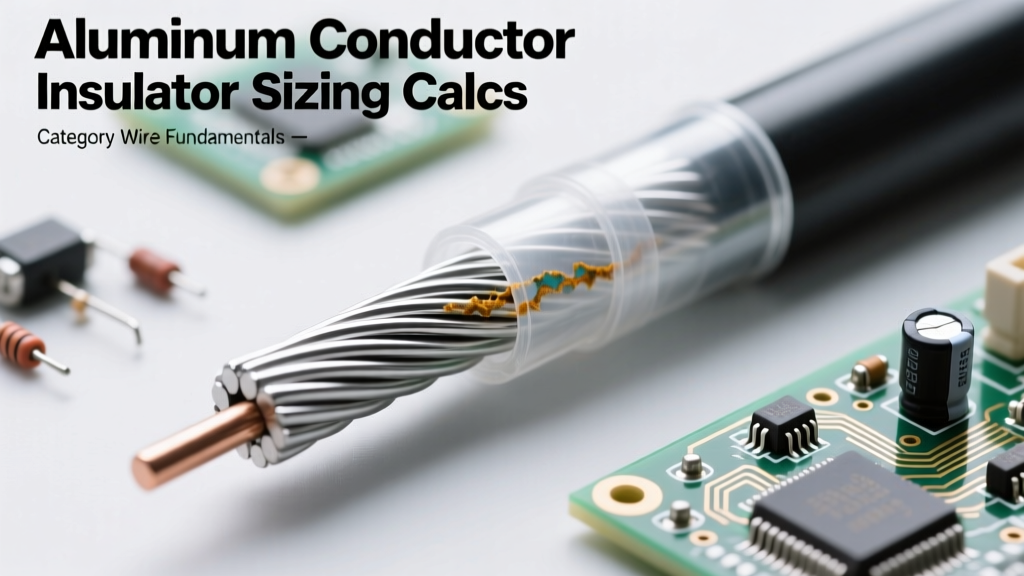

The Duality of Aluminum: Conductor Core, Insulator Skin
If you are asking, is aluminum a conductor or an insulator, the fundamental physics answer is definitive: aluminum is an excellent elemental conductor. In fact, it ranks as the fourth most conductive pure metal at room temperature, trailing only silver, copper, and gold. Its atomic structure features three valence electrons that easily detach to form a 'sea of electrons,' allowing electrical current to flow with minimal resistance.
However, from a practical electrical engineering and DIY wiring perspective, aluminum possesses a frustrating duality. While the bulk metal is a highly efficient conductor, its surface reacts with oxygen within milliseconds of exposure to air, forming aluminum oxide (Al₂O₃). This microscopic oxide layer is a dielectric insulator. Understanding this conductor-insulator paradox is the key to safely sizing, terminating, and calculating voltage drop for aluminum branch circuits and feeders.
Material Physics: Conductivity and IACS Standards
To calculate wire sizing accurately, we must compare aluminum to the industry baseline: copper. The electrical industry uses the International Annealed Copper Standard (IACS) to measure conductivity. By definition, pure annealed copper is set at 100% IACS.
| Material | IACS Conductivity | Resistivity (Ω·m at 20°C) | Density (g/cm³) |
|---|---|---|---|
| Silver | 105% | 1.59 × 10⁻⁸ | 10.49 |
| Copper (Annealed) | 100% | 1.68 × 10⁻⁸ | 8.96 |
| Gold | 70% | 2.44 × 10⁻⁸ | 19.32 |
| Aluminum (EC 1350) | 61% | 2.65 × 10⁻⁸ | 2.70 |
Because aluminum has only 61% of the conductivity of copper by volume, an aluminum conductor must have a cross-sectional area approximately 1.5 to 1.6 times larger than a copper conductor to carry the exact same ampacity. However, because aluminum is roughly 70% lighter than copper, it remains the undisputed king of overhead utility transmission lines where weight-to-conductivity ratio dictates structural engineering limits.
Step-by-Step Calculation Tutorial: Sizing a 100A Aluminum Feeder
Let’s transition from theory to application. Suppose you are installing a 100-Amp subpanel in a detached garage, located 150 feet from the main service panel. You are using 240V single-phase power. We will calculate the required wire size using the National Electrical Code (NEC) ampacity tables and voltage drop formulas.
Step 1: Determine Base Ampacity (NEC Table 310.16)
For a 100A feeder, the NEC requires us to look at the 75°C column for standard terminations (unless equipment is explicitly rated for 90°C).
- Copper Requirement: #3 AWG THHN/XHHW (Rated 100A at 75°C)
- Aluminum Requirement: #1 AWG XHHW-2 (Rated 100A at 75°C)
At this stage, #1 AWG Aluminum is our baseline legal minimum.
Step 2: Calculate Voltage Drop (The K-Factor Method)
The NEC recommends a maximum voltage drop of 3% for feeders. For a 240V system, 3% equals 7.2 Volts. We use the single-phase voltage drop formula:
VD = (2 × K × I × L) / CM
Where K = resistivity constant, I = current (100A), L = one-way length (150ft), CM = circular mils of the wire.
At standard operating temperatures (approx. 75°C), the 'K' constant for Aluminum is 21.2 (compared to 12.9 for Copper). The Circular Mils (CM) for #1 AWG Aluminum is 83,690.
- VD = (2 × 21.2 × 100 × 150) / 83,690
- VD = 636,000 / 83,690
- VD = 7.59 Volts (3.16%)
The voltage drop exceeds our 3% target. We must step up the wire size to reduce resistance.
Step 3: Upsizing for Optimal Performance
We calculate the required CM to achieve exactly 7.2V drop:
- Required CM = (2 × 21.2 × 100 × 150) / 7.2
- Required CM = 88,333
The next standard wire size up is 1/0 AWG Aluminum, which has 105,600 CM. Recalculating with 1/0 AWG yields a voltage drop of 6.02V (2.5%). Therefore, the final engineered specification is 1/0 AWG XHHW-2 Aluminum.
The Insulator Problem: Aluminum Oxide and Termination Failures
Why do older aluminum wires have a reputation for causing house fires? The answer lies in the insulator skin mentioned earlier. According to the Aluminum Association, the Al₂O₃ layer is incredibly hard, electrically insulative, and possesses a melting point of over 3,700°F (2,037°C).
When you strip an aluminum wire and place it under a copper or brass lug, you are trapping this insulating oxide layer between the conductor and the terminal. If the connection is not properly prepared, the insulating oxide forces the current to bottleneck through microscopic metal-to-metal contact points. This increases contact resistance, which generates heat (I²R losses). The heat causes thermal expansion, which loosens the mechanical lug. The loose lug allows more air in, creating more insulating oxide—a catastrophic thermal runaway loop.
Mitigation Protocol for DIYers and Electricians
To defeat the insulator skin, you must follow strict termination protocols:
- Wire Brushing: Use a dedicated stainless-steel wire brush to physically break the oxide layer on the exposed aluminum strands.
- Anti-Oxidant Paste: Immediately apply a zinc-dust anti-oxidant compound (e.g., Noalox or Penetrox). The zinc particles embed into the soft aluminum, piercing the oxide layer and maintaining conductivity while sealing out oxygen.
- Precision Torque: Aluminum suffers from 'cold flow' or 'creep.' It deforms under continuous mechanical pressure. You must use a calibrated torque screwdriver or torque wrench set to the exact inch-pound specification printed on the breaker or lug data sheet. Hand-tightening is a guaranteed failure mode.
Cost-Benefit Framework: When to Specify Aluminum
Choosing between copper and aluminum is ultimately an economic and spatial calculation. Here is a real-world decision matrix for residential and light commercial projects:
- Use Aluminum When: You are running long feeders (over 50 feet), service entrance cables (like 2/0 or 4/0 SER), or heavy subpanel circuits. The cost savings are massive. A 150-foot spool of 1/0 XHHW-2 Aluminum costs roughly 40% less than the equivalent ampacity in #3 AWG Copper, and it is significantly easier to pull through conduit due to its lighter weight.
- Use Copper When: You are wiring 15A or 20A branch circuits (14 AWG and 12 AWG). The NEC generally restricts solid aluminum branch circuit wiring due to historical termination failures. Furthermore, in tight junction boxes where space is at a premium, copper’s smaller physical footprint is mandatory.
Summary Verdict
So, is aluminum a conductor or an insulator? The bulk metal is a premier, high-efficiency conductor that powers the global electrical grid. However, its surface instantly forms a rugged insulator upon contact with air. By mastering the voltage drop calculations to account for its 61% IACS conductivity, and by utilizing chemical and mechanical strategies to defeat the insulating oxide layer at terminations, aluminum becomes one of the most reliable and cost-effective wiring materials available to the modern electrician.