
The Short Answer: Pure vs. Everyday Water
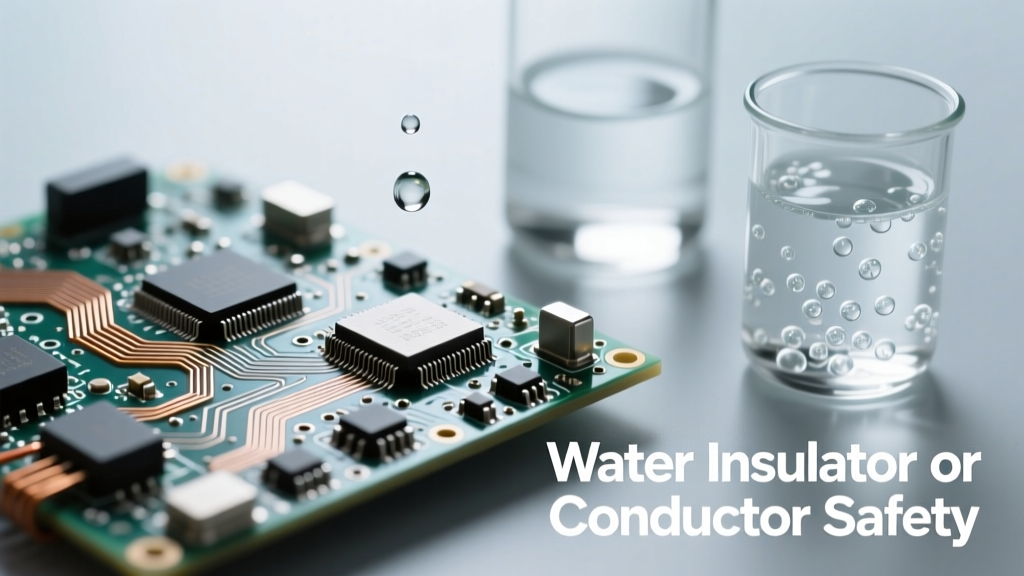
When beginners in electronics and wiring ask, is water an insulator or a conductor, the answer requires a critical scientific distinction. In its absolute purest form, distilled and deionized water is an insulator. It lacks the free electrons necessary to carry an electrical current. However, the water we interact with daily—tap water, rain, puddles, and seawater—is a conductor.
This confusion stems from the fact that 'pure' water practically does not exist in nature or in our homes. As soon as water comes into contact with soil, pipes, or the atmosphere, it dissolves minerals, salts, and gases. These impurities transform the water from a harmless insulator into a highly dangerous conductive path. Understanding this difference is not just academic trivia; it is a fundamental pillar of electrical safety, outdoor wiring design, and troubleshooting.
The Physics of Conductivity: Electrons vs. Ions
To truly grasp why water behaves the way it does, we must look at how electricity moves. In a copper wire, electrical current is the flow of free electrons hopping from atom to atom through a metallic lattice. Pure water (H2O) consists of molecules held together by covalent bonds. The electrons are tightly bound to the hydrogen and oxygen atoms, meaning there are no free electrons available to facilitate electron flow. Therefore, pure H2O resists electrical current, acting as an insulator with a massive resistivity of up to 18.2 MΩ·cm (megohm-centimeters).
How Dissolved Solids Create a Path for Current
Water is often called the 'universal solvent.' When everyday water encounters salts (like sodium chloride) or minerals (like calcium and magnesium), it breaks these compounds apart into ions. Ions are atoms that have lost or gained an electron, giving them a positive or negative charge.
Unlike metals, water does not conduct electricity via electron flow. Instead, it conducts via ion flow. When a voltage is applied across tap water, the positively charged ions (cations) migrate toward the negative terminal, and the negatively charged ions (anions) migrate toward the positive terminal. This physical movement of charged particles completes the circuit, allowing current to flow. The higher the concentration of Total Dissolved Solids (TDS), the more ions are available, and the lower the electrical resistance of the water.
Resistivity Data: Comparing Water Types
To put this into perspective, let us look at the actual conductivity measurements of different water types. Conductivity is measured in microsiemens per centimeter (µS/cm). According to data referenced by the USGS Water Science School, the variance between pure water and seawater is staggering.
| Water Type | Approximate TDS (mg/L) | Conductivity (µS/cm) | Electrical Classification |
|---|---|---|---|
| Ultrapure Water (Lab Grade) | 0 | 0.055 | Excellent Insulator |
| Distilled / Deionized Water | 1 - 5 | 2 - 10 | Poor Conductor / Insulator |
| Typical Rainwater | 10 - 20 | 20 - 50 | Weak Conductor |
| Municipal Tap Water | 100 - 500 | 200 - 800 | Moderate Conductor |
| Seawater | 35,000 | 50,000+ | Excellent Conductor |
As the table demonstrates, municipal tap water is roughly 10,000 times more conductive than lab-grade ultrapure water. This is why a hairdryer dropped into a bathtub full of tap water is lethal, whereas theoretically, dropping it into a tub of perfectly pure, deionized water would simply result in a short circuit within the appliance's internal components, not through the water itself.
The Human Body Factor: Ohm's Law in Wet Conditions
When evaluating electrical hazards, we must consider the resistance of the human body. Dry, intact human skin has a relatively high resistance, typically around 100,000 ohms (100 kΩ). However, water drastically alters this equation.
Tap water, combined with the natural salts and sweat on your skin, creates a highly conductive electrolyte solution. When your skin is wet with tap water, its resistance plummets to roughly 1,000 ohms (1 kΩ). If the water contains salt (like sweat or seawater), resistance can drop as low as 500 ohms.
Calculating the Lethal Threshold
Let us apply Ohm's Law (Current = Voltage / Resistance) to a standard 120V North American household circuit:
- Dry Skin Scenario: 120V / 100,000Ω = 0.0012A (1.2 mA). You might feel a slight tingle, but it is generally harmless.
- Wet Skin (Tap Water) Scenario: 120V / 1,000Ω = 0.12A (120 mA). This is a massive, lethal dose of current.
According to the Electrical Safety Foundation International (ESFI), currents as low as 30 mA can cause ventricular fibrillation and cardiac arrest. A wet environment effectively removes your body's natural electrical insulation, making standard household voltage incredibly deadly.
IP Ratings and NEMA Enclosures: Designing for Moisture
Because everyday water is a reliable conductor, electrical codes and engineering standards require specific protections when wiring outdoors or in damp locations. When selecting junction boxes, outdoor receptacles, and lighting fixtures, you must look at Ingress Protection (IP) or NEMA ratings.
Decoding IP Water Ratings
The second digit in an IP code dictates water resistance. For outdoor DIY electrical work, you should never use anything below IP44. Here is the practical breakdown for electrical enclosures:
- IP44: Protected against splashing water from any direction. Suitable for covered porches.
- IP65: Dust-tight and protected against low-pressure water jets. Ideal for standard outdoor wall sconces.
- IP66: Protected against high-pressure water jets. Required for areas that might be hit by a hose or heavy driving rain.
- IP67: Protected against temporary immersion (up to 1 meter for 30 minutes). Used for low-voltage landscape lighting buried in soil.
- IP68: Protected against continuous immersion under pressure. Mandatory for pool lights, fountain pumps, and marine electronics.
Expert Tip: In the United States, the National Electrical Code (NEC) frequently references NEMA ratings rather than IP codes. For outdoor, wet-location junction boxes, always specify NEMA 3R (rainproof) or NEMA 4X (watertight and corrosion-resistant) enclosures to prevent water ingress and subsequent short circuits.
GFCI Technology: Your Ultimate Defense
Since we have established that tap water is a conductor and wet skin has low resistance, how do we protect ourselves? The answer is the Ground Fault Circuit Interrupter (GFCI).
A GFCI does not rely on the grounding wire to function. Instead, it continuously monitors the current balance between the hot (line) and neutral conductors. In a perfectly functioning circuit, the current flowing out equals the current flowing back. If you drop a conductive tool into a puddle of water, or if moisture breaches an outdoor outlet, some of the current will leak through the water to the ground.
The GFCI detects this imbalance. If the leakage exceeds 4 to 6 milliamps (mA), the internal solenoid trips the circuit in roughly 25 milliseconds—far faster than the human heart can be thrown into fibrillation. The NEC strictly mandates GFCI protection in all wet and damp locations, including bathrooms, kitchens, garages, crawlspaces, and all outdoor receptacles.
Expert Troubleshooting: Moisture in Electrical Panels
Even if you use the correct IP-rated enclosures, temperature fluctuations can cause condensation inside outdoor junction boxes. When warm, humid air cools down at night, water droplets form on the inside of the enclosure, bridging terminal blocks and causing ground faults or corrosion.
Best Practices for Wet-Location Wiring
- Use Adhesive-Lined Heat Shrink: When splicing wires outdoors, standard electrical tape will eventually peel due to UV exposure and moisture. Use dual-wall, adhesive-lined heat shrink tubing. When heated, the inner adhesive melts and seals the connection completely against water ingress.
- Apply Dielectric Grease: For plug-in connections (like landscape lighting transformers or outdoor sensors), pack the connector with dielectric grease. This silicone-based compound repels water and prevents the oxidation of copper and aluminum conductors.
- Conformal Coating for PCBs: If you are building DIY microcontroller projects (like an Arduino-based sprinkler timer) that will live in a humid environment, coat the bare circuit board with an acrylic or silicone conformal coating. This creates a microscopic insulating barrier over the copper traces, preventing dissolved ions in the ambient humidity from causing short circuits.
- Drip Loops: Always create a 'drip loop' when running a cable into an outdoor enclosure. The cable should dip below the entry hole before going up into it. Gravity will pull rainwater down the cable and cause it to drip off the bottom of the loop, rather than running directly into your conduit or junction box.
Summary Checklist for DIYers
To summarize the science and safety rules regarding water and electricity:
- Pure water is an insulator, but it is virtually impossible to find outside a laboratory.
- Everyday water (tap, rain, sweat) contains dissolved ions and is a reliable conductor.
- Wet skin drops human electrical resistance from 100kΩ to 1kΩ, making 120V potentially lethal.
- Always use GFCI protection in any area where water and electricity might intersect.
- Verify IP/NEMA ratings on all outdoor enclosures and use adhesive-lined heat shrink for splices.
By understanding the underlying chemistry of why water conducts electricity, you can make vastly superior, safer decisions when designing, wiring, and troubleshooting electrical systems in the real world.