
The Viral Myth vs. Electromechanical Reality
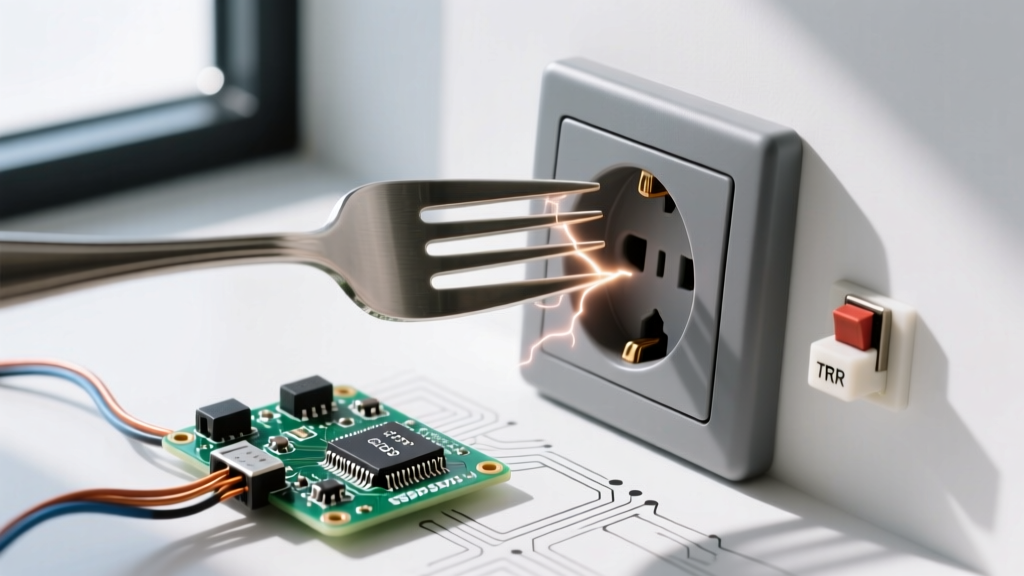
Every few years, a new variation of the fork in electrical outlet gif circulates across social media platforms, usually depicting a cartoonish explosion, a massive fireball, or a person being thrown across the room. These viral clips are often staged, digitally altered, or conflated with high-voltage industrial accidents. However, the underlying curiosity driving these searches is rooted in a very real, highly dangerous electrical phenomenon: the 120V dead short circuit.
As electrical professionals and DIY enthusiasts, it is critical to separate internet mythology from electromechanical reality. Inserting a conductive metal object like a stainless steel fork into a standard NEMA 5-15R receptacle does not trigger a Hollywood-style explosion. Instead, it initiates a violent, millisecond-long sequence of extreme fault currents, localized plasma arcs, and molten metal spatter. In 2026, modern safety codes and tamper-resistant technologies have made this specific scenario nearly impossible to execute accidentally, but understanding the physics of a receptacle short circuit remains essential for troubleshooting, safety, and system design.
The Physics of a 120V Dead Short
To understand what happens when metal bridges the hot and neutral slots of an outlet, we must look at Ohm’s Law and the resistivity of common metals. A standard dinner fork is typically manufactured from 18/8 or 18/10 stainless steel. The electrical resistivity of stainless steel is approximately $7.2 \times 10^{-7} \Omega\cdot m$, which is roughly 40 times higher than that of pure copper ($1.68 \times 10^{-8} \Omega\cdot m$).
When the tines of a fork bypass the outlet's safety mechanisms and simultaneously contact the hot (brass) and neutral (silver) terminals, they create a dead short. Because the fork has very low overall resistance—often between 0.01 and 0.05 ohms depending on the exact contact surface area—the current spikes catastrophically.
The Math of the Fault: If the fork's resistance at the point of contact is 0.02 ohms, a standard 120V residential circuit will attempt to push 6,000 Amps of current ($I = V/R$) through the steel. This is 400 times the normal 15-Amp rating of the circuit.
Arc Flash Dynamics and Molten Spatter
The viral GIFs often show a room-filling fireball, but a residential 120V short circuit produces a highly localized, intensely hot arc flash. The energy let-through, measured as $I^2t$ (current squared multiplied by time), generates immense heat at the microscopic contact points between the fork and the receptacle's brass contacts.
Within milliseconds, the stainless steel at the contact edge vaporizes, turning into a superheated plasma. While industrial arc flashes can reach 35,000°F, a residential 120V arc typically reaches localized temperatures between 10,000°F and 15,000°F. This vaporization causes a rapid expansion of gas, ejecting microscopic droplets of molten steel and copper outward. This is the primary danger to human skin and eyes during a low-voltage short circuit event, not a concussive blast.
The Breaker's Response: Thermal vs. Magnetic Trip Curves
Why doesn't the house burn down? The answer lies in the thermal-magnetic circuit breaker protecting the circuit. According to data published by the Occupational Safety and Health Administration (OSHA), overcurrent protection devices are designed to clear faults before the wiring can ignite.
A standard 15A or 20A breaker contains two distinct tripping mechanisms:
- Thermal Trip: A bimetallic strip that bends under sustained, moderate overloads (e.g., drawing 25A on a 15A circuit). This takes seconds to minutes.
- Magnetic Trip: A solenoid coil that reacts instantaneously to massive current spikes. The magnetic trip threshold is typically set between 5x and 10x the breaker's rated current (75A to 150A for a 15A breaker).
When the 6,000A fault current from the fork hits the breaker, the magnetic solenoid engages instantly. The breaker clears the fault in under 16 milliseconds (less than one full AC cycle at 60Hz). While 16 milliseconds is fast enough to prevent the copper wiring inside your walls from melting, it is still long enough for the arc flash to vaporize the tip of the fork and severely scorch the receptacle face.
Why Modern TRRs Neutralize the 'Fork' Threat
If you are searching for a fork in electrical outlet gif to see a real-world stunt, you will likely find that modern outlets physically reject the attempt. The National Fire Protection Association (NFPA) mandates Tamper-Resistant Receptacles (TRRs) under NEC Article 406.12. As of the 2026 NEC cycle, TRRs are universally required in all dwelling units, patient care facilities, and most commercial spaces.
The Mechanical Interlock
TRRs feature internal, spring-loaded shutters made of high-temperature thermoplastic. These shutters operate on a mechanical interlock system: they will only open if simultaneous, roughly equal pressure is applied to both the hot and neutral slots. A single fork tine pressed into one slot will simply hit a solid plastic wall.
Furthermore, standard NEMA 5-15R receptacles are polarized. The neutral slot is physically wider (0.312 inches) than the hot slot (0.260 inches). A standard dinner fork features uniform tine spacing and width, meaning it cannot physically seat deeply enough into both slots simultaneously to depress the internal shutters. The geometry of the outlet inherently defends against the geometry of the fork.
Material Conductivity and Fault Reactions
Not all metals react the same way during a short circuit. Below is a comparison of how common household metals behave when introduced to a 120V fault, highlighting why copper wiring survives while foreign objects fail.
| Material | Resistivity ($\Omega\cdot m$) | Melting Point | Fault Reaction (120V Dead Short) |
|---|---|---|---|
| Copper (Wire) | $1.68 \times 10^{-8}$ | 1,984°F | Remains intact; breaker trips before thermal damage occurs. |
| Aluminum (Foil) | $2.82 \times 10^{-8}$ | 1,221°F | Vaporizes explosively; high risk of secondary ignition. |
| Stainless Steel (Fork) | $7.20 \times 10^{-7}$ | 2,500°F | Localized plasma arc; molten spatter; severe pitting. |
| Silver (Jewelry) | $1.59 \times 10^{-8}$ | 1,763°F | Welds to brass contacts; massive current flow until breaker clears. |
Post-Fault Remediation Protocol
If an outlet has actually suffered a short circuit event—whether from a dropped tool, a child's curiosity prior to TRRs, or a failed appliance—never simply reset the breaker and continue using it. The U.S. Consumer Product Safety Commission (CPSC) warns that compromised receptacles are a leading cause of residential electrical fires. Follow this strict remediation protocol:
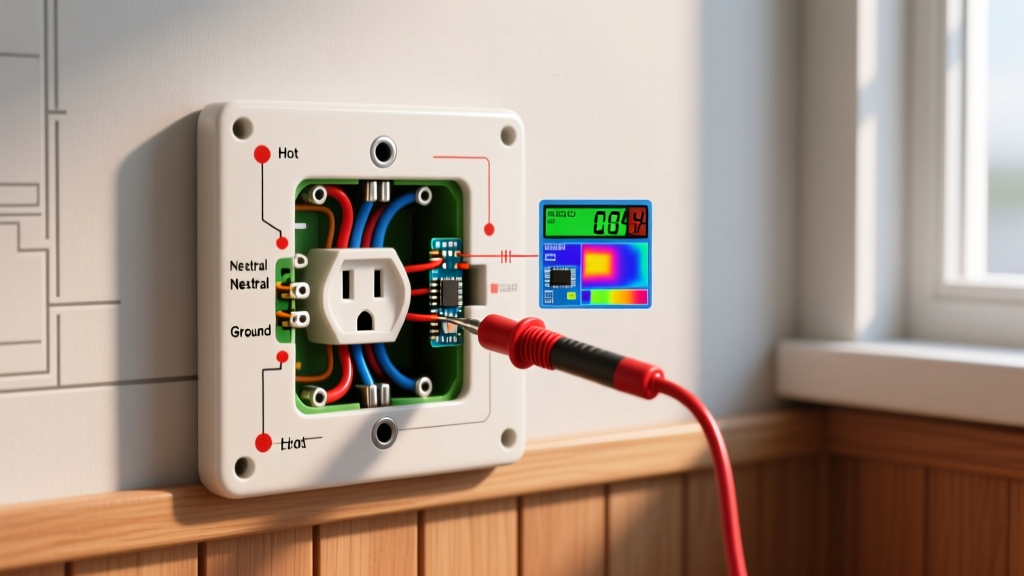
- Lockout/Tagout: Turn off the breaker and verify the absence of voltage using a non-contact voltage tester and a multimeter.
- Inspect the Yoke and Faceplate: Look for micro-fractures, soot tracking, or melted thermoplastic. Any discoloration means the structural integrity of the outlet is compromised.
- Check Wire Insulation: The massive magnetic forces generated by a 6,000A fault can cause the wires inside the junction box to physically jerk. Inspect the black and white THHN/copper conductors for micro-fractures or melted insulation near the terminal screws.
- Replace, Do Not Reuse: The internal brass contacts of a scorched receptacle lose their temper (springiness) when exposed to arc flash heat. A weakened contact will cause high resistance, arcing, and eventually a fire when a normal plug is inserted later. Always install a new, UL-listed TRR receptacle.
- Verify Grounding: Ensure the bare copper or green grounding wire is securely bonded to the green terminal and the metal junction box (if applicable) to ensure the next fault has a safe path to earth.
Conclusion
The fork in electrical outlet gif is a digital ghost story that obscures the fascinating, violent, and highly regulated reality of residential electrical systems. A 120V dead short is a masterclass in extreme physics, where thousands of amps of current, millisecond breaker trip curves, and localized plasma arcs collide. Thanks to the universal adoption of Tamper-Resistant Receptacles and advanced thermal-magnetic breakers, the modern electrical grid is engineered to neutralize these threats before they can cause harm. Respect the physics, trust the code, and always prioritize verified safety mechanisms over internet myths.