
The Critical Intersection of Outdoor Power and Safety
Installing an exterior electrical outlet is not merely a matter of extending indoor wiring to the outside. Outdoor environments subject electrical components to extreme temperature fluctuations, UV radiation, driving rain, and condensation. A compromised outdoor receptacle is a primary vector for ground faults, arc flashes, and severe electrical shock. As of 2026, with the widespread adoption of the 2023 National Electrical Code (NEC) across most U.S. jurisdictions, the safety margins and compliance requirements for outdoor power have become significantly more stringent.
This comprehensive safety guide and code compliance manual details the exact NEC articles, component specifications, and installation protocols required to deploy a reliable, shock-proof exterior electrical outlet. Whether you are powering landscape lighting, holiday decorations, or an electric vehicle (EV) charger, adherence to these standards is non-negotiable.
Decoding the NEC: Mandatory Requirements for Exterior Receptacles
The National Fire Protection Association (NFPA) outlines strict parameters for outdoor electrical installations under NFPA 70 (the NEC). Understanding these specific articles is the first step in passing inspection and ensuring long-term safety.
1. GFCI Protection (NEC Article 210.8)
Ground-Fault Circuit Interrupter (GFCI) protection is the absolute baseline for any exterior electrical outlet. A GFCI monitors the current balance between the hot and neutral conductors, tripping the circuit within 20 to 30 milliseconds if a leakage to ground as small as 4 to 6 milliamps is detected.
- 125V to 250V Expansion: Historically, GFCI protection was primarily mandated for 125V, 15A, and 20A receptacles. Under the current NEC (Article 210.8(A)(3) and (F)), this mandate has expanded. All outdoor receptacles up to 250V and up to 50A—including those installed for RV hookups or Level 2 EV chargers—must now feature GFCI protection.
- Placement of Protection: You may use a GFCI receptacle at the point of use, or protect a standard outdoor receptacle via a GFCI circuit breaker located in the main service panel. Point-of-use is generally preferred for outdoor circuits to prevent nuisance trips from taking down interior circuits on the same breaker.
2. Weatherproof Enclosures and 'In-Use' Covers (NEC Article 406.9)
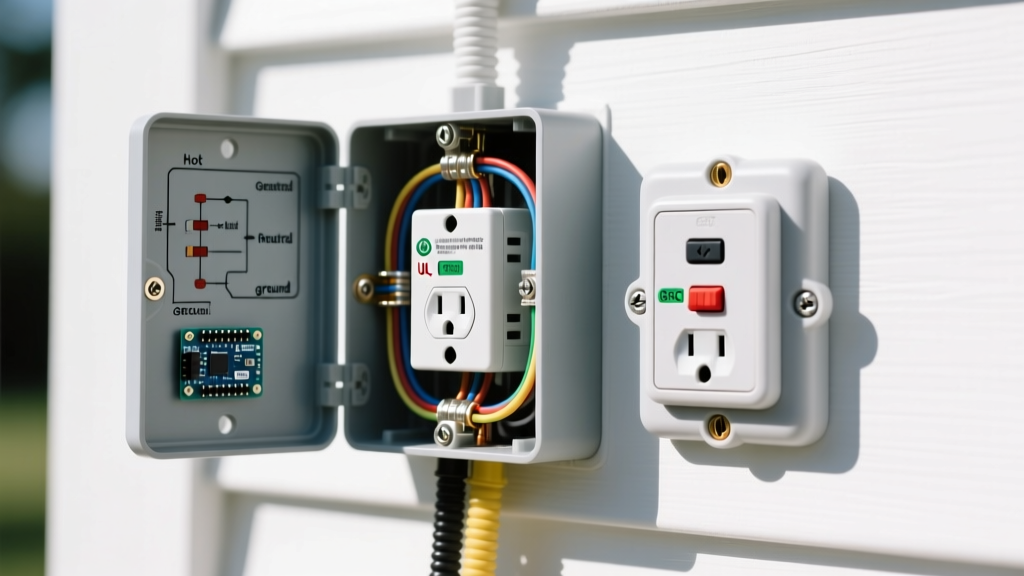
NEC Article 406.9(B)(1) dictates that all 15A and 20A receptacles installed in wet locations (which includes all exterior walls exposed to weather) must be enclosed in a weatherproof box. More importantly, the code requires an extra-duty weatherproof cover that maintains its weatherproof rating even when a cord is plugged in (commonly known as an 'in-use' cover).
Code Warning: Standard flat flip-covers that only seal the outlet when empty are strictly prohibited for new installations in wet locations. The cover must accommodate the physical profile of a plugged-in cord without compromising the internal gasket seal.
3. Tamper-Resistant (TR) and Weather-Resistant (WR) Ratings
Every exterior electrical outlet must bear both the 'TR' and 'WR' markings on its yoke. TR receptacles feature internal shutters that prevent foreign objects from being inserted into the slots. WR receptacles are constructed with UV-stabilized thermoplastics and nickel-plated brass contacts to resist corrosion and degradation from prolonged sun and moisture exposure.
Component Selection Matrix: Building a Code-Compliant Assembly
Cutting corners on outdoor components leads to premature failure and code violations. Below is a 2026 procurement guide featuring specific, industry-tested models that meet or exceed NEC requirements.
| Component Type | NEC Requirement | Recommended Model (2026) | Est. Retail Cost |
|---|---|---|---|
| Receptacle | 20A, WR, TR, GFCI | Leviton R52-GFNT2-WST (Smart GFCI) | $38.00 - $45.00 |
| Enclosure Box | Cast Metal / Polycarbonate | Red Dot 1900 (Cast Aluminum 1-Gang) | $14.00 - $18.00 |
| In-Use Cover | Extra-Duty, Wet Location | TayMac MM540C Bellweather Extra-Duty | $19.00 - $24.00 |
| Wiring Method | Wet Location Rated | 12/2 UF-B Cable or THWN-2 in PVC Conduit | $1.10 - $1.50 / ft |
| Gasket Sealant | Dielectric, Non-Corrosive | Gardner Bender GSW-14 Silicone Grease | $6.00 - $9.00 |
Step-by-Step Installation Protocol and Wiring Specifics
Proper execution is just as critical as component selection. Follow this precise installation sequence to ensure a watertight, code-compliant exterior electrical outlet.
- Power Isolation and Verification: Turn off the circuit at the main panel. Use a non-contact voltage tester (NCVT) and a digital multimeter to confirm zero voltage at the feed wires.
- Box Mounting and Flashing: If mounting to wood or composite siding, apply a continuous bead of exterior-grade polyurethane sealant (e.g., Loctite PL Premium) behind the cast box flange to prevent water intrusion behind the siding. Do not caulk the bottom of the box; leave the bottom weep holes clear to allow condensation to drain.
- Conduit and Cable Entry: When using UF-B cable, strip the outer gray jacket exactly 1/4 inch past the point where it enters the box. Leaving too much exposed wire inside a wet box creates a capillary action risk, where water can wick down the individual THHN conductors and into your interior walls.
- Termination and Torque: Strip the wire insulation to exactly 5/8 inch. Loop the wires clockwise around the terminal screws. Using a calibrated torque screwdriver, tighten the brass terminal screws to the manufacturer's specification—typically 12 to 14 inch-pounds for 12 AWG copper. Under-torquing causes arcing; over-torquing strips the soft brass threads.
- Gasket Preparation: Apply a microscopically thin layer of dielectric silicone grease to the rubber gasket of the extra-duty cover. This prevents the rubber from bonding to the cast aluminum box over time and maintains pliability during freezing temperatures.
- Securing the Cover: Tighten the cover screws in a star pattern to ensure even compression of the gasket. Stop tightening the moment the screwdriver meets resistance to avoid cracking the polycarbonate cover dome.
Real-World Failure Modes and Edge Cases
Even with code-compliant parts, environmental realities can defeat an exterior electrical outlet. According to field reports analyzed by Electrical Construction & Maintenance (EC&M), the following edge cases cause the majority of outdoor GFCI failures:
The 'Phantom Trip' Condensation Loop
In climates with high diurnal temperature swings (hot days, cold nights), condensation forms on the inside of the extra-duty cover. If the GFCI receptacle is mounted perfectly flush with no air gap, this condensation pools directly on the internal electronics, causing phantom nuisance tripping. Solution: Always use the foam spacer ring included with the extra-duty cover to create a 1/8-inch air gap between the receptacle face and the cover dome, allowing airflow to evaporate internal moisture.
UV Degradation of Polycarbonate Domes
Cheap, big-box-store weatherproof covers often use non-UV-stabilized polycarbonate. Within 24 months, these covers turn brittle and crack when closed with a cord inserted, instantly voiding the wet-location rating. Solution: Only purchase covers explicitly marked with a 'NEMA 3R' rating and UV-stabilization certifications.
Backstab Wiring in Wet Locations
Push-in 'backstab' wiring terminals rely on a small internal metal tang to grip the wire. In outdoor environments, thermal expansion and contraction will eventually loosen this grip, leading to high-resistance connections, localized melting, and arc faults. Solution: Never use backstab terminals for an exterior electrical outlet. Always use the side-binding terminal screws or a properly torqued screw-clamp back-wire mechanism.
Frequently Asked Questions (FAQ)
Can I wire an exterior outlet to an interior bathroom or kitchen GFCI circuit?
No. NEC Article 210.11(C)(1) and (3) mandate that bathroom and kitchen small-appliance circuits must be dedicated solely to those specific rooms. You must run a new dedicated circuit, or tap into an existing general lighting/outdoor receptacle circuit, ensuring the outdoor load does not exceed 80% of the breaker's continuous capacity.
How deep does UF-B cable need to be buried to feed a backyard exterior outlet?
Under NEC Article 300.5, direct-burial UF-B cable must be buried at a minimum depth of 24 inches. If you route the cable through rigid metal conduit (RMC) or intermediate metal conduit (IMC), the burial depth requirement drops to 6 inches. If the circuit is GFCI-protected and limited to 120V/20A, PVC conduit allows for an 18-inch burial depth.
Do I need an exterior outlet if I only use battery-powered tools?
Yes. NEC Article 210.52(E) requires that at least one outdoor receptacle be installed at both the front and rear of a one-family dwelling, and one accessible receptacle must be installed at grade level for any balcony, deck, or porch greater than 20 square feet. This is a structural code requirement for the dwelling, regardless of your personal tool preferences.
Final Safety Directives
Working with exterior electrical systems demands respect for the environment's destructive capabilities. By strictly adhering to NEC Articles 210.8 and 406.9, utilizing WR/TR rated components, and executing terminations with precision torque, you ensure your exterior electrical outlet remains a safe, reliable power source for years to come. Always consult with your local Authority Having Jurisdiction (AHJ) or a licensed master electrician, as local municipal codes may impose amendments stricter than the baseline national code.