
Electrical installation wiring is the permanent, code-compliant network of insulated conductors, cables, and raceways that distribute power from the service panel to branch-circuit endpoints in a building. This physical infrastructure dictates the maximum safe current capacity, acceptable voltage drop over distance, and thermal limits of your entire electrical system. Beginners commonly confuse the physical wire gauge (AWG) with the breaker's trip curve, or assume a wire's 90°C insulation rating overrides the 60°C terminal limits of standard receptacles—a mistake that leads to overheated connections and melted device yokes.
The Core Variables: AWG, Insulation, and Ampacity
When we talk about wiring a house, we are not just talking about copper. We are talking about copper combined with specific insulation polymers and installed via specific methods. The National Electrical Code (NEC) does not assign a single ampacity to a wire size; it assigns ampacity based on the insulation temperature rating and the installation environment.
| Cable/Wire Type | Insulation Rating | Typical Application | NEC Article |
|---|---|---|---|
| NM-B (Romex) | 90°C (derated to 60°C) | Dry, indoor branch circuits (studs/joists) | Article 334 |
| THHN / THWN-2 | 90°C dry / 75°C wet | Conduit runs, subpanel feeders, commercial | Article 310 |
| UF-B | 90°C (derated to 60°C) | Direct burial, outdoor damp locations | Article 339 |
| SER (Service Entrance) | 90°C | Main panel feeders, heavy appliance ranges | Article 338 |
Choosing the right type prevents premature insulation breakdown. For instance, running standard NM-B through a wet concrete block wall without a sleeve violates code because the paper wrap inside the cable wicks moisture, leading to ground faults.
Worked Example: Derating THHN in a Shared Conduit
Ampacity is not a fixed number; it shrinks when wires are bundled together because they cannot dissipate heat. Let us look at a real-world scenario where electrical installation wiring constraints force a design change.
The Scenario: You are running two 20A multi-wire branch circuits (MWBC) through a single 1/2-inch EMT conduit to a detached garage subpanel. This means you have four current-carrying conductors (two hot, two neutral) in the pipe, all 12 AWG THHN.
- Base Ampacity: According to NEC Table 310.16, 12 AWG THHN in the 90°C column has a base ampacity of 30A.
- Adjustment Factor: NEC Table 310.15(C)(1) states that for 4 to 6 current-carrying conductors in a raceway, you must apply an 80% derating factor.
- The Math: 30A × 0.80 = 24A Adjusted Ampacity.
- The Verdict: Because 24A is greater than the 20A breaker protecting the circuit, this installation is perfectly legal and safe.
The Edge Case: What if you decided to pull three circuits (6 current-carrying conductors) through that same conduit? The derating factor remains 80%, so 12 AWG is still legal. But if you added a fourth circuit (8 current-carrying conductors), the derating factor drops to 70%. The math becomes 30A × 0.70 = 21A. Still legal for a 20A breaker. However, if you crammed 10 conductors into the pipe, the factor drops to 50%. Now, 30A × 0.50 = 15A. Your 12 AWG wire is now only rated for 15A, meaning it cannot be used on a 20A breaker. You would be forced to upsize to 10 AWG wire to maintain the 20A circuit capacity.
Where You Meet This in Practice
Theory only matters when you are holding the wire strippers. Here is how electrical installation wiring principles dictate your physical workflow on the jobsite:
- Rough-In Stapling: When running NM-B through wooden studs, NEC 300.4(D) requires you to staple the cable within 12 inches of the outlet box, and every 4.5 feet thereafter. Failing to secure the wire allows it to be pulled back into the wall cavity when someone plugs in a vacuum cleaner, eventually straining the terminal screws.
- Conduit Pulling: When pulling THHN through long conduit runs, friction generates heat and can strip the insulation. You must use a UL-listed wire pulling compound (like Ideal 31-081) on the wires. Never use dish soap or petroleum jelly, which degrades the polymer insulation over time.
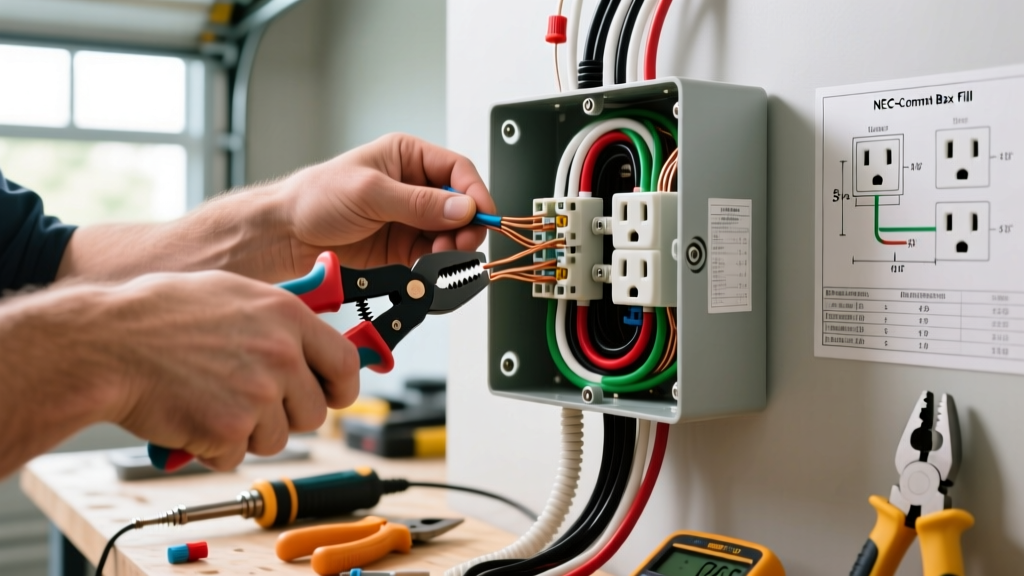
- Termination Torque: The most common cause of residential electrical fires is loose connections. When terminating 12 AWG or 14 AWG solid copper on a standard 15A or 20A receptacle, strip exactly 3/4 inch of insulation. Form a clockwise shepherd's hook around the screw terminal, and tighten to the manufacturer's specified torque—typically 14 in-lbs for modern Leviton or Hubbell devices. Use a calibrated torque screwdriver; hand-tightening is no longer considered best practice under NEC 110.14(D).
Frequently Asked Questions
What size wire is standard for electrical installation wiring in a modern home?
For standard 120V branch circuits, 14 AWG copper is the minimum for 15A lighting circuits, while 12 AWG is required for 20A receptacle circuits (especially in kitchens, bathrooms, and garages). For 240V appliances, 10 AWG handles 30A (dryers), 8 AWG handles 40A (cooktops), and 6 AWG handles 50A (ranges). However, many professional electricians in 2026 exclusively use 12 AWG for all 15A and 20A general lighting and receptacle circuits. The material cost difference is negligible (roughly $15 more per 250-foot roll), but 12 AWG significantly reduces voltage drop on long runs and provides physical robustness against accidental nicks during drywall installation.
Can I mix NM-B and THHN electrical installation wiring inside the same conduit?
You can use a short piece of conduit as a "sleeve" to protect NM-B from physical damage (for example, running it down a concrete block wall to a receptacle). However, you cannot strip the outer PVC jacket off NM-B and mix those bare wires with loose THHN conductors in a continuous, long-distance conduit run. The NM-B jacket is not rated for the heat dissipation profile of a bundled conduit environment, and leaving the jacket on inside a conduit ruins your NEC Chapter 9 conduit fill calculations, leading to jammed pulls and trapped heat.
How does ambient temperature affect electrical installation wiring ampacity?
Wire ampacity tables assume an ambient temperature of 30°C (86°F). If your electrical installation wiring passes through an unconditioned attic in a hot climate where temperatures routinely exceed 113°F (45°C), you must apply temperature correction factors from NEC Table 310.15(B)(1). For 90°C THHN wire in an ambient temperature of 113-122°F, you must multiply the base ampacity by 0.87. If you are running a 30A circuit with 10 AWG THHN (base 40A), the adjusted ampacity becomes 34.8A, which is still safe. But if the attic hits 141°F, the factor drops to 0.71, yielding 28.4A—meaning your 10 AWG wire can no longer safely carry a continuous 30A load, and you must upsize to 8 AWG.