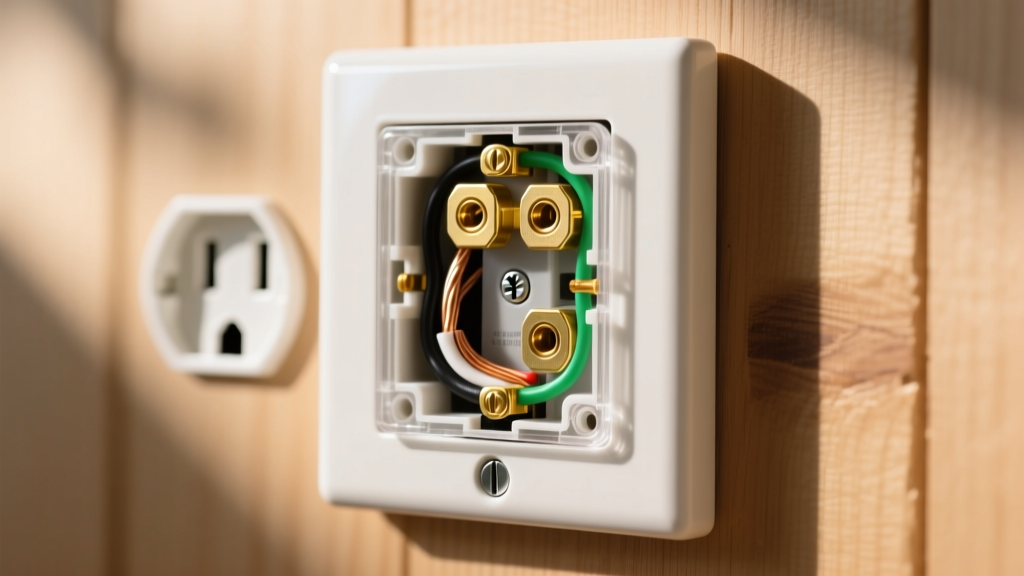
The equipment grounding conductor (EGC) does not carry current during normal operation. Its sole job is to provide a low-impedance path back to the panel during a fault. If a hot wire frays and touches the metal chassis of your table saw, and your ground wire is missing, broken, or improperly terminated, the breaker will not trip. The metal chassis remains energized at 120V. The next time you touch it while standing on a damp garage floor, your body becomes the ground path, resulting in severe shock or electrocution. A proper ground ensures the fault current spikes high enough, fast enough, to trip the breaker in milliseconds.
The Short Answer: Bare vs. Insulated Ground Wires
The direct answer to whether ground wires need to be insulated depends entirely on the type of cable or raceway you are using. In standard residential non-metallic sheathed cable (NM-B, commonly known as Romex), the equipment grounding conductor is bare copper and does not require insulation. It is perfectly legal and safe to leave it bare inside junction boxes and panel enclosures.
However, when you pull individual conductors through a conduit (using THHN/THWN wire), the ground wire must be insulated, and it must be colored green or green with a yellow stripe. The insulation in conduit runs prevents the bare ground from accidentally abrading against the hot wire's insulation over decades of thermal expansion and vibration, which could cause a dead short inside the pipe.
Ground, Neutral, and Bond: Why the Distinction Matters
To understand why bare wire is acceptable in some scenarios, you must separate three terms that DIYers frequently confuse: neutral, ground, and bond.
- Neutral (Grounded Conductor): The white or gray wire. This is a current-carrying conductor. It completes the circuit by carrying the return current back to the source under normal operation. Because it carries current, it must always be insulated.
- Ground (Equipment Grounding Conductor / EGC): The bare or green wire. This is a non-current-carrying conductor under normal conditions. It only carries current during a fault event. Because it sits at zero potential and carries no normal load, bare copper is acceptable in enclosed cable assemblies.
- Bond: The physical, mechanical connection between the neutral bus bar and the ground bus bar (and the metal panel enclosure). This only happens at the main service disconnect. The bond establishes the zero-voltage reference point for the entire system, ensuring that a fault on the hot wire creates a massive short circuit that instantly trips the breaker.
According to NFPA 70 (the National Electrical Code), the grounding system must provide a permanent, continuous, and low-impedance path. Whether that path is bare copper inside a vinyl sheath or insulated green wire inside PVC pipe, the physics of the fault loop remain identical.
When Code Requires Insulated Ground Wires
While bare wire is the default for DIYers working with Romex, specific installations mandate insulated grounds. The following decision tree outlines when you must reach for the green spool.
| Wiring Method | Ground Wire Type Required | Why / Code Context |
|---|---|---|
| NM-B Cable (Romex) | Bare Copper | Encased in a non-conductive PVC jacket; no risk of shorting to other conductors. |
| UF-B Cable (Underground) | Bare Copper | Same as NM-B, but with a solid gray sheath rated for direct burial. |
| Conduit (PVC, EMT, Rigid) with THHN | Insulated (Green or Green/Yellow) | Prevents abrasion against hot/neutral insulation inside the raceway over time. |
| Isolated Ground (IG) Receptacles | Insulated (Green with Yellow Stripe) | Used in medical/IT settings to bypass panel noise; the yellow stripe identifies it as an isolated path. |
| Flexible Metal Conduit (FMC) | Insulated (Green) | FMC is not approved as an EGC in all sizes/lengths; a separate insulated wire must be pulled. |
Disclaimer: The table above reflects standard NEC-style guidance; your local AHJ (Authority Having Jurisdiction) has final authority. Always check with your local building inspector before starting a rough-in, as some municipalities require insulated grounds in all residential applications regardless of cable type.
How to Verify Your Ground is Actually Working
Just because a receptacle has a third prong does not mean the ground wire is connected, properly sized, or low-impedance. Bootleg grounds (where a jumper wire connects the neutral screw to the ground screw) are a deadly DIY hack that fools basic plug-in testers. Here is how to verify a true ground using a digital multimeter (like a Fluke 117) and a 3-light receptacle tester.
Plug in a standard 3-light receptacle tester (e.g., Gardner Bender GFI-3501). If it shows 'Correct', proceed to Step 2 to rule out a bootleg ground. If it shows 'Open Ground', the ground wire is disconnected or broken somewhere upstream.
- Set your multimeter to AC Voltage (V~). Ensure the range is at least 200V.
- Measure Hot to Neutral. Insert the red probe into the shorter (hot) slot and the black probe into the longer (neutral) slot. You should read between 114V and 126V (120V nominal).
- Measure Hot to Ground. Keep the red probe in the hot slot and move the black probe to the round ground hole. You should read the exact same voltage (within 1-2V) as Hot-to-Neutral. If this reads 0V, your ground is open.
- Measure Neutral to Ground. Move the red probe to the neutral slot and keep the black probe in the ground hole. This should read very close to 0V (typically 0.5V to 2.0V due to normal voltage drop on the neutral). If this reads 120V, you have a bootleg ground or a reversed hot/neutral wiring fault.
- The Breaker Test (Optional but recommended). For GFCI/AFCI circuits, use the multimeter to verify voltage, then press the 'Test' button on the receptacle or breaker. The power must drop to 0V immediately.
For a deeper look into OSHA's wiring design and protection standards, maintaining this low-impedance path is not just a residential best practice; it is a fundamental requirement for life safety in all electrical systems.
When to Call a Licensed Electrician
While swapping a receptacle or adding a junction box to an existing grounded circuit is well within the scope of a competent DIYer, certain grounding scenarios require a licensed professional. You must hire an electrician when:
- Upgrading an Ungrounded System: If you live in a pre-1960s home with knob-and-tube or ungrounded NM cable (2-prong outlets), you cannot simply swap in 3-prong outlets. You must either run new grounded cables, install GFCI protection at the breaker or first receptacle in the chain (labeled 'No Equipment Ground'), or use metal conduit as a verified EGC.
- Panel Work and Bonding: Any work inside the main service panel, especially involving the neutral-to-ground bonding screw or strap, the grounding electrode conductor (GEC) to the ground rods, or adding a subpanel (where neutral and ground must remain strictly separated).
- Driving Ground Rods: Installing a supplemental grounding electrode system requires specific wire gauges (typically 4 AWG or 6 AWG bare copper) and exothermic or listed clamps.
Frequently Asked Questions
Can I wrap a bare ground wire with electrical tape to insulate it?
No. Standard vinyl electrical tape degrades over time, dries out, and loses its adhesive properties, especially inside warm junction boxes or attics. If you need to insulate a ground wire for a specific application (like an isolated ground), you must use properly rated heat shrink tubing or pull a new insulated green THHN wire. If you are just trying to prevent a bare ground from touching a hot terminal in a crowded metal box, use a wire nut or a push-in connector to cap the unused end, or carefully route it away from the terminals.
Does a ground wire need to be the same gauge as the hot wire?
For standard 15A and 20A branch circuits, yes. If you are using 14 AWG hot/neutral, you use a 14 AWG bare ground; for 12 AWG circuits, you use a 12 AWG ground. However, for larger feeders (like a 100A subpanel feeder using 3 AWG copper), the National Electrical Code (NEC Table 250.122) allows the equipment grounding conductor to be smaller than the current-carrying conductors, because the ground only needs to carry fault current long enough to trip the breaker, not continuous load.
Why is my ground wire green and yellow instead of just green?
A solid green wire is a standard equipment grounding conductor. A green wire with a yellow stripe specifically designates an Isolated Ground (IG). IG circuits are used in environments sensitive to electromagnetic interference (EMI), such as hospital operating rooms, MRI suites, or high-end audio/server rooms. The yellow stripe tells the electrician that this ground wire bypasses the standard panel ground bus and runs all the way back to a dedicated grounding point to prevent noise from other appliances from interfering with sensitive equipment.
Can I use a metal conduit as my ground wire instead of pulling a separate wire?
Under NEC Article 250.118, certain types of continuous metal raceways (like Rigid Metal Conduit or Intermediate Metal Conduit with threaded couplings) are approved as an Equipment Grounding Conductor. However, standard EMT (thin-wall metal conduit) with set-screw fittings is often viewed with skepticism by inspectors for grounding purposes due to the risk of loose connections creating high impedance. For DIYers and most residential retrofit work, always pull a separate, dedicated green or bare copper ground wire inside the conduit. It guarantees a reliable, low-impedance path regardless of the mechanical tightness of the conduit fittings.