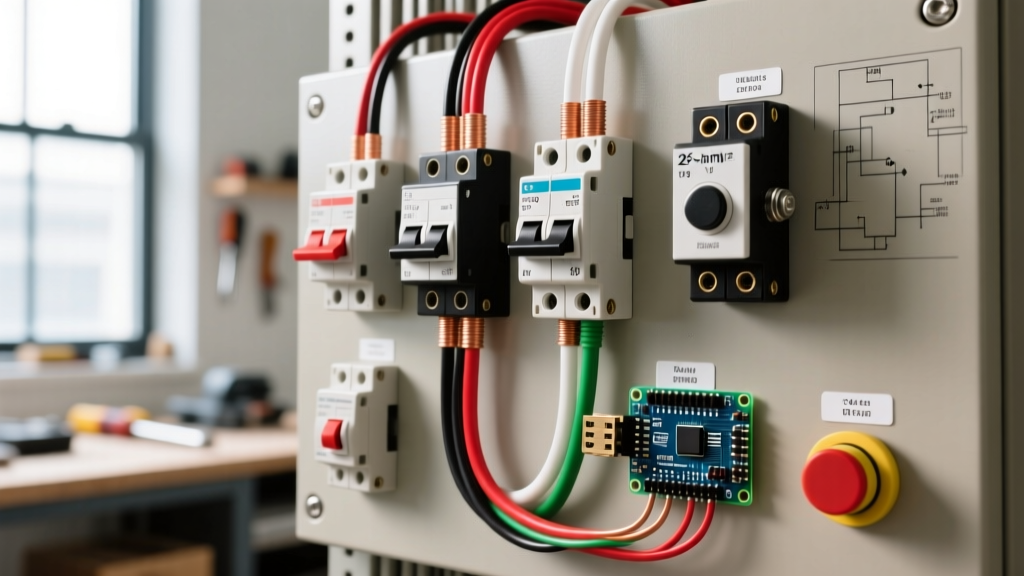
Current and wire gauge dictate the maximum safe continuous amperage a conductor can carry before its insulation degrades, governed by the wire's cross-sectional area and thermal limits. In a real circuit or installation, this relationship directly controls two physical realities: the operating temperature of the cable jacket under load, and the voltage drop delivered to the termination point. Beginners commonly confuse a wire’s voltage rating (e.g., 600V THHN) with its ampacity (current capacity), and mistakenly assume stranded wire carries more current than solid wire of the same AWG (it does not; ampacity is based on total circular mils, not strand count).
The Thermal Reality of Ampacity and Heat Dissipation
When electrons flow through a copper or aluminum conductor, they collide with the metal's atomic lattice, generating heat. This is governed by Joule's first law ($P = I^2R$). Because heat generation scales with the square of the current, doubling the amperage through a fixed wire gauge quadruples the heat generated.
The National Electrical Code (NEC) does not size wire based on when the copper will melt; it sizes wire based on when the insulation will fail. According to NFPA 70 (NEC Article 310), ampacity tables are divided by insulation temperature ratings: 60°C, 75°C, and 90°C.
- 60°C Column: Used for NM-B (Romex) cable and terminals on devices rated 100A or less (like standard receptacles and breakers).
- 75°C Column: Used for THHN/THWN wire in conduit and terminals on larger equipment.
- 90°C Column: Almost never used for final ampacity; it is only used as a starting point for derating calculations (like bundling multiple wires in a single conduit).
Worked Numeric Example: Sizing a 24A Continuous Circuit
Let’s size the conductors for a 240V hardwired air compressor that draws a continuous 24A load, located 80 feet from the subpanel.
NEC Article 210.20(A) requires continuous loads (operating for 3 hours or more) to be multiplied by 125%.
24A × 1.25 = 30A. We need a 30A breaker and wire rated for at least 30A.
Step 2: Select Wire Gauge Based on Insulation Type
- Scenario A (NM-B Cable): If running Romex through wall studs, we must use the 60°C column. Standard ampacity charts show 10 AWG copper at 60°C is rated for exactly 30A. Code allows 10 AWG NM-B here.
- Scenario B (THHN in Conduit): If pulling individual THHN wires through PVC conduit, we use the 75°C column. 10 AWG THHN at 75°C is rated for 35A. We can legally use 10 AWG.
Step 3: The Voltage Drop Reality Check
While 10 AWG is code compliant for ampacity, it might be terrible for performance over an 80-foot run. Voltage drop formula: VD = (2 × Length × Current × Resistance per 1000ft) / 1000.
For 10 AWG copper, resistance is ~1.24 ohms/kft.
VD = (2 × 80 × 24 × 1.24) / 1000 = 4.76V.
On a 240V circuit, that is a 1.98% drop, which is well under the NEC recommended 3% maximum. In this specific case, 10 AWG is the correct, final pick. If the run were 150 feet, the drop would exceed 3%, and we would be forced to upsize to 8 AWG to protect the compressor motor from brownout conditions.
Where You Meet Current and Wire Gauge in Practice
You will encounter this relationship in three primary jobsite and bench scenarios:
- Branch Circuit Rough-In: Pulling 14 AWG for 15A lighting circuits and 12 AWG for 20A receptacle circuits. Here, the physical stiffness of 12 AWG solid copper makes termination harder, but it is mandatory for the higher current.
- Feeder and Subpanel Wiring: When feeding a 100A subpanel, you transition from copper to aluminum (like 2-2-2-4 SER cable) because the cost of 2 AWG copper is prohibitive. Aluminum has a higher resistance, requiring a physically larger gauge to carry the same current.
- Low Voltage and DC Systems: In 12V solar or automotive systems, current is massively higher for the same wattage ($I = P/V$). A 1200W inverter pulls 100A at 12V. You must use 2 AWG or 1/0 AWG welding cable here, whereas a 1200W microwave on a 120V AC circuit only pulls 10A and uses a standard 14 AWG cord.
Decision Path: Selecting Your Conductor
Use this decision tree to terminate your wire sizing process with a concrete purchase. Always assume copper unless explicitly building a heavy feeder.
| If Your Load Is... | And Your Wiring Method Is... | Then Pick This Exact Wire |
|---|---|---|
| Up to 15A (Lighting) | NM-B in walls | 14 AWG Copper NM-B |
| Up to 20A (Receptacles) | NM-B in walls | 12 AWG Copper NM-B |
| Up to 30A (Dryer/HVAC) | NM-B in walls | 10 AWG Copper NM-B |
| Up to 50A (Range/EV) | NM-B in walls | 6 AWG Copper NM-B |
| Up to 50A (Any load) | THHN in Conduit | 8 AWG Copper THHN (75°C col) |
| 100A Subpanel Feeder | SER Cable / Conduit | 2 AWG Aluminum SER |
Common Pitfalls and Final Recommendations
The most dangerous mistake DIYers make is sizing the wire to the breaker rather than the load, or ignoring terminal temperature ratings. If you connect a 75°C rated 8 AWG THHN wire (rated 50A) to a standard residential breaker with a 60°C terminal limit, the entire assembly is legally and thermally downgraded to 40A. The weakest link in the thermal chain dictates the circuit's true ampacity.
Another frequent error is assuming aluminum wire is universally banned. While banned for small branch circuits inside walls due to historical creep and oxidation issues at small terminals, modern AA-8000 series aluminum alloy is perfectly safe, code-compliant, and standard for any feeder over 60A, provided you use anti-oxidant paste (like Noalox) and torque the lugs to manufacturer specifications.