
The Workshop Dilemma: Single Phase vs Three Phase Electricity
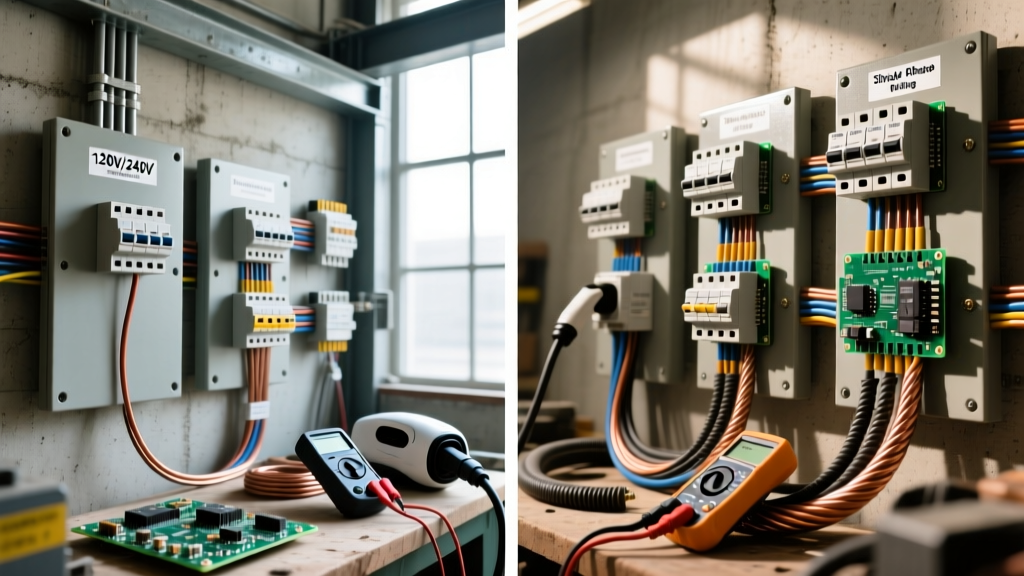
When you transition from a standard home garage to a serious fabrication shop, or when you decide to install a commercial-grade Level 3 EV fast charger, you will inevitably hit an electrical wall. The crux of this wall is the debate of single phase vs three phase electricity. While residential homes in North America are universally supplied with 120/240V split-phase power, heavy industrial machinery, large CNC routers, and commercial HVAC systems demand the relentless torque and efficiency of three-phase power. Understanding the real-world wiring, cost, and application differences between these two systems is critical for any advanced DIYer, electrician, or shop owner.
The Physics of Power Delivery: Zero-Crossings vs. Constant Torque
To understand the practical differences, we must briefly look at the waveforms. Single-phase alternating current (AC) operates on a single sine wave. In a 240V circuit, the voltage crosses zero 120 times per second (in a 60Hz system). For resistive loads like a water heater, this is irrelevant. But for inductive loads like electric motors, these zero-crossings create micro-pauses in torque, leading to vibration, heat, and reduced efficiency.
Three-phase power utilizes three overlapping sine waves, each offset by 120 degrees. As one phase drops to zero, the other two are still delivering peak power. The result is a continuous, unbroken transfer of energy. According to power quality experts at Fluke, this constant power delivery allows three-phase motors to be physically smaller, run cooler, and last significantly longer than their single-phase counterparts of the same horsepower rating.
Real-World Wiring: Conductor Counts and Sizing Math
The most immediate real-world impact of choosing between single phase vs three phase electricity is the wiring infrastructure. The conductor count and wire gauge requirements shift dramatically based on the phase configuration.
Scenario: Wiring a 5HP Air Compressor
Let us apply the National Electrical Code (NEC) guidelines to a practical scenario: wiring a 5-horsepower (HP) air compressor motor located 50 feet from the panel.
- Single-Phase (230V): A standard 5HP single-phase motor has a Full Load Amp (FLA) rating of approximately 28A. The NEC requires motor branch circuits to be sized at 125% of the FLA (28A x 1.25 = 35A). You will need to pull a 4-wire cable (two hots, one neutral, one ground) or a 3-wire cable (two hots, one ground) using #8 AWG THHN copper conductors to safely handle the load and mitigate voltage drop over 50 feet.
- Three-Phase (230V): A 5HP three-phase motor draws significantly less current, with an FLA of roughly 15.2A. Applying the 125% rule (15.2A x 1.25 = 19A), you can legally wire this motor using #12 AWG THHN copper conductors. You will pull four wires (three hots, one ground).
While the three-phase setup requires one additional current-carrying conductor (three hots instead of two), the drastic reduction in wire gauge from #8 to #12 results in massive savings on copper costs, conduit fill space, and physical pulling effort.
Bridging the Gap: Phase Converters and VFDs
What happens when you buy a used Bridgeport mill or a commercial bandsaw that requires three-phase power, but your building only has single-phase utility service? Upgrading to a commercial three-phase utility drop can cost upwards of $15,000 to $40,000, requiring new transformers and utility trenching. Instead, real-world workshops rely on conversion technology.
Rotary Phase Converters (RPC)
An RPC uses a single-phase motor to spin an idler generator, creating a synthetic third leg of power. Brands like Phase-A-Perfect or Kay Industries build robust RPCs that allow you to run multiple three-phase machines off a single oversized converter. However, RPCs introduce a 'wild leg' (often high-leg delta), meaning the synthesized third leg can have voltage imbalances of up to 10%, which can prematurely burn out sensitive CNC control boards if not properly balanced.
Variable Frequency Drives (VFD)
For individual machines, a VFD is the superior modern solution. A VFD takes single-phase 240V input, rectifies it to DC, and then uses pulse-width modulation (PWM) to synthesize a perfectly balanced three-phase output. As noted in motor efficiency guides by the U.S. Department of Energy, VFDs not only solve the phase issue but also allow for soft-starting, reducing mechanical shock to gears and belts, and lowering inrush current spikes that dim shop lights.
Comparison Matrix: Single Phase vs Three Phase Electricity
| Feature | Single-Phase (Residential/Light Commercial) | Three-Phase (Industrial/Heavy Commercial) |
|---|---|---|
| Standard Voltages (NA) | 120V / 240V (Split-Phase) | 208Y/120V, 480Y/277V, 240V Delta |
| Motor Efficiency | Moderate; prone to heat and vibration | High; constant torque, cooler operation |
| Wiring for 10HP Motor | #4 AWG Copper (approx. 50A FLA) | #10 AWG Copper (approx. 27A FLA) |
| Equipment Cost | Lower (ubiquitous residential panels) | Higher (requires specialized breakers/panels) |
| Best Application | Welders, EV Level 2, HVAC, Lighting | CNC Mills, Conveyors, DC Fast Chargers |
Troubleshooting Phase Imbalance and Voltage Drop
When working with three-phase electricity in a real-world setting, phase imbalance is a critical failure mode. If the voltage across the three legs varies by more than 2%, the motor will experience a disproportionate temperature rise, degrading the insulation on the stator windings.
Pro-Tip: Always measure phase-to-phase voltage (L1-L2, L2-L3, L3-L1) under a loaded condition. Measuring without a load can mask severe utility-side imbalances that will only manifest when a heavy machine starts up.
Furthermore, when sizing wires for three-phase circuits, remember that the voltage drop formula changes. The multiplier for three-phase voltage drop is √3 (1.732), whereas single-phase uses a multiplier of 2. This mathematical advantage means three-phase power can travel further over smaller wires while maintaining the NEC-recommended 3% maximum voltage drop threshold.
Final Verdict for the Modern Maker
The choice between single phase vs three phase electricity ultimately comes down to your equipment roster. If you are running manual lathes, MIG welders, and standard woodworking tools, 240V single-phase is entirely adequate and cost-effective. However, if your workflow demands high-duty-cycle CNC machining, large rotary screw air compressors, or commercial EV infrastructure, the copper savings, motor longevity, and operational efficiency of three-phase power make it an indispensable upgrade. Plan your panel schedules carefully, leverage VFDs where utility upgrades are cost-prohibitive, and always respect the physics of the waveform.