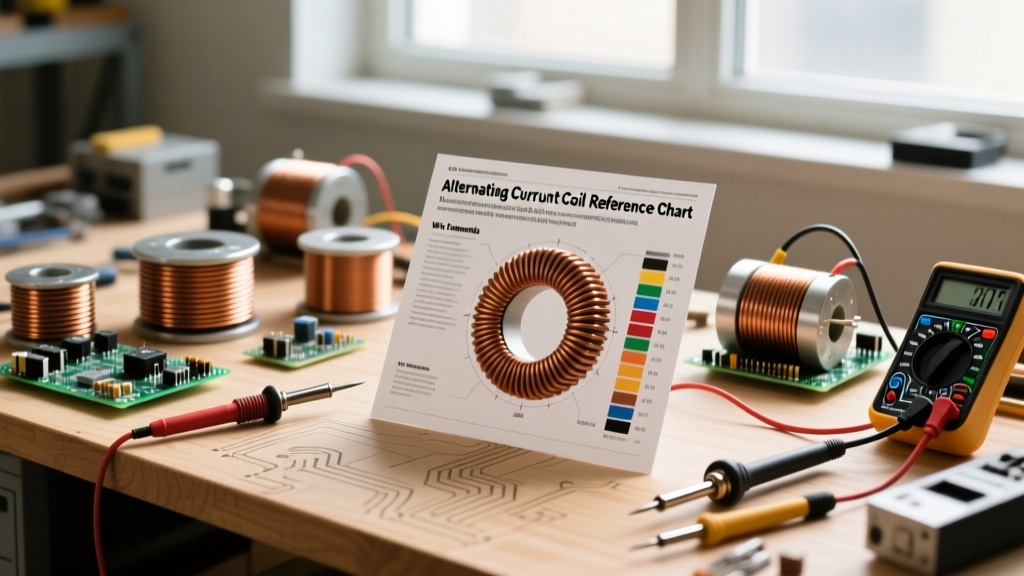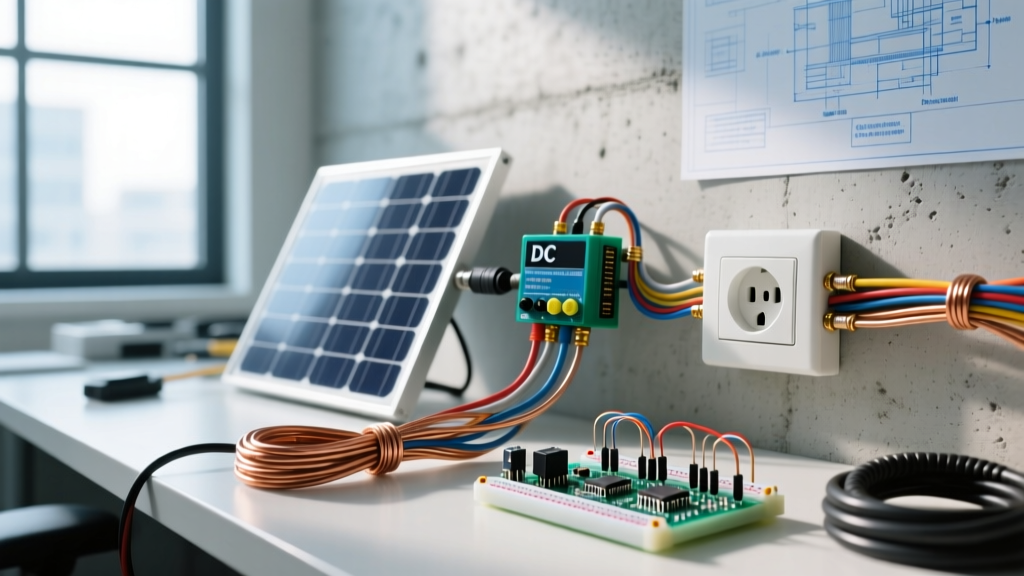

When studying electrical fundamentals, looking at practical examples of direct current and alternating current helps bridge the gap between textbook theory and workbench reality. Whether you are designing an off-grid solar array, wiring a home workshop, or debugging a microcontroller circuit, understanding how AC and DC behave in real-world applications is critical for safety, efficiency, and proper wire sizing.
In this guide, we move beyond basic definitions. We will explore exactly where these currents are used, how they dictate conductor selection, and the specific failure modes that occur when DIYers misunderstand their unique characteristics.
The Physics in Practice: How AC and DC Actually Behave in Wiring
Direct Current (DC) features a unidirectional flow of electric charge. In a copper conductor, DC utilizes the entire cross-sectional area of the wire uniformly. Alternating Current (AC), however, reverses direction periodically (typically 60 Hz in North America). This oscillation creates a phenomenon known as the skin effect.
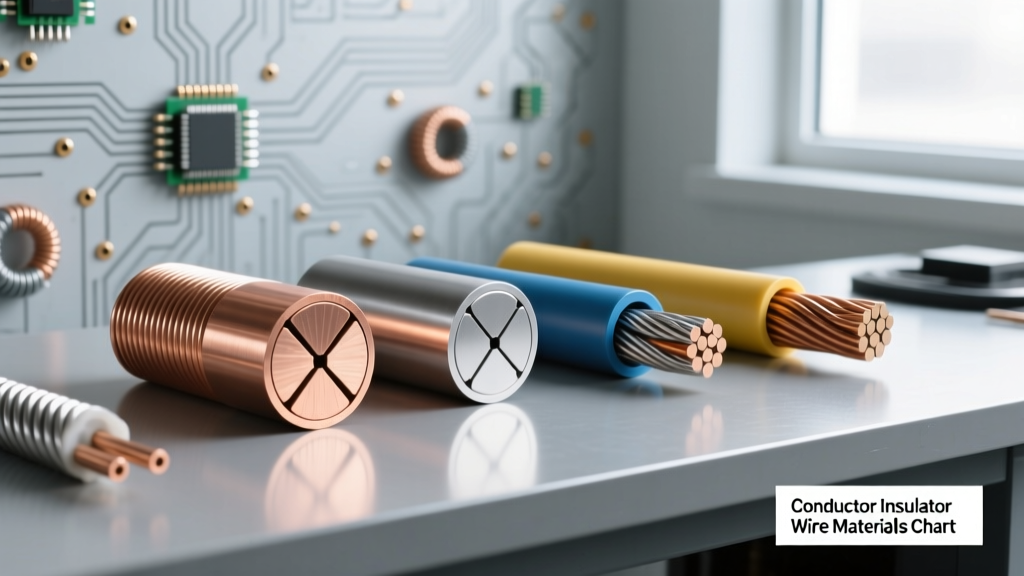
Expert Insight: At 60 Hz, the skin depth in copper is approximately 8.5 millimeters. While this rarely impacts standard residential AWG wiring (where the wire radius is smaller than the skin depth), it becomes a massive factor in high-amperage AC busbars and large-gauge feeders, forcing engineers to use hollow or specially shaped conductors to save copper weight.
Because DC lacks the skin effect, it is highly efficient for long-distance, high-voltage transmission (HVDC), but at the low voltages typical of DIY projects (12V to 48V), DC suffers from severe voltage drop over distance, demanding much thicker wire gauges than equivalent AC circuits.
5 Real-World Examples of Alternating Current (AC) Applications
AC dominates power generation and distribution because its voltage can be easily stepped up or down using transformers. Here is how AC manifests in real-world electrical work:
1. Residential Split-Phase Power (120V/240V)
In North America, the grid delivers split-phase AC to homes. A center-tapped transformer provides two 120V legs that are 180 degrees out of phase, yielding 240V across both legs. Heavy appliances like electric dryers and HVAC compressors use 240V AC to reduce the required amperage, allowing for smaller wire gauges (e.g., 10 AWG for a 30A dryer circuit) compared to running them on 120V.
2. Variable Frequency Drives (VFDs) in Machine Shops
Modern DIY machinists use VFDs to control 3-phase AC motors on lathes and mills using single-phase AC mains. The VFD rectifies the incoming AC to DC, then uses Pulse Width Modulation (PWM) to synthesize a simulated 3-phase AC output at variable frequencies, allowing precise RPM control.
3. Induction Motors in HVAC and Pumps
AC is the undisputed king of induction motors. The alternating magnetic field naturally creates a rotating stator field, meaning these motors require no brushes or commutators, resulting in decades of reliable operation in well pumps and furnace blowers.
4. Audio Signal Transmission
While not a power source, analog audio signals are complex AC waveforms. Understanding AC impedance is crucial when wiring unbalanced vs. balanced audio lines to prevent 60 Hz mains hum from inducing into the signal path.
5. Neon and High-Voltage LED Drivers
Grid-tied lighting often utilizes AC directly or steps it up. Older neon signs require high-voltage AC transformers (GNEs) to ionize the gas, while modern architectural lighting uses AC-to-DC switching power supplies hidden in junction boxes.
5 Real-World Examples of Direct Current (DC) Applications
DC is the language of electronics, battery storage, and renewable energy. Here are the most critical DC applications for modern electrical hobbyists:
1. Off-Grid Solar PV Arrays and Battery Banks
Solar panels generate DC. A typical 48V nominal battery bank actually floats at around 54.4V. According to the National Electrical Code (NEC) Article 690, solar DC circuits require specific wire types (like PV Wire) that resist UV degradation and handle the continuous DC loads without standard AC thermal breaker trip curves, which often fail to extinguish DC arcs.
2. Electric Vehicle (EV) Fast Charging
While Level 2 home chargers supply AC to the car's onboard charger, DC Fast Chargers (Level 3) bypass the car's internal rectifier, pumping up to 800V DC directly into the battery pack at currents exceeding 400A, requiring massive, liquid-cooled DC conductors.
3. Microcontrollers and Logic Boards
Platforms like Arduino, ESP32, and Raspberry Pi operate strictly on low-voltage DC (3.3V or 5V). The power delivery network (PDN) on these PCBs requires meticulous decoupling capacitors to smooth out DC ripple and provide instantaneous current during logic switching.
4. Power over Ethernet (PoE)
PoE injects 48V DC onto the unused pairs (or data pairs via phantom power) of Cat6 Ethernet cables. This allows DIY security camera installers to run a single cable for both data and power, limited to around 90W for Type 4 PoE standards.
5. Automotive and Marine 12V Systems
Cars and boats run on 12V DC (nominally 14.4V when the alternator is charging). Marine environments require tinned copper DC wire to prevent galvanic corrosion, a stark contrast to the bare copper THHN used in AC residential wiring.
AC vs. DC Wire Sizing and Conductor Selection Matrix
Choosing the wrong wire for an AC or DC application is a leading cause of voltage drop and electrical fires. Below is a decision matrix comparing the physical requirements for standard AC mains versus low-voltage DC systems.
| Parameter | AC Mains (120V/240V) | Low Voltage DC (12V/48V) |
|---|---|---|
| Voltage Drop Limit | 3% to 5% (NEC Recommendation) | 1% to 3% (Critical for battery charging) |
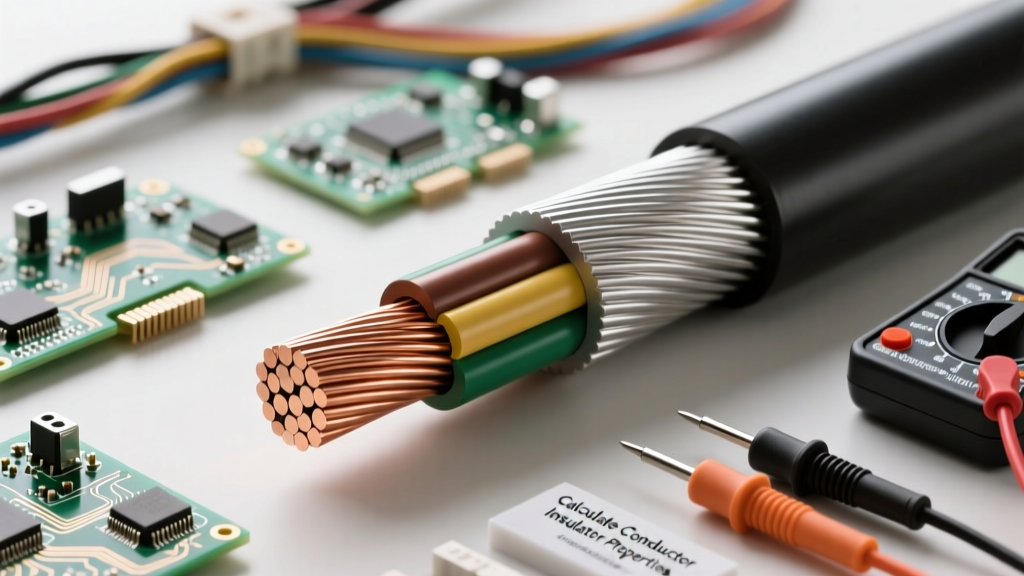
| Conductor Stranding | Solid or standard stranded (THHN) | Fine-stranded (Class K or Welding cable) for flexibility |
| Overcurrent Protection | AC-rated Thermal-Magnetic Breakers | DC-rated Fuses or specialized DC Breakers |
| Arc Extinguishing | AC zero-crossing naturally extinguishes arcs | DC arcs sustain; requires wider breaker gaps |
| Insulation Type | PVC / Nylon (THHN/THWN-2) | XLPE or UV-rated PV Wire for solar |
Note: Never use standard AC breakers on high-voltage DC solar arrays. The continuous nature of DC will draw an arc that an AC breaker cannot quench, leading to catastrophic melting.
The Crossover: Where AC and DC Meet in Modern Electronics
In modern DIY electronics, pure AC or pure DC systems are rare; most projects involve a crossover. The most common intersection is the Switching Mode Power Supply (SMPS). When you plug a 120V AC mains cord into your laptop or a 3D printer, an internal SMPS rectifies the AC to high-voltage DC, chops it at high frequencies (often >65 kHz) using a MOSFET, steps it down via a tiny high-frequency transformer, and rectifies it back to low-voltage DC.
Because of this high-frequency internal AC, SMPS units can suffer from Electromagnetic Interference (EMI). This is why DIYers building custom electronics enclosures must use shielded AC power entry modules with integrated EMI filters to prevent high-frequency AC noise from bleeding back into the grid or interfering with sensitive DC radio-frequency (RF) circuits.
Troubleshooting Common AC/DC Integration Failures
When working with mixed-signal or mixed-power environments, understanding the fundamental behaviors of AC waveforms helps diagnose elusive bugs.
- Ground Loops in Audio: If you are building a DIY audio amplifier powered by an AC-to-DC linear supply, a 60 Hz hum often indicates a ground loop. The AC magnetic field from the transformer induces a current in the DC ground shield. Fix this by implementing star-grounding topologies on your DC PCB layout.
- Solar Inverter Clipping: If your DC solar array voltage is too close to the AC inverter's maximum power point tracking (MPPT) window, thermal derating in the summer heat will drop the DC voltage below the inverter's threshold, causing the system to shut off prematurely. Always oversize your DC string voltage by 20% relative to the inverter's minimum startup voltage.
- Automotive Relay Chatter: Using an AC-rated relay to switch a high-inductance DC load (like a winch motor) will result in contact welding. The DC arc will pit and destroy the relay contacts in a matter of cycles. Always use heavy-duty DC contactors with arc chutes for automotive loads.
Final Thoughts on Current Selection
Mastering the applications of DC in renewable systems and the distribution benefits of AC mains power allows you to design safer, more robust projects. Always respect the unique wire sizing requirements, overcurrent protection rules, and physical behaviors of the current type you are working with. Whether you are pulling THHN through conduit for a 240V AC welder outlet or crimping fine-stranded copper lugs for a 48V DC battery bank, applying these real-world principles ensures your build will perform reliably for years to come.