
When beginners and seasoned electricians alike search for what are conductors and insulators of electricity, they usually find basic physics textbooks explaining electron flow and atomic valence bands. However, in the electrical trade, physics is only half the story. The other half is governed by strict legal and safety frameworks, primarily the National Electrical Code (NEC) and Underwriters Laboratories (UL) standards. From a Code & Standards perspective, a conductor is not just a metal that carries current; it is a highly regulated component with specific alloy requirements, ampacity ratings, and installation mandates. Similarly, an insulator is not merely a material that blocks electrons; it is a certified dielectric barrier tested for thermal endurance, chemical resistance, and mechanical toughness.
This guide bridges the gap between fundamental electrical theory and the rigorous code requirements that dictate how conductors and insulators are manufactured, selected, and installed in real-world electrical systems.
The Physics vs. The Code: Defining the Terms
To understand what are conductors and insulators of electricity in a practical sense, we must look at how the National Fire Protection Association (NFPA) defines them in NEC Article 100.
- Conductor: A material capable of carrying an electric current. In the NEC, this usually refers to copper, aluminum, or copper-clad aluminum wires, busbars, and cords.
- Insulation: A material or combination of materials that prevents the flow of electric current. The Code mandates that insulation must be suitable for the voltage, temperature, and environmental conditions of the installation.
- Covered Conductor: A crucial code distinction. A "covered" conductor has a dielectric wrapping that is not rated or tested as primary insulation. For example, bare overhead transmission wires wrapped in a thin weatherproof layer are "covered," not "insulated."
Code Insight: The NEC strictly differentiates between "insulated" and "covered." Working on a "covered" line requires the same safety protocols and PPE as working on a completely bare, energized conductor.
Conductor Materials: NEC Article 310 and the Aluminum Mandate
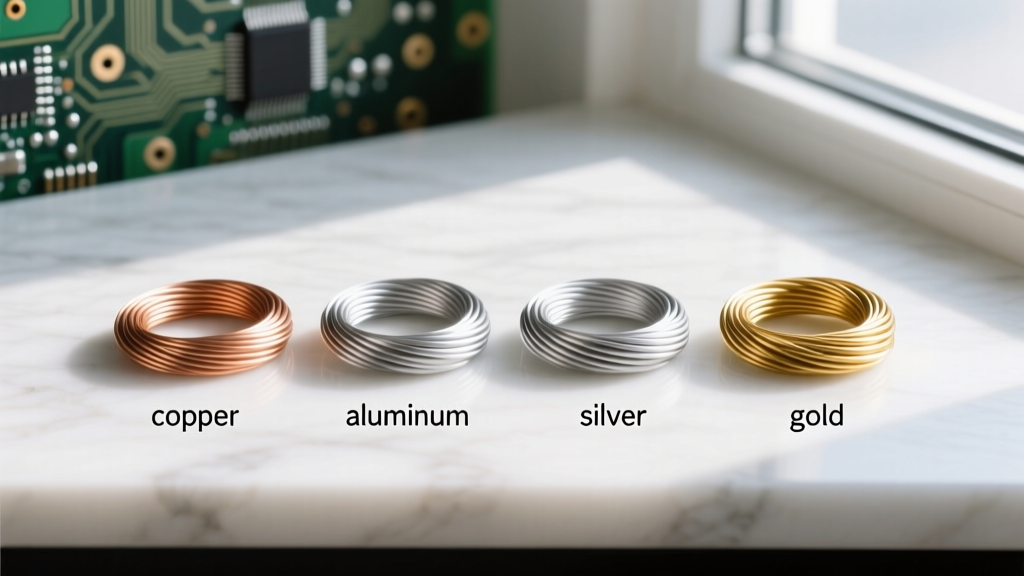
While silver and gold are superior conductors physically, the NEC and National Electrical Manufacturers Association (NEMA) standards primarily recognize copper and aluminum for building wire. However, the Code heavily regulates which types of these metals can be used.
The AA-8000 Series Requirement
In the 1960s and 1970s, a shortage of copper led to the widespread use of utility-grade aluminum (AA-1350) for residential branch circuits. This resulted in catastrophic failures. Aluminum expands and contracts at a different rate than copper and brass, and utility-grade aluminum suffered from "creep"—a slow deformation under pressure that caused terminations to loosen, arc, and start fires.
To answer the historical crisis of what are conductors and insulators of electricity when they fail in the field, the NEC was updated. Today, NEC Section 310.14 strictly mandates that solid or stranded aluminum conductors for branch circuits and feeders must be made of an AA-8000 series electrical grade aluminum alloy. This specific metallurgical formula includes iron and other trace elements that drastically reduce creep and improve termination stability.
| Conductor Material | NEC / UL Standard | Key Code Restriction & Application | Relative Conductivity (vs Copper) |
|---|---|---|---|
| Soft-Drawn Copper | UL 83, NEC 310.14 | Permitted for all branch, feeder, and service applications. Must be properly torqued. | 100% |
| AA-8000 Aluminum | UL 83, NEC 310.14 | Required for Al branch/feeder circuits. Requires anti-oxidant paste and specific lug ratings (CU/AL). | ~61% |
| Copper-Clad Aluminum | UL 83, NEC 310.14 | Must use aluminum-specific terminations. Cannot be mixed with pure copper in standard lugs. | ~63% |
Insulation Standards: UL 83, UL 44, and Letter Designations
Understanding what are conductors and insulators of electricity requires looking at the insulation jacket. Insulation is not a single material; it is a complex polymer system engineered to withstand specific thermal and electrical stresses. In North America, building wire insulation is primarily governed by two UL standards:
- UL 83: Standard for Thermoplastic-Insulated Wires and Cables (e.g., PVC, Nylon).
- UL 44: Standard for Thermoset-Insulated Wires and Cables (e.g., XLPE, EPR).
Decoding THHN and XHHW-2
The NEC uses a letter designation system to classify insulation properties. Let us break down the two most common building wires to understand their material science:
- THHN (Thermoplastic, High Heat, Nylon-coated): The PVC base provides excellent dielectric strength, while the thin nylon jacket offers superior mechanical protection against abrasion during wire pulling. However, nylon is highly susceptible to degradation when exposed to certain chemicals, oils, and prolonged moisture.
- XHHW-2 (Cross-linked Polyethylene, High Heat, Water-Resistant): This is a thermoset insulation. Through a chemical or irradiation process, the polyethylene molecules are cross-linked, creating a 3D molecular bond. XHHW-2 has a higher dielectric strength than THHN, superior water resistance, and does not melt when exposed to a soldering iron or extreme short-circuit temperatures.
Dielectric Strength and Field Failure Modes
When evaluating what are conductors and insulators of electricity, electrical engineers look at dielectric strength—the maximum electric field an insulator can withstand before it breaks down and becomes conductive. This is measured in Volts per mil (V/mil).
Standard 600V THHN wire has a dielectric strength of roughly 400 to 500 V/mil. If an installer strips a wire and accidentally nicks the insulation with a wire stripper, the remaining dielectric thickness may drop below the safety threshold for transient voltage spikes, leading to corona discharge or insulation tracking.
NETA Testing and Insulation Resistance
The InterNational Electrical Testing Association (NETA) sets the standard for field-testing insulation. Using a Megohmmeter (Megger), technicians apply high DC voltage (e.g., 500V or 1000V) to measure the resistance of the insulation. According to NETA Acceptance Testing Specifications (ATS), a standard 600V building wire should ideally read well over 100 Megohms. Readings dropping below 1 Megohm indicate moisture ingress, thermal degradation, or physical damage, requiring immediate replacement before energization.
The Gray Area: Grounding and Shielding
The intersection of conductors and insulators becomes fascinating when examining grounding and medium-voltage systems.
Equipment Grounding Conductors (EGC)
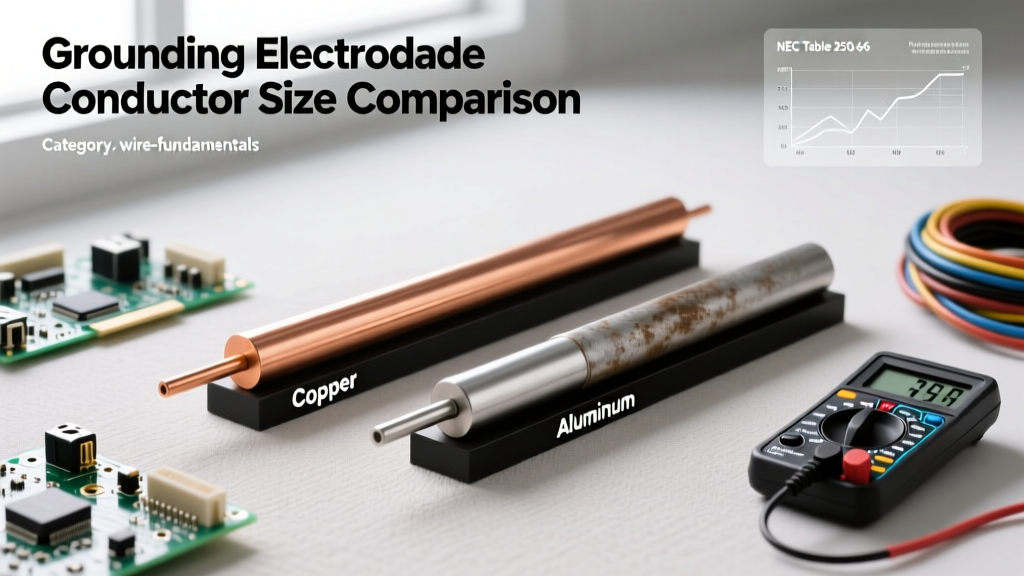
Under NEC Article 250, an Equipment Grounding Conductor does not carry current under normal operating conditions. Therefore, the Code allows EGCs to be bare, covered, or insulated. However, if an installer chooses to use an insulated grounding conductor, the Code strictly mandates that the insulation must be continuous green, or green with one or more yellow stripes. This prevents the dangerous scenario of a grounded conductor (neutral) being misidentified as a ground due to identical white or gray insulation.
Semiconducting Shields in Medium Voltage
In cables rated above 2,000 volts (NEC Article 310), the concept of "what are conductors and insulators" blurs. Medium-voltage cables utilize semiconducting shields layered directly over the conductor and under the metallic shield. These shields are neither pure conductors nor pure insulators. They are formulated with carbon black to have a specific, controlled electrical resistance. Their purpose is to smooth out the electrical field gradient, preventing localized high-stress points that would otherwise cause the primary XLPE insulation to fail via electrical treeing.
Summary: Compliance is the Ultimate Safety Factor
Ultimately, answering what are conductors and insulators of electricity from a professional standpoint means recognizing that materials are only as safe as their compliance with recognized testing standards. A copper wire is just a piece of metal until it is drawn, annealed, and tested to ASTM and UL specifications. Similarly, a plastic jacket is just a polymer until it passes the rigorous flame, crush, and dielectric tests outlined in UL 83 and the NEC. Always verify the UL listing mark and the specific letter designations on your wire to ensure the materials match the environmental and electrical demands of your specific installation.