
When DIYers and apprentice electricians ask, 'how does alternating current work,' they are usually looking for a basic explanation of a sine wave or a generator. However, from a safety and practical wiring perspective, understanding alternating current (AC) requires a much deeper dive into peak voltages, frequency-driven biological hazards, and the physical behavior of electrons in a conductor. Unlike direct current (DC), which flows steadily in one direction, AC constantly reverses direction, creating unique hazards and wiring requirements that can be lethal if misunderstood.
The Physics of AC: Beyond the Basic Sine Wave
To truly grasp AC safety, you must first understand that the voltage printed on your electrical panel is not the maximum voltage the wire is actually handling. In North America, standard residential outlets are rated for 120V AC. This is the Root Mean Square (RMS) voltage, a mathematical average that delivers the equivalent heating power of 120V DC. However, the actual sine wave peaks much higher.
The peak voltage of a standard 120V AC circuit is approximately 169.7V (calculated as 120V × √2). For a 240V circuit, the peak voltage reaches nearly 340V. This distinction is critical for safety and component selection. Insulation breakdown, arc flash potential, and the dielectric strength of capacitors must be rated for the peak voltage, not just the RMS voltage. Using a component rated strictly for 120V DC on a 120V AC line can result in catastrophic failure, as the insulation will be subjected to 170V peaks 120 times every second.
The Zero-Crossing Point and Arc Extinction
A fundamental characteristic of how alternating current works is the 'zero-crossing' point. Because the 60Hz sine wave crosses the zero-voltage line 120 times per second, AC arcs naturally tend to extinguish at these zero points. This is why AC circuit breakers are designed differently than DC breakers. DC arcs, having no zero-crossing, will sustain a continuous plasma channel that can melt breaker contacts and cause fires if not interrupted by specialized magnetic blowouts or arc chutes. When working on AC panels, you must still treat every exposed busbar as a severe arc flash hazard, but understanding this zero-crossing behavior explains why AC breakers can safely interrupt massive fault currents in milliseconds.
Why AC is More Lethal Than DC: The Biological Impact
The 60Hz frequency of North American AC power is notoriously dangerous to the human body. According to the Occupational Safety and Health Administration (OSHA), the alternating nature of the current causes rapid, repeated muscle contractions. This frequency perfectly overlaps with the human nervous system's electrical signaling, leading to a phenomenon called tetany.
When a person grasps an energized AC conductor, the tetanic muscle contractions force the hand to close tighter around the wire, making it impossible to let go. This 'let-go' threshold is significantly lower for AC than for DC. Furthermore, AC is far more efficient at inducing ventricular fibrillation (a fatal disruption of the heart's rhythm) than equivalent levels of DC.
| Current (60Hz AC) | Physiological Effect | Safety Consequence |
|---|---|---|
| 0.5 - 1 mA | Perception threshold | Mild tingling; often ignored by DIYers, leading to complacency. |
| 5 - 10 mA | Pain and mild shock | Involuntary reflex reactions; risk of secondary falls from ladders. |
| 10 - 20 mA | 'Let-Go' threshold | Sustained muscle tetany; victim cannot release the conductor. |
| 50 - 100 mA | Ventricular fibrillation | Heart rhythm disrupted; fatal without immediate defibrillation. |
| > 1000 mA | Cardiac arrest and burns | Severe internal tissue burning; heart may stop completely. |
The NFPA 70E standard mandates strict approach boundaries and personal protective equipment (PPE) precisely because these milliamp thresholds are easily breached when working on standard 120V or 240V residential circuits, especially in damp conditions where skin resistance drops from 100,000 ohms to under 1,000 ohms.
The 'Skin Effect' and Wiring Safety Implications
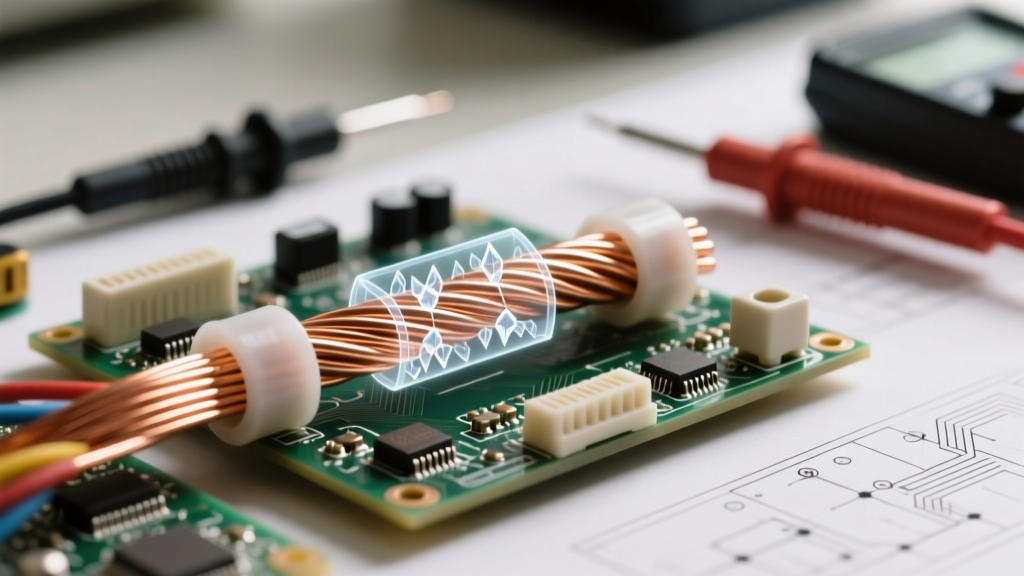
When analyzing how alternating current works within a copper or aluminum conductor, we must account for the 'skin effect.' Because AC generates a constantly changing magnetic field, it induces eddy currents within the wire itself. These eddy currents cancel out the flow of electrons in the center of the conductor and reinforce them at the outer edge.
At 60Hz, the skin effect is negligible for standard residential wiring (14 AWG through 2 AWG). However, when sizing large feeder wires for subpanels or industrial equipment (e.g., 250 kcmil to 750 kcmil), the center of the solid conductor carries almost no current. This effectively reduces the cross-sectional area of the wire, increasing its AC resistance compared to its DC resistance. To mitigate this, electrical codes require the use of stranded conductors, or even hollow tubing, for massive amperage feeds. For DIYers, this means you should never attempt to parallel multiple small solid wires to replace a single large stranded feeder; the proximity effect and unequal impedance can cause one wire to carry the vast majority of the load, leading to thermal melting and fire.
Critical Safety Protocols for AC Circuit Troubleshooting
Because AC relies on electromagnetic fields and capacitive coupling, troubleshooting requires specialized tools and an understanding of 'phantom voltages.' A common mistake DIYers make is relying solely on Non-Contact Voltage Testers (NCVTs). While useful, NCVTs detect the capacitive electric field surrounding an AC wire. In multi-conductor cables (like 14/3 Romex), an energized black wire can induce a phantom voltage on the adjacent, disconnected red wire. An NCVT will beep, falsely indicating the red wire is live. Always verify with a hard-wired meter.
Multimeter CAT Ratings for AC Mains
When measuring AC voltage, the internal architecture of your multimeter is your last line of defense against an arc flash explosion inside your hands. You must use a meter with the correct Overvoltage Installation Category (CAT) rating:
- CAT II: Safe for single-phase receptacle loads (appliances, portable tools). Do not use at the main panel.
- CAT III: Required for three-phase distribution, single-phase commercial lighting, and the load side of your main residential breaker panel.
- CAT IV: Mandatory for the line side of the main service entrance, outdoor meter bases, and utility drop connections.
Using a CAT II rated meter to probe a 240V main breaker busbar can result in a catastrophic internal meter short, causing a plasma blast. Always use a high-impedance, independently verified meter, such as the Fluke 87V (rated CAT III 1000V / CAT IV 600V), and inspect the probe insulation for micro-tears before every use.
Expert Safety Warning: Never assume a circuit is dead based on the position of a wall switch or a tripped breaker. Switches only break the 'hot' leg. If the neutral and hot are reversed in the panel (a common wiring error in older homes), the switch breaks the neutral, leaving the fixture fully energized at 120V peak-to-ground, even when the light is off. Always test before you touch.
Grounding and Bonding: Your Primary AC Defense
Because AC systems are referenced to ground (the utility transformer center-taps the neutral and bonds it to a grounding rod), the earth itself becomes a part of the circuit's fault path. The Equipment Grounding Conductor (EGC)—the bare copper or green wire in your Romex—does not carry current during normal operation. Its sole purpose is to provide a low-impedance path back to the source to facilitate the instantaneous operation of the overcurrent protective device (the breaker).
If a loose hot wire touches a metal appliance chassis, the EGC creates a dead short. This massive surge of AC fault current (often hundreds of amps) generates a magnetic field inside the breaker that trips the mechanical latch in under 1/60th of a second. If the EGC is missing, improperly bonded, or replaced with a high-impedance path, the metal chassis remains energized at 120V RMS. The next person to touch the appliance while standing on a grounded surface completes the circuit, subjecting their heart to the lethal 60Hz AC frequencies detailed in the table above. Understanding the mechanics of AC is not just an academic exercise; it is the foundational knowledge required to wire systems that protect human life.