
Decoding the Rheem AC Wiring Diagram: A 2026 Technical Reference
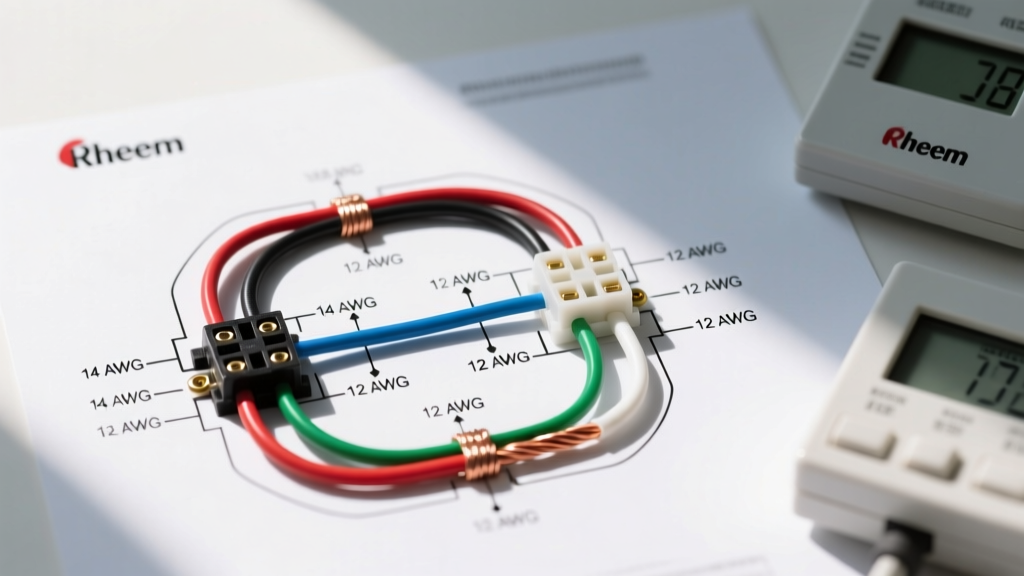
Reading a wiring diagram for Rheem air conditioner systems requires more than just matching colors; it demands a strict understanding of Minimum Circuit Ampacity (MCA), Maximum Overcurrent Protection (MOCP), and proprietary communicating protocols. Whether you are installing a standard Rheem Classic Plus (RA16) single-stage unit or a cutting-edge Rheem Prestige (RP17) variable-speed inverter system, the electrical infrastructure must be sized precisely to prevent contactor degradation, voltage drop, and control board failures.
This guide serves as a comprehensive wire gauge and color code reference, bridging the gap between the manufacturer's schematic and the National Electrical Code (NEC) Article 440 requirements for HVAC installations.
High-Voltage Power Supply: Wire Gauge Sizing by Tonnage
The high-voltage circuit (208/230V single-phase) powers the compressor and the outdoor fan motor. Sizing this wire incorrectly is the leading cause of premature compressor burnout in residential installations. Rheem units specify two critical metrics on the data plate: MCA (Minimum Circuit Ampacity) and MOCP (Maximum Overcurrent Protection or Max Fuse Size).
The MCA vs. MOCP Sizing Rule
A common and dangerous mistake is sizing the wire based on the breaker size (MOCP). According to the NEC and U.S. Department of Energy HVAC guidelines, you must size the wire to handle the MCA, but you must also ensure the wire's ampacity rating is not exceeded by the MOCP breaker. If the MOCP is 30A, you cannot use 12 AWG wire (rated for 20A), even if the MCA is only 19A. You must step up to 10 AWG to safely handle the 30A breaker's trip threshold.
| Unit Tonnage | Rheem Series Example | Typical MCA | Typical MOCP | Required Copper Wire Gauge (THHN/THWN) | Breaker Size |
|---|---|---|---|---|---|
| 1.5 Ton | RA14 / RA16 | 11.5A | 15A | 14 AWG (12 AWG recommended for long runs) | 15A Double-Pole |
| 2.0 Ton | RA16 | 14.2A | 20A | 12 AWG | 20A Double-Pole |
| 3.0 Ton | RA16 / RP17 | 19.8A | 30A | 10 AWG | 30A Double-Pole |
| 4.0 Ton | RP17 / RA20 | 24.5A | 40A | 8 AWG | 40A Double-Pole |
| 5.0 Ton | RA20 | 31.0A | 50A | 6 AWG | 50A Double-Pole |
Expert Insight: For variable-speed inverter models like the Rheem RP17, the MCA is often lower than equivalent single-stage units due to soft-start technology. However, always default to the exact data plate on the specific condenser you are installing, as coil combinations and SEER2 ratings alter the electrical draw.
Low-Voltage Control Wiring: Thermostat Color Codes
The low-voltage circuit (24VAC) controls the relays, contactors, and reversing valves. Standard HVAC installations use 18 AWG solid copper wire. For standard single-stage or two-stage Rheem units, a standard 5-conductor (18/5) or 8-conductor (18/8) cable is used.
Standard 24VAC Color Code Matrix
| Terminal | Standard Wire Color | Function | Rheem Specific Notes |
|---|---|---|---|
| R / Rc / Rh | Red | 24VAC Hot (Power) | Supplied by the indoor air handler or furnace transformer. |
| C | Blue or Black | 24VAC Common | Required for smart thermostats and Rheem EcoNet modules. |
| Y / Y1 | Yellow | Compressor Contactor | Energizes the outdoor contactor coil for cooling. |
| Y2 | Light Blue | Second Stage Cooling | Used on two-stage models (e.g., RA17) for high-stage compressor activation. |
| G | Green | Indoor Blower Fan | Controls the indoor ECM or PSC blower motor relay. |
| W / W1 | White | Primary Heat | Used for heat pump defrost or auxiliary electric/gas heat. |
| O/B | Orange | Reversing Valve | Rheem/Ruud heat pumps typically energize the reversing valve in Heating (B), unlike most other brands that energize in Cooling (O). |
Rheem EcoNet Communications: A Different Paradigm
If you are wiring a modern Rheem Prestige series system equipped with the EcoNet communicating control system, standard color codes and star-topology wiring do not apply. EcoNet uses a digital data bus to allow the thermostat, air handler, and condenser to communicate bidirectionally.
EcoNet Wiring Requirements
- Cable Type: 18 AWG shielded, twisted-pair cable (often 3-conductor or 4-conductor). Shielding is mandatory to prevent Electromagnetic Interference (EMI) from the inverter drive.
- Topology: Strict Daisy-Chain (dual-path) wiring. Star or T-splice wiring will cause data packet collisions and result in 'Device Not Found' error codes on the thermostat.
- Terminals: EcoNet uses R (24VAC Power), C (Common), and D (Data). Some newer 2025/2026 control boards utilize a 4-wire setup (R, C, D1, D2) for redundancy.
According to the National Electrical Manufacturers Association (NEMA) standards for digital control signals in high-EMI environments, the shield wire must be grounded at one end only (typically at the indoor control board) to prevent ground loops that can fry the transceiver chips.
Step-by-Step: Wiring the Outdoor Disconnect Box
The NEC requires a lockable, readily accessible disconnect switch within sight of the outdoor condenser. Here is the professional sequence for wiring a 60A non-fused pull-out disconnect box:
- Mount the Box: Secure the NEMA 3R-rated disconnect box to the exterior wall or a pressure-treated post within 6 feet of the condenser.
- Pull the Feeder: Run the appropriately sized THHN/THWN wires (e.g., 10 AWG for a 3-ton unit) through liquid-tight flexible metallic conduit (LFMC) or PVC from the main panel to the disconnect.
- Line Side Termination: Connect the incoming L1 and L2 hot wires from the main breaker to the 'LINE' terminals on the disconnect block. Connect the bare copper ground to the grounding bus bar.
- Load Side Termination: Connect the outgoing wires to the 'LOAD' terminals. These will route through the conduit directly into the condenser's control panel.
- Condenser Whip: Use a pre-assembled, UV-rated LFMC 'whip' (usually 6 feet) to bridge the gap between the disconnect and the condenser, allowing for vibration isolation and service movement.
Common Wiring Mistakes and Failure Modes
Even with the correct wiring diagram for a Rheem air conditioner, field errors lead to specific, predictable failures:
- Blown 3A or 5A Control Board Fuse: This almost always occurs when the 'Y' (compressor) and 'C' (common) wires short together in the thermostat cable, or if the wire is pinched under the condenser sheet metal. Always check the low-voltage wiring path for sharp metal edges.
- Contactor Chatter and Pitting: If the 24VAC control wire is run parallel to the 230V high-voltage wire over a long distance without separation, inductive voltage drop can cause the contactor coil to receive less than 18VAC. This results in the contactor 'chattering' (rapidly opening and closing), which will pit the contacts and weld them shut within a single season.
- Reversing Valve Stuck in Cooling (Heat Pump): As noted, Rheem heat pumps typically use the 'B' terminal to energize the reversing valve for heating. If a technician wires it to 'O' (the standard for Trane/Carrier), the system will cool when heat is called, and vice versa.
Frequently Asked Questions
Can I use aluminum wire for a Rheem condenser?
While aluminum wire (like 8 AWG AL) is sometimes used for large 5-ton units to save money, it is highly discouraged for residential HVAC. The vibration of the condenser can cause aluminum wire to loosen at the lugs over time, leading to arcing and melted disconnect blocks. Always use copper THHN/THWN.
What size wire do I need for a 50-foot run to a 3-ton Rheem unit?
For a standard 3-ton unit (MCA ~20A, MOCP 30A), 10 AWG copper is standard. However, if the one-way wire run exceeds 75 feet, you should upsize to 8 AWG copper to keep the voltage drop below the 3% threshold recommended by the NEC for branch circuits, ensuring the compressor receives adequate voltage during startup.
Does the EcoNet system require a separate high-voltage connection?
Yes. The EcoNet communicating cable only carries 24VAC power and digital data signals. The outdoor inverter condenser still requires a dedicated 208/230V high-voltage circuit sized to the unit's specific MCA and MOCP data plate ratings.