
The Metallurgy of Low-Temperature Jewelry Repair
In the realm of fine metalsmithing, traditional hard silver soldering (brazing at temperatures exceeding 700°C) is the undisputed standard for structural integrity. However, advanced soft soldering jewelry techniques—operating strictly below 400°C—are an indispensable, highly specialized skill set. This low-temperature approach is critical when repairing electroplated vintage components, assembling mixed-metal steampunk architectures, or performing micro-repairs around severely heat-sensitive gemstones like opals, turquoise, amber, and emeralds.
Unlike electronics assembly, where components are secured to fiberglass PCBs, jewelry soldering requires navigating high thermal conductivity metals (like sterling silver and copper) while managing strict aesthetic and skin-safety requirements. According to metallurgical guidelines tracked by IPC J-STD-006 and jewelry manufacturing standards, the shift away from lead-based solders in jewelry is absolute due to skin-contact toxicity regulations like California Prop 65 and EU REACH. Therefore, modern advanced soft soldering relies entirely on specialized tin-based eutectic alloys.
Advanced Alloy Selection: Beyond Basic 60/40
The traditional 60/40 (Tin/Lead) solder is obsolete in modern jewelry studios. Advanced practitioners utilize specific lead-free alloys engineered for high tensile strength, tarnish resistance, and precise melting profiles. Selecting the correct alloy dictates the success of the repair and the survivability of the gemstone.
| Alloy Designation | Composition | Melting Point | Tensile Strength | Best Jewelry Application | Approx. Cost (2026) |
|---|---|---|---|---|---|
| SAC305 | Sn96.5 / Ag3.0 / Cu0.5 | 217°C (423°F) | 45 MPa | High-strength bezel repairs, silver findings | $48 / lb |
| Sn42/Bi58 | Tin 42% / Bismuth 58% | 138°C (280°F) | 38 MPa | Ultra-low temp repairs on amber/opal | $65 / lb |
| Sn96/Ag4 | Tin 96% / Silver 4% | 221°C (430°F) | 41 MPa | Copper foil jewelry, filigree, mixed metals | $52 / lb |
Expert Edge Case: While Sn42/Bi58 (Bismuth) offers an incredibly low melting point perfect for amber, bismuth alloys are inherently brittle. They must never be used on structural, load-bearing joints like ring shanks or heavy clasp attachments. Reserve them strictly for pendant bails, lightweight earring posts, and decorative bezel closures.
Precision Thermal Management for Delicate Gems
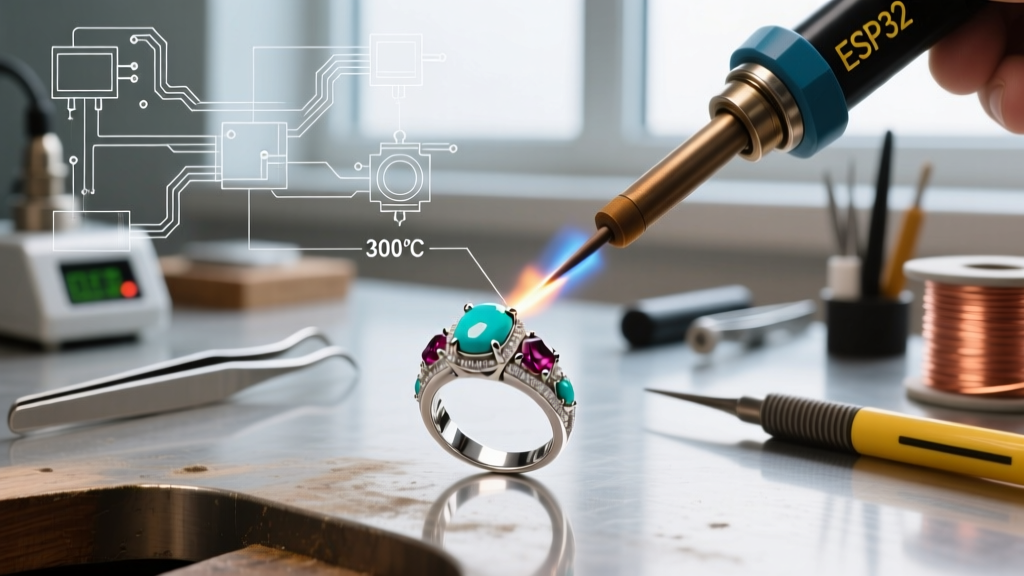
Heat-sensitive stones do not merely melt; they fracture due to thermal shock, lose their internal water content (causing opals to craze), or undergo irreversible chemical color shifts (as seen in turquoise). Protecting these stones requires aggressive thermal sinking and precise heat localization.
- Thermal Mass Sinking: Use cross-locking titanium tweezers (such as the Swanstrom STT-104, retailing around $45). Titanium has a significantly lower thermal conductivity than steel, meaning the tweezers will draw heat away from the joint and act as a localized heat sink without burning your fingers.
- Chemical Heat Shields: Apply a thick layer of water-based heat shield paste (e.g., Rio Grande Heat Shield) directly over the gemstone and the immediate bezel wall. This paste absorbs latent heat as its water content boils off at 100°C, creating a thermal buffer.
- Pre-Heating Dynamics: To prevent thermal shock, gently pre-heat the entire jewelry piece using a warm air gun set to 80°C before introducing the 220°C soldering iron. This reduces the thermal gradient (ΔT) across the stone.
Step-by-Step: Bezel Repair on an Opal Cabochon
Repairing a lifted bezel wall on an opal requires speed, precision, and the right tooling. A standard 40W iron will suffer thermal collapse when touching sterling silver. We recommend a station like the Hakko FX-951 ($280 range), which uses T12 cartridge tips where the heater and sensor are integrated, offering 200ms thermal recovery.
- Mechanical Preparation: Use a 600-grit silicon carbide sanding stick to lightly abrade the inside of the lifted bezel wall and the base plate. Silver oxide prevents wetting; mechanical removal is mandatory.
- Chemical Fluxing: Apply a micro-drop of Rubyfluid or Stay-Clean liquid flux using a fine sable brush. Do not flood the joint; capillary action will pull the flux where it is needed.
- Thermal Sinking: Clamp your titanium cross-locking tweezers exactly 2mm away from the repair joint, directly between the joint and the opal. Apply heat shield paste to the stone.
- Capillary Delivery: Set the Hakko FX-951 to 260°C using a micro-chisel tip (T12-D12). Touch the iron to the joint for exactly 1.5 seconds to bring the silver to temperature.
- Solder Feeding: Introduce 0.5mm Sn96/Ag4 wire to the joint, not the iron tip. The moment the solder flashes and flows via capillary action, remove the iron. Total dwell time must remain under 3 seconds.
Expert Insight: Never use standard electronics rosin flux (RMA) on sterling silver or gold-filled components. The activated rosin residues polymerize under high heat and trap microscopic oxidation, leading to 'black joint' syndrome that is impossible to polish out without aggressive mechanical abrasion. Always use water-soluble acid fluxes formulated for precious metals.
Surface Tension and Wetting Dynamics
Advanced soft soldering jewelry relies heavily on understanding surface tension. Silver and copper oxidize rapidly when heated. If your flux burns off before the solder flows, the surface tension of the molten alloy will cause it to ball up rather than wet the surface. This is known as 'de-wetting.' To combat this, always use an active flux that matches your operating temperature, and ensure your soldering iron tip is tinned and free of carbon buildup. Wiping the tip on a damp cellulose sponge (never brass wool, which can cool the tip too rapidly and cause micro-fractures in the iron plating) immediately before touching the joint is a non-negotiable habit.
Troubleshooting Advanced Failure Modes
Even with premium equipment, low-temperature jewelry repairs present unique failure modes. Here is how to diagnose and correct them:
- Capillary Starvation (Bulky Joints): The joint looks like a blob rather than a seamless seam. Cause: The iron temperature was too low, or the solder wire diameter was too thick, preventing capillary draw. Fix: Increase tip temp by 15°C and switch to a 0.3mm diameter solder wire.
- Cold Fracture Lines: A visible, dull, crystalline line appears in the solder bead upon cooling. Cause: The joint was disturbed during the plastic (pasty) phase of the alloy's cooling curve, common in non-eutectic alloys. Fix: Use strictly eutectic alloys (like Sn42/Bi58) which transition instantly from liquid to solid, eliminating the plastic phase. Ensure the piece is locked in a third-hand jig.
- Plating Burn-Off: Gold or rhodium plating adjacent to the joint blisters or peels. Cause: Thermal bleed. Fix: You failed to use a physical heat sink (tweezers) or exceeded a 4-second dwell time. Switch to a lower temperature Bismuth alloy and increase flux volume to accelerate wetting.
Post-Soldering Cleanup and Passivation
Because advanced soft soldering jewelry requires mildly acidic, water-soluble fluxes to achieve proper wetting on precious metals, post-soldering cleanup is critical to prevent long-term galvanic corrosion. Do not simply wipe the piece. Submerge the jewelry in an ultrasonic cleaner filled with warm distilled water (50°C) and a single drop of pH-neutral dish soap for exactly 4 minutes. This cavitation process will violently eject microscopic flux residues from the capillary seams. For mixed-metal pieces containing copper or brass, follow this with a quick dip in a mild sodium bicarbonate (baking soda) bath to neutralize any lingering acid, then dry immediately with compressed air to prevent water spots.
Sources and Further Reading
For continuous education on metallurgy and advanced bench techniques, consult the following authoritative resources:
- Ganoksin - The premier online community and technical library for jewelry makers, featuring extensive archives on low-temperature soldering and gemstone protection.
- IPC J-STD-006 - The global standard defining the exact chemical compositions and melting profiles of electronic and precision solder alloys.
- Hakko Corporation - Technical documentation on thermal recovery rates and T12 cartridge tip geometry for precision micro-soldering.