
The Thermodynamics of SMD Rework: Why Airflow Matters as Much as Heat
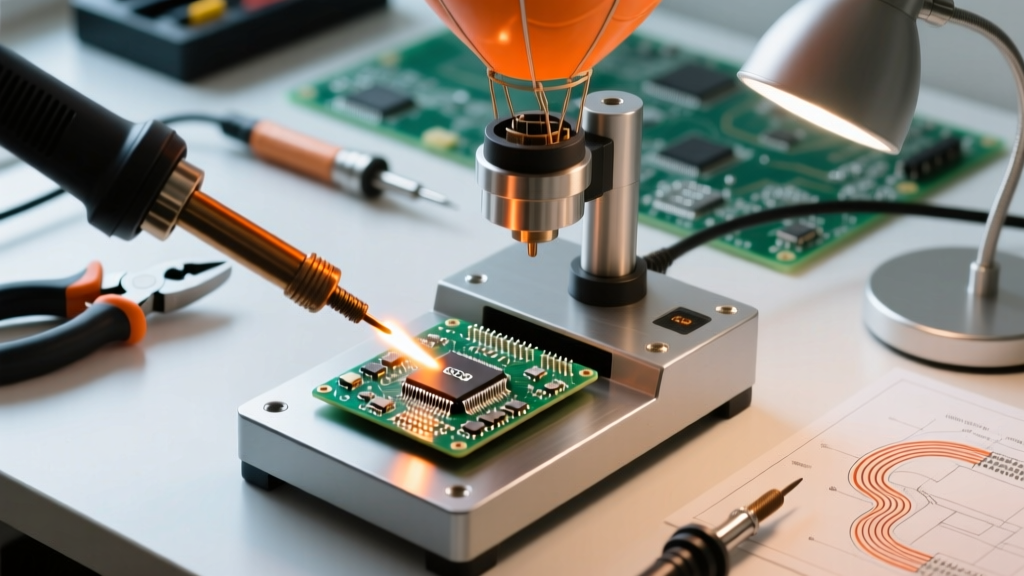
When technicians search for the ideal hot air gun temperature for soldering, they often fall into the trap of treating the station's digital readout as an absolute truth. In reality, convective heat transfer in SMD rework is a complex interplay of thermal mass, airflow volume (L/min), and nozzle proximity. A dial set to 380°C does not mean your PCB pad reaches 380°C; it simply means the air leaving the nozzle is at that temperature. By the time that air crosses the 10mm gap to the board, it loses significant thermal energy to the ambient environment.
Furthermore, the thermal mass of modern high-density interconnect (HDI) boards acts as a massive heat sink. A 6-layer board with internal copper ground planes will pull heat away from a QFN pad much faster than a 2-layer flex PCB. Therefore, mastering hot air rework in 2026 requires understanding that temperature is only half the equation; airflow and dwell time complete the thermal profile.
Hot Air Gun Temperature for Soldering: The 2026 Master Chart
The transition to lead-free alloys like SAC305 (melting point 217°C–220°C) in commercial electronics demands higher nozzle temperatures and tighter thermal control than legacy Sn63/Pb37 (183°C). Below is the definitive reference matrix for setting your hot air rework station, based on current industry standards and component thermal limits.
| Component / Task | Target Nozzle Temp | Airflow Rate | Preheat Required? | Est. Dwell Time |
|---|---|---|---|---|
| 0402 / 0603 MLCCs (Leaded) | 320°C | 20 - 25 L/min | No | 3 - 5 seconds |
| QFP / QFN (SAC305 Lead-Free) | 360°C - 380°C | 35 - 45 L/min | Recommended | 10 - 15 seconds |
| BGA / CSP (Lead-Free) | 380°C - 400°C | 50 - 60 L/min | Mandatory (150°C) | 45 - 90 seconds |
| Through-Hole Desoldering | 380°C | 40 L/min | No | 5 - 8 seconds/pin |
| Heat Shrink / Wire Insulation | 180°C - 200°C | 60+ L/min | No | Until flush |
Top Hot Air Rework Stations Reviewed for Precision Temperature Control
Not all stations deliver the heat they promise. Budget units often suffer from severe thermal lag, where the PID controller overshoots the target temperature during low-airflow settings, risking component damage. Here is how the top contenders in the 2026 market stack up.
Quick 861DW: The Benchmark for Mid-Range Precision
Price Range: $240 - $270
Power: 1000W
Pump Type: Brushless Fan
The Quick 861DW remains the undisputed king of the prosumer and mid-tier repair market. Its 1000W heating element paired with a brushless blower motor provides immediate thermal recovery. When you lower the nozzle to a massive ground plane, the closed-loop sensor detects the temperature drop and ramps the heater instantly without overshooting. The digital airflow control (1-120 L/min) is exceptionally smooth, preventing the 'blowing away' of 0402 resistors that plagues cheaper diaphragm pump stations.
Hakko FR-830: The High-Volume Production Workhorse
Price Range: $450 - $500
Power: 700W
Pump Type: Brushless Blower
For production environments and advanced BGA rework, the Hakko FR-830 is a staple. While its 700W element might seem lower than the Quick, Hakko's thermal efficiency and nozzle design focus heat directly onto the target area with minimal dissipation. According to Hakko's official global portal, the FR-830 features a digital airflow meter and a robust auto-cooling function that extends the life of the heating element by ensuring it never sits at idle temperatures for extended periods. It is an investment for those doing daily, high-stakes SMD rework.
Yihua 8786D: The Budget Hobbyist Compromise
Price Range: $60 - $80
Power: 700W (Combined with iron)
Pump Type: Diaphragm (Vibration)
The Yihua 8786D is ubiquitous in beginner kits, but it comes with severe thermodynamic compromises. It uses a diaphragm pump, which pushes air in rapid pulses rather than a continuous stream. This results in uneven heat distribution and a distinct vibration that can shift components if the air pressure is set too high. Furthermore, the thermal sensor is located deep inside the handpiece, meaning the actual nozzle temperature can lag behind the digital display by up to 15 seconds. It is acceptable for basic heat shrink and large SOIC chips, but highly discouraged for fine-pitch QFNs or BGAs.
Critical Failure Modes: What Happens When Your Calibration is Off
Ignoring the precise hot air gun temperature for soldering leads to catastrophic, often irreversible board damage. Understanding these failure modes is critical for passing IPC-7711/7721 rework standards.
- Pad Cratering and Lifting: FR4 fiberglass has a Glass Transition Temperature (Tg) typically between 130°C and 180°C. If you apply 400°C air for too long without adequate airflow to distribute the heat, the substrate softens, and the copper adhesion fails. When you remove the IC, the pads rip out of the board.
- The Popcorn Effect: Moisture trapped inside the epoxy casing of ICs turns to steam at 217°C. If the board hasn't been baked or preheated properly, the rapid steam expansion cracks the silicon die or delaminates the package. This is heavily documented in JEDEC moisture sensitivity standards and NASA-STD-8739.3 workmanship requirements.
- Tombstoning: When reworking small passives like 0402 capacitors, applying hot air from a single direction causes one pad's solder to reflow before the other. The surface tension of the molten solder pulls the component upright, standing it on its end like a tombstone.
Buying Guide: Specifying Your Next Hot Air Station in 2026
If you are upgrading your lab, evaluate potential purchases against this strict criteria checklist:
- Sensor Placement: Ensure the thermocouple is located as close to the nozzle tip as possible. Internal handpiece sensors are a hallmark of budget, inaccurate units.
- Brushless vs. Diaphragm: Always choose a brushless fan for SMD work. The laminar airflow prevents micro-components from being blown off the board and ensures even thermal distribution.
- Nozzle Ecosystem: Verify that the station supports a wide variety of nozzles (e.g., 4mm for spot heating, 12mm for QFPs, and custom BGA shields). Proprietary, hard-to-find nozzles will bottleneck your repair capabilities.
- Auto-Cooling / Sleep Modes: High-end stations automatically drop the temperature to 150°C and reduce airflow when the handpiece is placed in the cradle, saving the heating element from premature oxidation.
Expert Insight: Never rely solely on the hot air gun for large BGA rework. Always pair your hot air station with a dedicated PCB preheater (like an Axiom or Puhui IR bed) set to 130°C. This reduces the thermal delta between the board and the nozzle, allowing you to use lower hot air temperatures (e.g., 340°C instead of 400°C), virtually eliminating the risk of pad lifting and substrate scorching.
Expert FAQ on Hot Air Rework Thermodynamics
Why does my solder melt on the edges of a QFN but not in the center?
This is a classic symptom of insufficient thermal mass penetration. The center ground pad of a QFN is usually tied to a massive internal copper plane. The hot air is heating the perimeter leads, but the center plane is acting as a heat sink, keeping the center solder below its liquidus point. You must increase your airflow (to push more thermal energy into the board) or utilize a PCB preheater to saturate the board's thermal mass before applying the hot air gun.
Can I use a standard heat gun for electronics soldering?
Absolutely not. Standard hardware store heat guns operate at 500°C+ with massive, unshrouded airflow. They lack localized nozzles, closed-loop PID temperature control, and the fine airflow adjustments required. Using one will instantly melt plastic connectors, scorch the FR4 substrate, and destroy sensitive silicon dies via thermal shock.