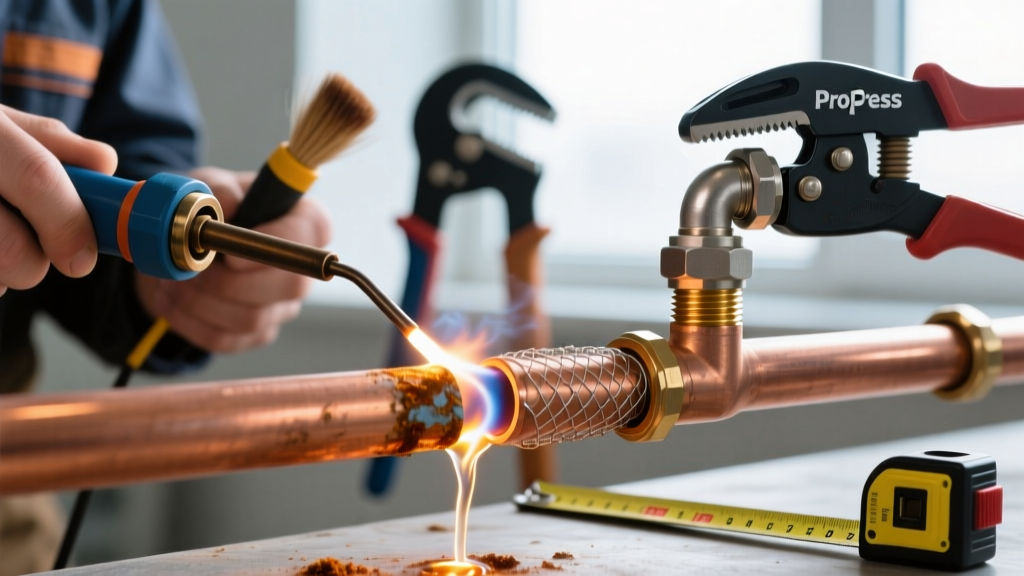

The Anatomy of a Copper Pipe Leak: Choosing Your Repair Method
Discovering a pinhole leak or a weeping joint in your home's copper plumbing is a homeowner's nightmare. The immediate instinct is to grab a torch and fix it, but the reality of modern plumbing offers multiple divergent paths. When you are faced with the task of soldering a leaking copper pipe, you are actually making a critical decision about tool investment, skill application, and long-term reliability. In 2026, the debate between traditional sweat soldering, hydraulic press systems (like Viega ProPress), and push-to-connect fittings (like SharkBite) is more nuanced than ever.
This guide breaks down the exact methodologies, failure modes, and real-world costs of each approach, providing the technical depth required to choose the right repair strategy for your specific leak scenario.
The Baseline: Soldering a Leaking Copper Pipe (Sweat Fitting)
Traditional soldering relies on capillary action to draw molten filler metal into the microscopic clearance between the copper pipe's outer diameter (OD) and the fitting's inner diameter (ID). According to the Copper Development Association, the ideal capillary gap is between 0.001 and 0.005 inches. When executed correctly, a soldered joint becomes a monolithic, permanent extension of the piping system.
Required Tooling and Materials
- Torch: Bernzomatic TS8000 (runs on MAP-Pro gas, reaching 3,730°F) for rapid heating without oxidizing the copper.
- Filler Metal: Oatey Safe-Flo 95/5 Tin-Antimony or Silver-bearing lead-free solder (melting point ~450°F). Never use acid-core electrical solder.
- Flux: Oatey No-Cor water-soluble paste flux to prevent oxidation and promote wetting.
- Abrasives: Emery cloth and wire fitting brushes to achieve bare, bright copper.
The Primary Failure Mode: Residual Water
The absolute biggest hurdle when soldering a leaking copper pipe is water. Capillary action will fail instantly if even a few drops of water are present in the joint; the water turns to steam, expanding 1,600 times in volume and blowing the molten solder out of the gap. This results in a 'cold joint' that will leak the moment the system is repressurized. Plumbers combat this using pipe freezing kits (like the Rothenberger Super Freeze, costing around $450) to create an ice dam upstream, or the classic 'bread trick' (stuffing the pipe with white bread, which dissolves later). If you cannot achieve a bone-dry joint, traditional soldering is off the table.
The Mechanical Contenders: ProPress vs. Push-to-Connect
When a torch is a fire hazard, or when water cannot be fully drained from the line, mechanical fittings step in to save the day.
Viega ProPress (Hydraulic Crimping)
ProPress utilizes a specialized copper fitting equipped with an EPDM (Ethylene Propylene Diene Monomer) O-ring. A hydraulic pressing tool deforms the fitting's stainless steel grip ring and compresses the O-ring against the copper pipe.
The Reality Check: While the fittings are relatively inexpensive ($4 to $12 each), the tooling is a massive barrier to entry. A manual press tool (like the iCrimps manual press) costs around $250, while professional electric press tools (like the RIDGID RP 340) range from $2,200 to $3,500 in 2026. Furthermore, pressing a joint with active water flow can cause the O-ring to slip or hydro-lock, leading to catastrophic failure.
Push-to-Connect (SharkBite Max)
Push fittings use a stainless-steel grab ring and an O-ring seal. You simply deburr the copper, mark the insertion depth, and push the fitting on.
The Reality Check: SharkBite Max brass fittings cost between $9 and $18 each. They require zero specialized tools and can be installed on wet, slightly weeping pipes. However, if the copper OD has deep longitudinal scratches from a tubing cutter or previous corrosion, the O-ring will bypass, causing a slow leak inside the wall.
Head-to-Head Comparison Matrix
| Feature | Traditional Soldering | ProPress (Hydraulic) | Push-to-Connect |
|---|---|---|---|
| Fitting Cost (1/2 in.) | $1.25 - $2.50 | $5.00 - $9.00 | $9.50 - $14.00 |
| Tool Investment | $80 - $150 (Torch kit) | $250 - $3,500+ | $0 (Deburr tool only) |
| Wet Pipe Tolerance | Zero (Must be 100% dry) | Low (Damp is okay, flowing is bad) | High (Can install while weeping) |
| Installation Time | 15 - 30 mins (incl. prep) | 2 - 5 mins | 1 - 3 mins |
| Fire Hazard | High (Requires heat shield) | None | None |
| Concealed Wall Code | Approved universally | Approved universally | Approved, but highly debated |
Deep Dive: Long-Term Reliability and Failure Edge Cases
When deciding on the method for soldering a leaking copper pipe versus using mechanical alternatives, you must consider the 25-year horizon.
Solder Joint Degradation
A properly sweated joint outlasts the copper pipe itself. The only failure mode is galvanic corrosion (if improperly coupled to dissimilar metals without a dielectric union) or flux-induced corrosion if the exterior was not wiped clean with a damp rag post-soldering. Acidic water (pH below 6.5) can cause internal pinhole leaks over decades, but the joint itself remains structurally sound.
O-Ring Degradation in Mechanical Fittings
Both ProPress and Push-to-Connect rely on elastomeric O-rings. EPDM and Nitrile rubber degrade when exposed to UV light, certain water treatment chemicals (like high concentrations of chloramines), or extreme heat. According to Viega's technical specifications, ProPress fittings are rated for continuous operation up to 250°F at 160 PSI, making them suitable for domestic hot water. However, push-fittings are generally not recommended for exposed outdoor applications where UV radiation will embrittle the plastic release collars and rubber seals over time.
Step-by-Step Decision Framework for Active Leaks
Expert Rule of Thumb: Never use a push-to-connect fitting as a permanent, concealed repair behind drywall. Reserve them for emergency stops, accessible utility rooms, or temporary bypasses.
- Assess the Environment: Is the leak inside a finished wall near wooden studs? If yes, eliminate traditional soldering unless you can safely rig a fiberglass heat shield and fire-extinguishing gear. Choose ProPress if you have the tool, or cut a larger access hole to safely solder.
- Assess the Water Drainage: Can you shut off the main and open the lowest faucet to drain the line completely? If the leak is on a horizontal run that traps water, and you cannot freeze the pipe, soldering is impossible. Use a SharkBite slip-coupling for an emergency patch, then plan to drain the system fully for a permanent sweat or press repair later.
- Evaluate Pipe Condition: If the copper is heavily pitted, oxidized, or out-of-round from a previous freezing event, push-to-connect grab rings will fail to bite properly. You must cut back to clean, perfectly round copper, which may require soldering a new extender coupling.
Code Compliance and the International Plumbing Code (IPC)
Understanding local building codes is paramount. The International Code Council (ICC) outlines strict guidelines for plumbing repairs. Soldered joints using lead-free filler metals are universally accepted for both exposed and concealed potable water lines. ProPress fittings (specifically the black EPDM O-ring models for water) are also fully approved for concealed use behind walls and under slabs.
Push-to-connect fittings are technically approved by the IPC for concealed use, provided they are installed according to manufacturer instructions. However, many municipal inspectors in 2026 still reject concealed push-fittings due to the historical failure rates of early-generation plastic collars and the inherent risk of improper insertion depth marking. Always verify with your local Authority Having Jurisdiction (AHJ) before closing up a wall with a mechanical push fitting.
The Final Verdict
When it comes to soldering a leaking copper pipe, the traditional torch method remains the undisputed king of permanence, cost-efficiency, and universal code compliance. It requires the most skill and demands a perfectly dry work environment, but the resulting metallurgical bond is bulletproof. ProPress is the superior choice for professionals or high-end renovations where open flames are prohibited and tool costs can be amortized. Push-to-connect fittings are invaluable emergency bandaids and excellent for accessible, low-risk utility lines, but they should not be your first choice for permanent, concealed leak repairs. Master the torch, respect the water line, and your plumbing will outlast the house itself.