
The Hidden Danger of Rosin Flux Fumes
When rosin-core solder melts at typical operating temperatures of 320°C to 380°C, the flux undergoes thermal decomposition, releasing a complex aerosol of colophony (rosin) fumes, aliphatic aldehydes, and microscopic particulate matter. According to the UK Health and Safety Executive (HSE), colophony is a known respiratory sensitizer. Prolonged exposure without adequate extraction is a leading cause of occupational asthma in electronics manufacturing and DIY environments.
For hobbyists and professionals alike, mitigating this risk requires active air management. However, the market is flooded with conflicting solutions, primarily splitting into two distinct camps: the traditional benchtop soldering fan and the sealed, multi-stage fume extractor. In this comprehensive method comparison, we break down the fluid dynamics, real-world 2026 pricing, and filtration efficacy of both approaches to help you engineer a safer workspace.
The Physics of Fume Capture: Why Method Matters
To understand why a simple fan often falls short, we must look at capture velocity. The National Institute for Occupational Safety and Health (NIOSH) defines capture velocity as the air speed required at the contaminant source to overcome opposing air currents and pull the fumes into the exhaust hood. For soldering fumes, which are generated with low thermal buoyancy compared to welding smoke, a minimum capture velocity of 100 to 150 feet per minute (fpm) at the soldering iron tip is recommended.
The Inverse Square Law of Airflow: Air velocity drops exponentially as you move away from the intake. A soldering fan might generate 500 fpm at its grille, but just 12 inches away—where your iron actually sits—velocity drops to less than 40 fpm, allowing toxic colophony to escape into your breathing zone.
Method 1: The Benchtop Soldering Fan
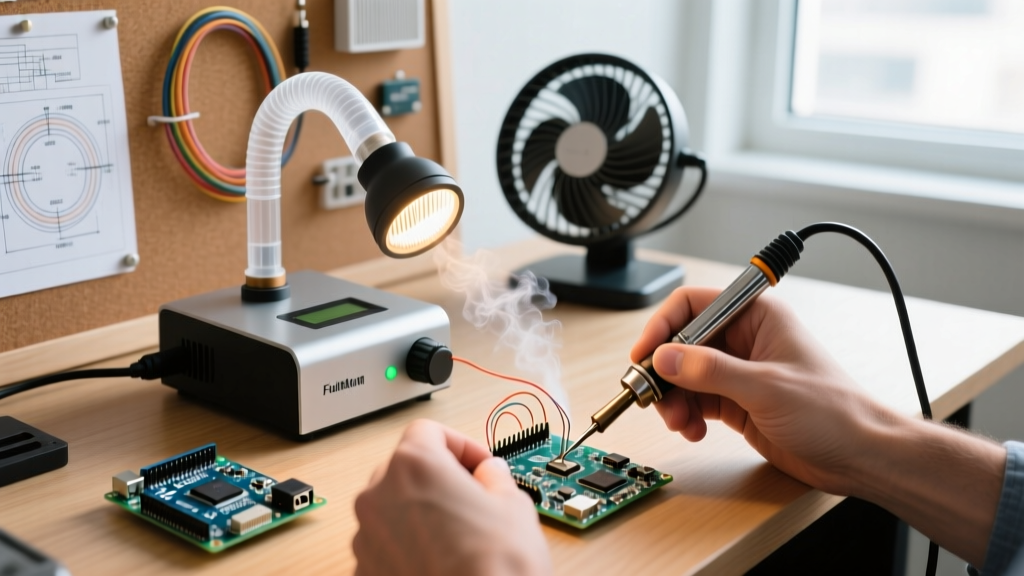
A benchtop soldering fan relies on an axial fan motor to pull ambient air through a thin, replaceable activated carbon filter sheet, subsequently exhausting the air back into the room. This is a 'recirculation and dilution' method rather than true source capture.
How It Works & Airflow Dynamics
The typical soldering fan uses a high-RPM brushed or brushless DC motor paired with a porous carbon-impregnated foam or pleated carbon sheet. While the carbon does adsorb some volatile organic compounds (VOCs), the thin media offers virtually zero resistance to particulate matter (PM2.5). Furthermore, because the air is exhausted out the back of the unit, it creates turbulent eddies that can actually push unfiltered fumes back toward the operator if the unit is not positioned perfectly.
Top 2026 Models & Pricing
- Hakko FA-400: The industry standard benchtop fan. Features a 2700 RPM motor and a pleated carbon filter. Priced around $58 in 2026. Filter replacements cost roughly $15 each.
- KSGER Soldering Smoke Absorber: A popular budget alternative featuring a 4-blade axial fan and dual carbon sponges. Retails for approximately $45. Excellent for light, intermittent THT (through-hole) work.
- Generic USB Desktop Fans: Often sold for $15-$25. These lack sufficient static pressure to pull air through dense carbon media and should be avoided for serious electronics work.
Pros and Cons of Soldering Fans
- Pros: Low initial capital expenditure (under $60); highly portable; requires zero ducting; replacement filters are cheap and easy to source.
- Cons: Fails to capture PM2.5 particulates; creates exhaust turbulence; carbon sheets saturate rapidly (often within 20-30 hours of heavy use); requires the operator to position their face dangerously close to the intake for any real benefit.
Method 2: Active HEPA/Carbon Fume Extractors
Professional fume extractors utilize a completely different methodology: high-static-pressure centrifugal blowers paired with multi-stage, sealed filtration chambers. Instead of a thin carbon sheet, these units use deep-bed activated carbon and HEPA filters to trap both VOCs and microscopic particulates before recirculating scrubbed air.
Filtration Stages & Capture Velocity
True extractors use a three-stage process: 1. Pre-filter: Captures large dust and flux splatter to protect the main filters. 2. HEPA Filter (H13 or H14): Traps 99.97% of particulate matter down to 0.3 microns, eliminating the physical aerosolized flux. 3. Deep-Bed Activated Carbon: Often weighing 2 to 5 lbs, this dense carbon bed adsorbs the toxic VOC gases that cause respiratory sensitization.
Because they use centrifugal blowers, these units maintain high capture velocity even when connected to 3-foot flexible extraction arms positioned directly over the solder joint.
Leading Units in 2026
- Metcal BVX-101: A compact, single-arm extractor featuring a brushless motor and smart filter-life monitoring. Current street price is approximately $699. Replacement HEPA/Carbon combo filters cost around $240.
- Weller WFE 2X: A dual-arm powerhouse designed for continuous production environments. Priced at $890, it offers auto-start capabilities via iron stand integration and ultra-quiet operation at 52 dBA.
Head-to-Head Comparison Matrix
| Feature | Benchtop Soldering Fan (e.g., Hakko FA-400) | Active Fume Extractor (e.g., Metcal BVX-101) |
|---|---|---|
| Initial Cost | $45 - $65 | $650 - $950 |
| Motor Type | Axial Fan (Low Static Pressure) | Centrifugal Blower (High Static Pressure) |
| Particulate Filtration | None (Passes through carbon sheet) | HEPA H13/H14 (99.97% at 0.3µm) |
| VOC / Gas Filtration | Low (Thin carbon foam/sheet) | High (Deep-bed activated carbon) |
| Capture Method | Ambient room dilution | Source capture via extraction arm |
| Filter Replacement Cost | $12 - $18 (every 1-3 months) | $180 - $250 (every 6-12 months) |
| Noise Level | 55 - 65 dBA (High-pitch whine) | 50 - 58 dBA (Low-frequency hum) |
Decision Framework: Which Method Should You Buy?
Choosing between a soldering fan and a professional extractor is not just about budget; it is about calculating your exposure time and workspace geometry.
When to Choose a Soldering Fan
A benchtop soldering fan is strictly recommended for intermittent, low-volume hobbyists. If you solder for less than 2 hours per week, primarily working with lead-free SAC305 or standard Sn63/Pb37 rosin-core wire in a well-ventilated room with open windows, a Hakko FA-400 positioned within 6 inches of the workpiece provides adequate nuisance relief. It is also the only viable option for field repair technicians who need to pack their gear into a backpack.
When to Upgrade to a Fume Extractor
You must upgrade to a sealed HEPA/Carbon extractor if you meet any of the following criteria:
- Volume: You solder for more than 4 hours per week.
- Chemistry: You frequently use highly active fluxes, liquid flux pens, or work with polyurethane-coated wires that release isocyanates when burned.
- Environment: Your workspace is a closed room without cross-ventilation, or you share the space with family members/pets.
- Health: You have a pre-existing respiratory condition or have noticed a persistent cough or wheezing after soldering sessions.
Frequently Asked Questions
Can I just use a standard desk fan to blow soldering fumes away?
No. Using a standard oscillating desk fan to blow fumes away from your face is a dangerous practice. While it removes the fumes from your immediate breathing zone, it disperses the colophony aerosol throughout the entire room, increasing the ambient concentration of PM2.5 and VOCs. Over time, these particulates settle on surfaces, carpets, and HVAC intakes, creating a chronic secondary exposure risk.
How do I know when the carbon filter in my soldering fan is saturated?
Activated carbon does not have a visual indicator for saturation. In a benchtop soldering fan, the thin carbon sheets typically reach maximum adsorption capacity after 25 to 40 hours of active soldering. If you can smell the distinct 'pine' or sweet odor of rosin flux passing through the back of the unit, the filter is entirely spent and is merely acting as a physical dust screen. Replace it immediately.
Are DIY PC fan carbon scrubbers effective?
DIY builds utilizing 120mm PC case fans strapped to 3D-printed housings and generic aquarium carbon mesh have become popular on maker forums. While these are a fun engineering exercise and offer slightly better airflow than cheap USB fans, they lack the static pressure required to pull air through dense, high-quality HEPA media. They remain a recirculation method and should not be considered a substitute for commercial safety equipment in a professional setting.
Final Verdict
The benchtop soldering fan remains a staple of the electronics workbench due to its accessibility and low barrier to entry. However, as our understanding of colophony-induced respiratory sensitization deepens, the limitations of axial fans and thin carbon sheets are glaring. For anyone treating electronics assembly as more than a passing weekend hobby, investing in a high-static-pressure fume extractor with HEPA and deep-bed carbon filtration is a non-negotiable investment in long-term pulmonary health.