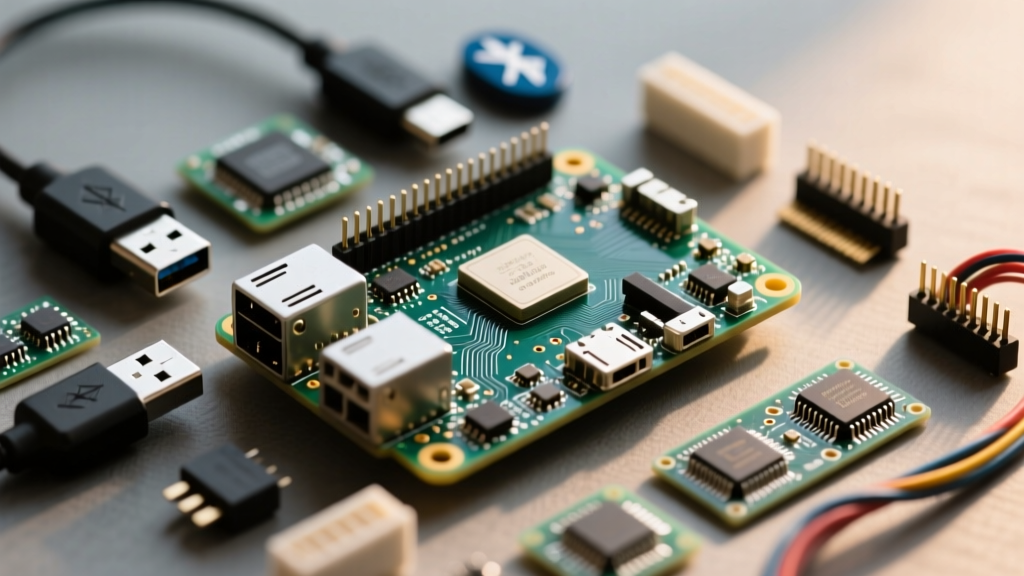
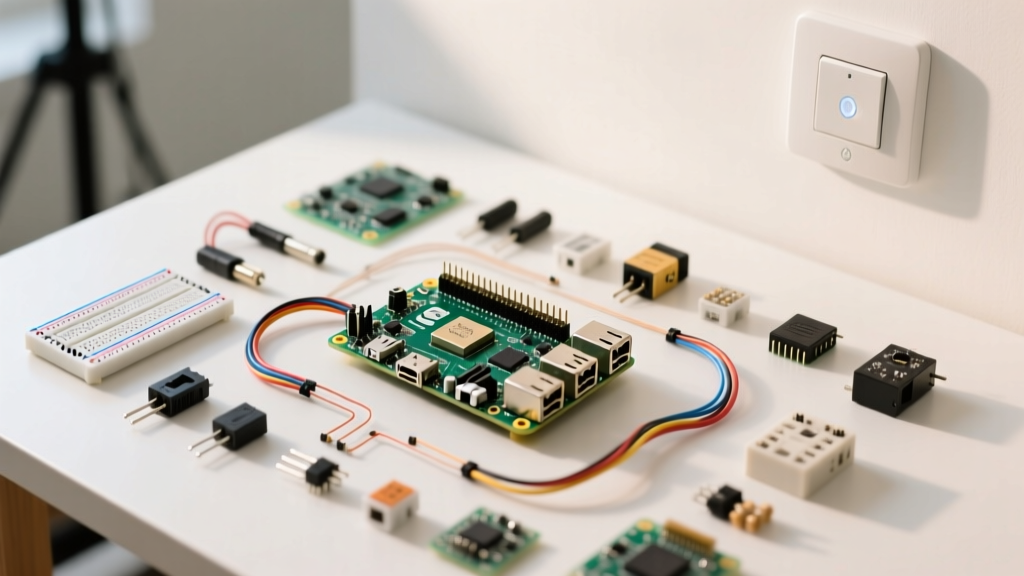
Turning a Raspberry Pi Spotify setup into a dedicated, headless audio receiver is one of the most practical embedded projects you can build. Instead of relying on a phone app or a bulky desktop interface, you can build a standalone Spotify Connect endpoint that boots directly into a high-fidelity audio sink, controlled by physical tactile buttons. This guide details a robust build using spotifyd (a lightweight, open-source Spotify Connect daemon), an I2S digital-to-analog converter (DAC) for lossless audio, and a Python script bridging physical GPIO buttons to the D-Bus MPRIS media control interface.
Hardware Bill of Materials (BOM) & Specifications
The foundation of a reliable audio endpoint is bypassing the Raspberry Pi's notoriously noisy onboard 3.5mm PWM audio jack. We use an I2S DAC bonnet, which pulls digital audio directly from the Pi's I2S bus, resulting in a clean, high-resolution analog signal. The parts listed below are priced based on early 2026 electronics distributor averages.
| Component | Exact Model / Variant | Est. Price (USD) | Technical Purpose |
|---|---|---|---|
| Microcontroller | Raspberry Pi 4 Model B (2GB RAM) | $45.00 | Host SBC; 2GB is sufficient for headless spotifyd and Python scripts. |
| Audio DAC | Adafruit I2S 3W Stereo Speaker Bonnet (MAX98357A) | $12.50 | I2S audio extraction and 3W per channel amplification. |
| Storage | Sandisk Ultra 32GB microSD (A1 rated) | $9.00 | OS boot drive; A1 rating ensures fast random I/O for OS responsiveness. |
| Controls | 3x 30mm Illuminated Arcade Pushbuttons (12V/5V) | $6.00 | Physical Play/Pause, Next Track, and Previous Track inputs. |
| Power Supply | Official Raspberry Pi 27W USB-C PD PSU | $12.00 | Stable 5V/5A delivery to prevent brownouts when DAC draws peak current. |
GPIO Pin Mapping for Physical Controls
We map the arcade buttons to the Raspberry Pi's GPIO header using internal pull-up resistors. This means the buttons simply connect the GPIO pin to Ground (GND) when pressed, pulling the logic level LOW. No external resistors are required.
| Button Function | GPIO Pin (BCM) | Physical Pin # | Wiring Connection |
|---|---|---|---|
| Play / Pause | GPIO 17 | Pin 11 | Button NO to Pin 11, Button COM to GND (Pin 9) |
| Next Track | GPIO 27 | Pin 13 | Button NO to Pin 13, Button COM to GND (Pin 14) |
| Previous Track | GPIO 22 | Pin 15 | Button NO to Pin 15, Button COM to GND (Pin 20) |
Mechanical arcade buttons suffer from contact bounce, which can register as multiple rapid presses. While the Python
gpiozero library handles software debouncing (configured in the code below), if you experience double-skipping tracks, solder a 0.1µF ceramic capacitor across the button terminals for hardware-level RC debouncing.
Audio Backend Comparison: I2S vs. USB vs. Analog
Before flashing the OS, it is critical to understand why we chose I2S over other audio routing methods. The choice of audio backend dictates your CPU overhead, latency, and signal-to-noise ratio (SNR).
| Audio Backend | SNR / Quality | CPU Overhead | Setup Complexity | Best Use Case |
|---|---|---|---|---|
| I2S DAC (Our Choice) | High (95dB+) | Negligible (Hardware DMA) | Medium (Requires config.txt overlay) | Dedicated hi-fi receivers, permanent installs. |
| USB Audio Interface | High (Depends on DAC) | Low (USB polling) | Low (Plug and play) | Desktop setups, portable DACs. |
| 3.5mm PWM Jack | Poor (70dB, noisy) | High (Software PWM) | None | Prototyping, voice-only outputs. |
| Bluetooth (A2DP) | Medium (Lossy compression) | Medium | High (Pairing/PulseAudio) | Mobile, wire-free temporary setups. |
The Control Script: Python, GPIO, and D-Bus MPRIS
This project targets the Raspberry Pi 4 Model B (2GB) running Raspberry Pi OS Bookworm (64-bit). Bookworm uses pipewire and wayland by default, but for a headless spotifyd setup, we run it as a headless systemd service.
The spotifyd daemon exposes its playback state via the standard Linux D-Bus MPRIS (Media Player Remote Interfacing Specification) interface. Instead of relying on the Spotify Web API—which requires managing OAuth tokens and API rate limits—we use the pydbus library to send local IPC (Inter-Process Communication) commands directly to the daemon.
Prerequisites: Install spotifyd via the official Spotifyd documentation, enable it as a systemd user service, and install the Python dependencies via sudo apt install python3-gpiozero python3-pydbus.
#!/usr/bin/env python3
"""
Raspberry Pi Spotify Connect GPIO Controller
Target: Raspberry Pi OS Bookworm (64-bit) + spotifyd (MPRIS enabled)
"""

import sys
import time
import logging
from signal import pause
from gpiozero import Button
from pydbus import SystemBus, SessionBus

# Configure logging for systemd journal integration
logging.basicConfig(level=logging.INFO, format='%(levelname)s: %(message)s')

# --- PIN DEFINITIONS (BCM Numbering) ---
PIN_PLAY_PAUSE = 17
PIN_NEXT = 27
PIN_PREV = 22

# Debounce time in seconds to prevent mechanical contact bounce
deBOUNCE_TIME = 0.15

def get_mpris_player():
    """Connects to the D-Bus session and locates the spotifyd MPRIS interface."""
    try:
        # spotifyd typically runs on the user session bus, but if run as a
        # system service, it may be on the SystemBus. We check Session first.
        bus = SessionBus()
        # The MPRIS naming convention is org.mpris.MediaPlayer2.
        player = bus.get('org.mpris.MediaPlayer2.spotifyd', '/org/mpris/MediaPlayer2')
        return player
    except Exception as e:
        logging.error(f"Failed to connect to spotifyd via D-Bus: {e}")
        logging.error("Ensure spotifyd is running and MPRIS is enabled in spotifyd.conf")
        return None

def handle_play_pause():
    player = get_mpris_player()
    if player:
        player.PlayPause()
        logging.info("Toggled Play/Pause")

def handle_next():
    player = get_mpris_player()
    if player:
        player.Next()
        logging.info("Skipped to Next Track")

def handle_prev():
    player = get_mpris_player()
    if player:
        player.Previous()
        logging.info("Returned to Previous Track")

def main():
    logging.info("Initializing GPIO buttons for Spotify Connect...")

    # Initialize buttons with internal pull-ups and hardware debounce
    btn_play = Button(PIN_PLAY_PAUSE, pull_up=True, bounce_time=deBOUNCE_TIME)
    btn_next = Button(PIN_NEXT, pull_up=True, bounce_time=deBOUNCE_TIME)
    btn_prev = Button(PIN_PREV, pull_up=True, bounce_time=deBOUNCE_TIME)

    # Bind button press events (when_pressed triggers on the falling edge / GND connection)
    btn_play.when_pressed = handle_play_pause
    btn_next.when_pressed = handle_next
    btn_prev.when_pressed = handle_prev

    logging.info("Buttons mapped. Waiting for physical input...")

    try:
        # Keep the script alive and listening for GPIO interrupts
        pause()
    except KeyboardInterrupt:
        logging.info("Shutting down GPIO controller.")
        sys.exit(0)

if __name__ == "__main__":
    main()
Debugging: Audio Backend and D-Bus Failures
When integrating spotifyd with modern Raspberry Pi OS, you will inevitably hit audio routing conflicts. Bookworm's transition to PipeWire fundamentally changed how ALSA devices are exposed to user-space applications.
The Exact Error String
If your spotifyd service crashes immediately upon receiving a playback command from your phone, check the systemd journal (journalctl --user -u spotifyd -e). The most common fatal error string in 2026 is:
spotifyd: error: Audio backend error: pulseaudio: pa_context_connect() failed
or
ALSA lib pcm_dmix.c:1035:(snd_pcm_dmix_open) unable to open slave
Ranked Causes and Fixes
- PipeWire/PulseAudio Monopolizing the ALSA Device: PipeWire claims the I2S hardware device, leaving
spotifyd(which defaults to the ALSA backend) unable to open it. Fix: Forcespotifydto use the PulseAudio/PipeWire backend by addingbackend = "pulseaudio"to yourspotifyd.conf, or mask the PipeWire service if you want direct ALSA access (systemctl --user mask pipewire). - Missing I2S Device Tree Overlay: The MAX98357A DAC requires a kernel overlay to map the I2S pins. If missing, the ALSA device simply does not exist. Fix: Add
dtparam=audio=offanddtoverlay=max98357ato/boot/firmware/config.txtand reboot. - Spotify Premium Account Invalidation: Spotifyd requires a Premium account. If your session token expires or the account is downgraded to Free, the daemon will accept the D-Bus connection but fail to stream, often throwing a
ConnectionRefusedor401 Unauthorizederror in the logs.
The First Three Things to Check When It Fails
If the Python script runs but the buttons do nothing, execute this triage sequence:
- Verify D-Bus Visibility: Run
dbus-send --session --dest=org.freedesktop.DBus --type=method_call --print-reply /org/freedesktop/DBus org.freedesktop.DBus.ListNames | grep spotify. Iforg.mpris.MediaPlayer2.spotifyddoes not appear, the daemon isn't exposing MPRIS. Adduse_mpris = truetospotifyd.conf. - Check GPIO Permissions: Ensure the user running the Python script is in the
gpioandinputgroups. Runsudo usermod -aG gpio,input $USERand log out/in. - Test ALSA Output Directly: Bypass Spotify entirely and test the DAC. Run
speaker-test -c2 -t sine -f 440. If you hear a 440Hz tone, your hardware and I2S overlay are perfect; the issue is strictly within thespotifydsoftware stack.
How to Extend or Simplify the Build
Embedded projects should be tailored to your exact tolerance for maintenance versus customization. Here is how to adjust the complexity of this Raspberry Pi Spotify build.
Simplifying the Build (The No-Code Route)
If writing Python scripts and configuring systemd daemons feels like overkill, abandon spotifyd and flash Volumio OS or moOde Audio onto your microSD card. These are purpose-built, headless audiophile operating systems. They include Spotify Connect out-of-the-box via a web GUI, handle I2S DAC configuration via dropdown menus, and support GPIO button plugins natively without writing a single line of code. The trade-off is a heavier OS footprint and less granular control over the underlying Linux environment.
Extending the Build (Adding Visual Feedback)
To push this project further, add an I2C OLED display to show the currently playing track and artist. Because the I2S DAC uses the PCM/I2S pins, the I2C bus (GPIO 2 / SDA and GPIO 3 / SCL) remains completely free.
You can extend the Python script above by importing the luma.oled library, initializing an SSD1306 128x64 display, and polling the MPRIS Metadata property. Whenever player.PlaybackStatus changes, extract the xesam:title and xesam:artist D-Bus dictionary keys and render them to the OLED buffer. This transforms the project from a blind audio sink into a complete, interactive desktop media console.