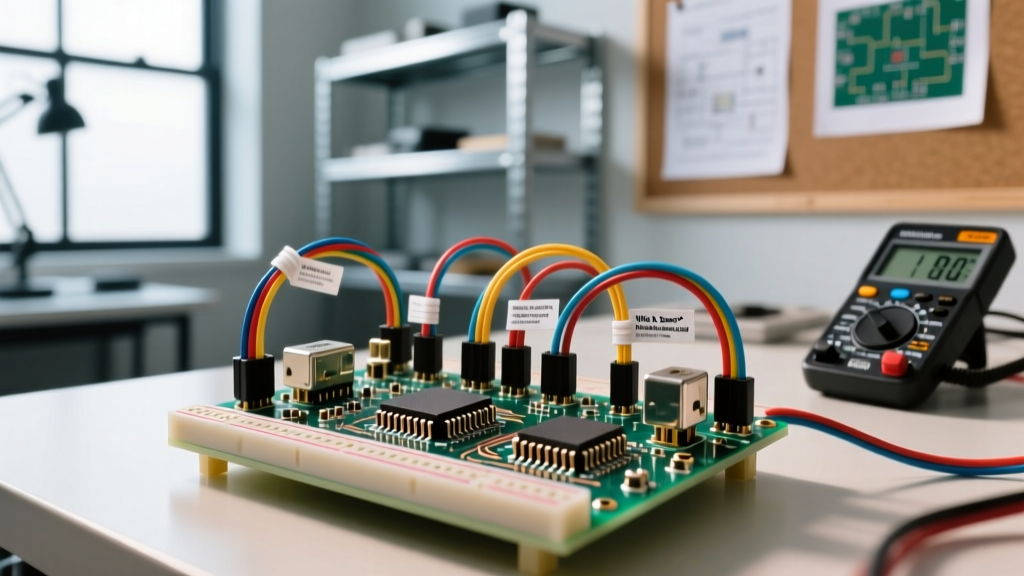
When embedded engineers and security researchers search for an ESP32 Bluetooth jammer, they are rarely looking to build a crude noise generator. Instead, they are building BLE penetration testing tools (like AppleJuice UI spammers) or 2.4GHz spectrum sniffers. To build these tools effectively, you must understand the physical layer of Bluetooth Low Energy (BLE), how the ESP32 routes RF data internally, and how to debug the 2.4GHz ISM band when packets drop.
The 2.4GHz ISM "Bus": BLE Physical Layer & ESP32 RF Mechanics
Unlike wired protocols (I2C, SPI, UART), BLE operates over a wireless "bus"—the 2.4GHz ISM band. However, the ESP32 also relies on an internal hardware bus to shuttle data between the Xtensa LX6 CPU and the integrated 2.4GHz radio co-processor. Understanding both layers is critical for RF penetration testing.
RF & Internal Bus Mechanics
| Parameter | BLE 5.0 RF "Bus" (Over-the-Air) | ESP32 Internal Radio Bus (SDIO/SPI) |
|---|---|---|
| Wires / Medium | 0 (RF over air, 40 channels, 2MHz spacing) | Internal silicon traces (SDIO or SPI) |
| Speed / Bandwidth | 1 Mbps or 2 Mbps (PHY rate) | Up to 80 MHz clock (theoretical 320 Mbps) |
| Addressing | 48-bit MAC (Public or Randomized) | Memory-mapped registers (e.g., 0x3FF44000) |
| Distance / Range | ~10m to 100m (depends on PA/LNA and TX power) | < 10 cm (internal PCB die routing) |
Which Protocol Fits Distance, Speed, and Device Count?
If you are designing a 2.4GHz mesh or penetration test rig, choosing the right protocol stack on the ESP32 dictates your physical limitations:
- BLE 5.0 (Long Range/Coded PHY): Best for low-speed telemetry and high device counts (broadcasting). Fits ranges up to 1km with external PA/LNA, but throughput drops to 125-500 kbps.
- Classic Bluetooth (BR/EDR): Best for continuous audio streaming (A2DP). Fits short distances (<10m), moderate speed (3 Mbps), but strictly limits active connections to 7 piconet devices.
- ESP-NOW (Wi-Fi 802.11b/g): Best for low-latency, medium-speed (up to 150 Mbps theoretical) peer-to-peer control. Fits medium distances (~100m line-of-sight) and supports up to 20 encrypted peers.
Physical Wiring: ESP32 to External RF PA/LNA and I2C Feedback
A bare ESP32-WROOM-32 module outputs roughly +20 dBm (100mW) max on its PCB trace antenna. For serious spectrum analysis or long-range BLE advertising, makers wire an external Power Amplifier/Low Noise Amplifier (PA/LNA) like the CC2592 or RFaxis RFX2411N. Furthermore, a local I2C OLED is typically wired to display sniffed MAC addresses in the field without a serial tether.
I2C Pull-Up Requirements
The most common physical layer failure when adding an OLED to an ESP32 RF rig is a missing pull-up resistor on the I2C lines. The ESP32's internal pull-ups are roughly 45kΩ—far too weak for reliable 400kHz I2C communication, especially when long jumper wires act as antennas picking up 2.4GHz harmonic noise.
- 100kHz I2C: Use 4.7kΩ pull-up resistors to 3.3V on both SDA and SCL.
- 400kHz I2C: Use 2.2kΩ pull-up resistors to 3.3V to ensure fast rise times.
RF Trace and Antenna Wiring
If you are bypassing the ESP32's u.FL connector to wire a raw SMA pigtail, the coaxial trace must maintain a strict 50Ω impedance. A mismatch here causes signal reflection, burning out the ESP32's internal RF front-end at high TX duty cycles. Always use a calibrated VNA (Vector Network Analyzer) to verify the Smith chart sits at the 50Ω center point before transmitting.
Sniffing the Spectrum: Debugging BLE Traffic and Classic Failures
When your BLE spammer or sniffer fails to capture packets, the issue is rarely in the Arduino code. It is almost always a physical or link-layer failure. Here is how to sniff the bus and resolve the classic triad of embedded RF failures.
How to Sniff and Debug the 2.4GHz Bus
To debug BLE traffic, you need a Software Defined Radio (SDR) or a dedicated sniffer dongle.
- Hardware: Connect a HackRF One or an nRF52840 Dongle (flashed with Sniffer firmware) to your PC.
- Software: Open Wireshark and select the Bluetooth interface. For ESP-IDF native debugging, Espressif provides an ESP32 Wi-Fi/BT coexistence logger that dumps HCI (Host Controller Interface) packets directly over UART to Wireshark.
- Filtering: Use the Wireshark display filter
btle.advertising_header.pdu_type == 0x00to isolate ADV_IND (connectable undirected advertising) packets from the noise floor.
The Classic Failures
- Address Clash (MAC Randomization): Modern iOS and Android devices use Resolvable Private Addresses (RPAs) that rotate every 15 minutes. If your ESP32 sniffer relies on a static MAC whitelist, it will fail to track the target. Fix: Sniff the Identity Resolving Key (IRK) during initial pairing, or track devices by their specific Service UUID fingerprint rather than MAC.
- Missing Pull-Up (I2C Hang): As mentioned, floating I2C lines cause the ESP32 to hard-lock during the
Wire.begin()initialization, right before the RF stack starts. Fix: Measure SDA/SCL with a multimeter; they should read ~3.2V at idle. If they read near 0V or float randomly, solder 2.2kΩ resistors to the 3V3 rail. - Baud Mismatch (UART Sniffer Drops): When using an external nRF52840 sniffer module wired to the ESP32 via UART to offload packet processing, a baud rate mismatch (e.g., ESP32 at 115200, sniffer at 1000000) results in corrupted HCI headers. Fix: Force both devices to 921600 baud and verify with an oscilloscope that the UART TX rise time is under 50ns.
Minimal Working Exchange: BLE Sniffer & Advertiser Setup
Below is a minimal, working BLE scanner (sniffer) designed for the ESP32. It scans for nearby advertising packets and outputs the MAC, RSSI, and payload length. We include an I2C OLED to display the count of discovered devices in the field.
Physical Wiring Table
| ESP32-WROOM-32 Pin | SSD1306 I2C OLED Pin | Function |
|---|---|---|
| GPIO 21 | SDA | I2C Data (Add 2.2kΩ pull-up to 3V3) |
| GPIO 22 | SCL | I2C Clock (Add 2.2kΩ pull-up to 3V3) |
| 3V3 | VCC | Power (Do not use 5V on ESP32 I2C) |
| GND | GND | Common Ground |
ESP32 BLE Scanner Code
#include <BLEDevice.h>
#include <BLEScan.h>
#include <BLEAdvertisedDevice.h>
#include <Wire.h>
#include <Adafruit_GFX.h>
#include <Adafruit_SSD1306.h>

#define SCREEN_WIDTH 128
#define SCREEN_HEIGHT 64
Adafruit_SSD1306 display(SCREEN_WIDTH, SCREEN_HEIGHT, &Wire, -1);

int deviceCount = 0;

class MyAdvertisedDeviceCallbacks: public BLEAdvertisedDeviceCallbacks {
  void onResult(BLEAdvertisedDevice advertisedDevice) {
    deviceCount++;
    Serial.printf("MAC: %s | RSSI: %d dBm\n",
      advertisedDevice.getAddress().toString().c_str(),
      advertisedDevice.getRSSI());

    // Update OLED
    display.clearDisplay();
    display.setCursor(0,0);
    display.printf("BLE Sniffer Active\nDevices: %d", deviceCount);
    display.display();
  }
};

void setup() {
  Serial.begin(115200);

  // Init I2C OLED
  if(!display.begin(SSD1306_SWITCHCAPVCC, 0x3C)) {
    Serial.println(F("SSD1306 allocation failed"));
    for(;;); // Halt on missing pull-up or wrong address
  }
  display.clearDisplay();
  display.setTextColor(SSD1306_WHITE);
  display.setTextSize(1);
  display.display();

  // Init BLE Stack
  BLEDevice::init("ESP32_Sniffer");
  BLEScan* pBLEScan = BLEDevice::getScan();
  pBLEScan->setAdvertisedDeviceCallbacks(new MyAdvertisedDeviceCallbacks());
  pBLEScan->setActiveScan(true); // Requests scan response data
  pBLEScan->setInterval(100);
  pBLEScan->setWindow(99);
}

void loop() {
  BLEScanResults foundDevices = BLEDevice::getScan()->start(5, false);
  Serial.printf("Scan cycle complete. Found: %d\n", foundDevices.getCount());
  BLEDevice::getScan()->clearResults();
  deviceCount = 0; // Reset for next UI cycle
  delay(2000);
}
ESP32 Bluetooth Jammer FAQs
Can an ESP32 block or jam Bluetooth audio signals?
No, not legally or effectively via brute force. True jamming requires transmitting high-power broadband noise across the 2.402–2.480 GHz spectrum, which violates FCC enforcement regulations and will get you fined heavily. Furthermore, the ESP32's internal radio is limited to +20 dBm and uses narrowband frequency hopping; it physically lacks the hardware to generate wideband noise. What makers can do is use the ESP32 to flood a target with thousands of spoofed BLE pairing requests (a protocol-level denial of service), which crashes poorly written Bluetooth stacks on older IoT devices.
Why does my ESP32 BLE spammer get ignored by iOS 17+?
Apple and Google introduced OS-level mitigations against BLE proximity spam (like AirTag spoofing) starting in iOS 17.2 and Android 14. The OS now rate-limits and silently drops repeated, identical BLE advertising payloads from non-bonded devices that lack valid cryptographic tags. To bypass this in authorized penetration testing, researchers use rolling randomized MAC addresses and dynamically generated payload bytes on every advertising interval, forcing the OS to treat each packet as a brand-new, unique device.
What is the maximum range for an ESP32 Bluetooth penetration test?
A stock ESP32-WROOM-32 with a PCB trace antenna maxes out around 30 meters in open air for reliable packet injection. By wiring an external 2.4GHz PA/LNA module (like the CC2592) and using a high-gain directional Yagi antenna, you can push the BLE advertising range past 1.5 kilometers. However, remember that while the ESP32 can transmit that far, the target phone's low-power BLE radio must still be able to transmit a response back to the ESP32 for connection-based attacks, making the practical two-way range much shorter than the one-way broadcast range.