
The Energy Crisis in Desktop Robotics
Building a multi-axis robotic arm with an ESP32 or Arduino is a rite of passage for automation enthusiasts. However, a common frustration quickly emerges: battery life plummets, motor drivers overheat, and the power supply struggles to keep up. When makers and engineers first ask, what do robot arms use for motors, the answers online are often fragmented, focusing purely on torque while entirely ignoring power consumption. In modern robotics, especially for mobile manipulators and battery-tethered IoT projects, energy-efficient design is not optional—it is the primary constraint.
To truly answer what do robot arms use for motors in a modern, energy-conscious context, we must look beyond basic hobby servos and explore the intersection of motor topology, smart silicon drivers, and mechanical synergy. This guide breaks down the exact actuator choices used in professional and advanced DIY robot arms, focusing strictly on minimizing watt-hour consumption and eliminating thermal throttling.
Decoding the Actuators: What Do Robot Arms Use for Motors?
The robotic arm industry relies on three primary motor topologies, each with distinct electrical characteristics. Understanding how they handle electrical-to-mechanical conversion is the first step in designing an efficient system.
1. Standard RC Servos (The Baseline)
Models like the ubiquitous MG996R use a brushed DC motor paired with a potentiometer for feedback. While cheap, they are inherently inefficient. The internal control board constantly pulses the motor to maintain position, leading to severe PWM jitter. This jitter causes the motor to draw continuous micro-currents just to fight its own gear friction, resulting in poor holding efficiency and rapid battery drain.
2. Smart Digital Servos (The Middle Ground)
Advanced actuators like the ROBOTIS Dynamixel XM430-W350 use coreless DC motors or high-efficiency brushed motors paired with magnetic encoders and PID controllers. They draw roughly 40mA at idle and can dynamically adjust their current based on the load. While vastly superior to RC servos, they still rely on mechanical commutation (brushes), which introduces friction and limits peak electrical efficiency to around 75%.
3. BLDC and Stepper Motors (The High-Efficiency Standard)
For industrial and high-end DIY arms, Brushless DC (BLDC) motors and NEMA stepper motors are the standard. However, their efficiency is entirely dependent on the driver IC. A stepper motor driven by a legacy L298N H-bridge is a massive energy waster, whereas a BLDC motor driven by Field Oriented Control (FOC) can achieve upwards of 90% electromechanical efficiency.
Energy Consumption Breakdown: Actuator Comparison
To visualize the power dynamics, consider the following comparison of motor types commonly used in 6-DOF (Degree of Freedom) robotic arms operating on a 12V to 24V DC bus.
| Motor Topology | Idle Current (mA) | Holding Efficiency | Backdrivability | Best MCU Interface |
|---|---|---|---|---|
| Standard RC Servo (MG996R) | ~15mA (jitter spikes) | Poor (Continuous PWM) | Low (Gear friction) | 50Hz PWM |
| Smart Servo (Dynamixel XL430) | ~40mA | Good (PID sleep) | Medium | UART (TTL/RS485) |
| Stepper (NEMA 17) + TMC2209 | ~30mA (IC standby) | Excellent (CoolStep) | Low (Magnetic detent) | STEP/DIR or UART |
| BLDC + FOC Driver | ~15mA (Encoder polling) | Superior (Sinusoidal) | High (Zero cogging) | SPI/I2C + PWM |
The Hidden Power Drain: Holding Torque and Thermal Failure
The most critical factor in robot arm energy design is holding torque. A robotic arm fighting gravity at a 90-degree extension requires continuous force. If you use standard stepper motors, the driver floods the coils with maximum rated current (often 1.5A to 2.5A per phase) just to keep the arm stationary. This generates massive heat, requiring active cooling and wasting enormous amounts of energy.
Solving the Stepper Problem with Smart Silicon
If your design dictates the use of steppers for their precision and open-loop simplicity, you must use modern driver ICs. The Trinamic TMC2209 features a technology called CoolStep. By measuring the back-EMF (electromotive force) generated by the motor, the driver calculates the exact mechanical load and dynamically scales the coil current. If the arm is resting on a table or holding a light load, the TMC2209 can reduce the holding current by up to 70%, virtually eliminating thermal runaway and drastically extending battery life.
Engineering for Efficiency: Field Oriented Control (FOC)
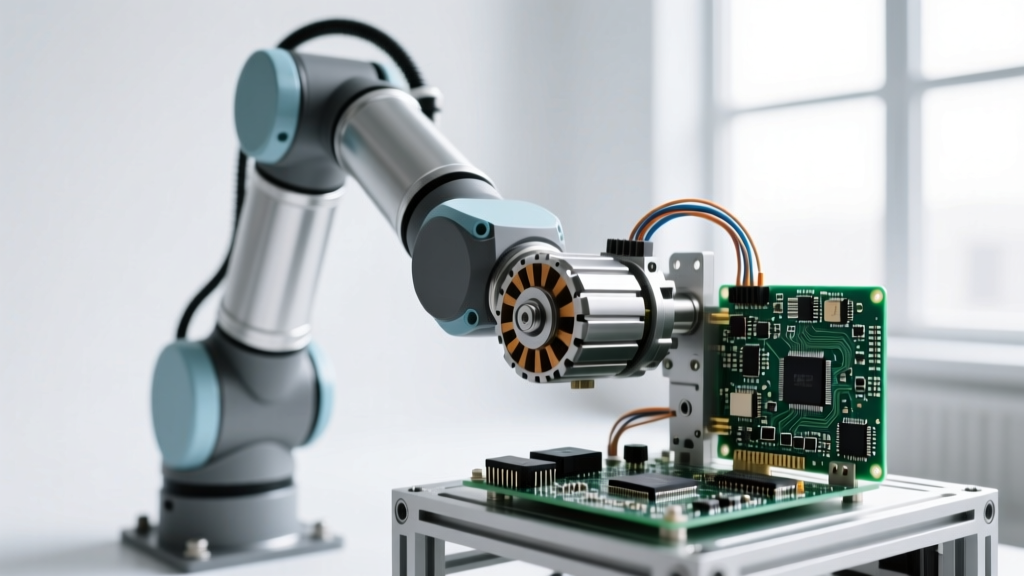
When evaluating what do robot arms use for motors in cutting-edge, energy-efficient designs, the answer is increasingly BLDC motors paired with FOC. Unlike traditional trapezoidal commutation (which causes torque ripple and acoustic noise), FOC uses Space Vector PWM (SVPWM) to deliver smooth, sinusoidal currents to the motor phases.
By utilizing high-resolution magnetic encoders like the AS5047P and an open-source library like SimpleFOC on an ESP32, you can achieve precise torque control. FOC allows the MCU to command exact torque rather than just position or velocity. This means the motor only draws the exact milliamps required to counteract gravity and the payload, resulting in the lowest possible energy footprint for dynamic movements.
Expert Insight: Thermal throttling in robotic joints rarely happens during fast movements; it happens during static holds. Designing your MCU firmware to detect a 'static hold' state and automatically engage mechanical brakes or reduce current limits via I2C is a mandatory practice for battery-operated arms.
Mechanical Synergy: Gearboxes and Gravity Compensation
You cannot code your way out of poor mechanical design. The motor you choose is only as efficient as the gearbox attached to it. High-ratio planetary gearboxes introduce significant friction, forcing the motor to work harder to overcome its own gearing.
- Strain Wave Gearing (Harmonic Drives): These offer zero backlash and high reduction ratios (e.g., 100:1) with remarkably low friction. Because the gear train holds the load mechanically with minimal backdrive, the BLDC motor can operate at near-zero current during static holds.
- Gravity Compensation: Advanced arms use gas springs, elastic bands, or physical counterweights to offset the mass of the links. By mechanically neutralizing gravity, the motors only need to provide power for acceleration and friction, slashing continuous power draw by up to 60%.
- Backdrivability: Choosing motors with low cogging torque (like slotless BLDCs from Maxon) allows the arm to be backdriven by hand. This is crucial for 'teach-by-demonstration' programming and ensures that regenerative braking circuits can actually harvest energy during downward arm movements.
ESP32 Power Gating: Putting the Arm to Sleep
Even the most efficient motor drivers draw quiescent current. In an IoT-connected robotic arm that spends 80% of its time idle, the cumulative drain of 6 to 7 motor drivers can deplete a battery overnight. Energy-efficient design requires hardware power gating.
By placing P-channel MOSFETs (such as the IRF9540N) or dedicated high-side load switches on the power rails of each joint, the ESP32 can physically sever the connection to idle motors. When the arm completes a task, the MCU can command the joints to a safe resting position, engage mechanical brakes (if equipped), and pull the MOSFET gates high, cutting the current to absolute zero. Combined with the ESP32's deep sleep modes, this ensures the entire robotic system draws microamps while waiting for the next MQTT command.
Conclusion: Designing the Next Generation of Arms
So, what do robot arms use for motors? The modern answer is a carefully orchestrated system of BLDC or smart stepper motors, governed by FOC or CoolStep drivers, and supported by strain-wave mechanics. By shifting your focus from raw stall torque to dynamic holding efficiency, back-EMF utilization, and hardware-level power gating, you can build robotic arms that are not only incredibly precise but capable of running for hours on a single LiPo battery pack. Whether you are building an automated PCB soldering station or a mobile agricultural manipulator, prioritizing energy-efficient actuator design is the hallmark of a mature robotics engineer.