
Why Move Beyond Basic Arduino Projects?
When makers first search for cool projects with Arduino, they are often met with beginner-level tutorials involving blinking LEDs, basic servo sweeps, or simple serial monitor outputs. While these are excellent for learning syntax, they rarely prepare you for the rigorous demands of real-world, deployed embedded systems. In 2026, the true frontier of microcontroller engineering lies in ultra-low-power, long-range telemetry.
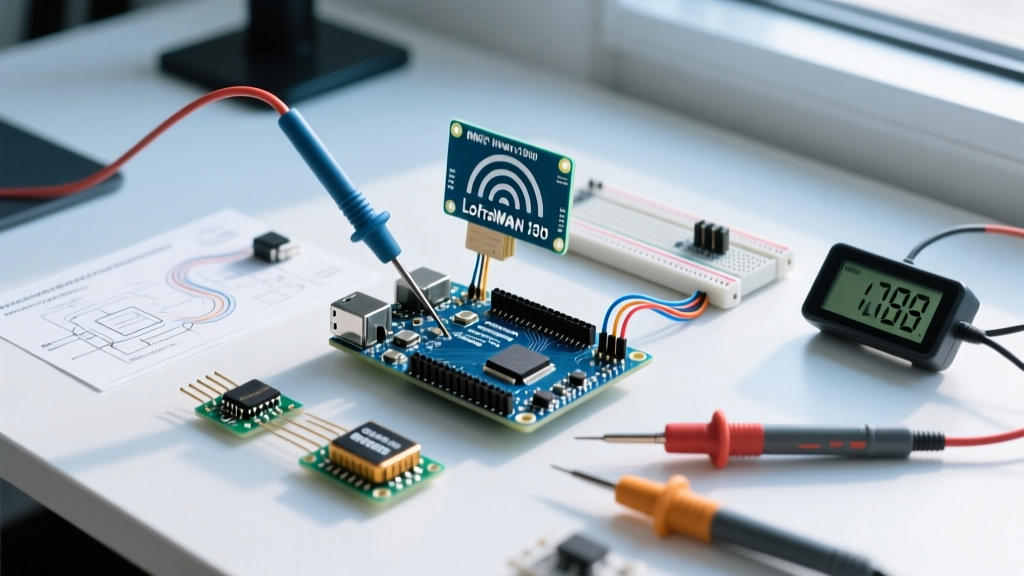
This advanced build guide bypasses the basics. We will design, assemble, and program a fully autonomous LoRaWAN Environmental Sensor Node using the Arduino MKR WAN 1310 and the Bosch BME688 AI-capable gas sensor. This project requires an understanding of RF impedance, I2C bus capacitance, and deep-sleep power profiling. By the end of this guide, you will have a deployment-ready IoT node capable of transmitting multi-variable environmental data over 10+ kilometers while running for years on a single battery charge.
Hardware Bill of Materials (BOM)
Selecting the right silicon is critical for LoRaWAN applications. The Arduino MKR WAN 1310 is chosen for its integrated Murata CMWX1ZZABZ module, which pairs an STM32L072 Cortex-M0+ microcontroller with a Semtech SX1276 LoRa transceiver.
| Component | Model / Specification | Est. Cost (2026) | Engineering Justification |
|---|---|---|---|
| MCU Board | Arduino MKR WAN 1310 (868/915 MHz) | $55.00 | Native LoRaWAN stack support, ultra-low sleep current (10µA). |
| Sensor | Adafruit BME688 Breakout (I2C) | $20.00 | Measures Temp, Hum, Press, and VOCs in a single 3x3mm package. |
| Antenna | 2dBi SMA Duck Antenna (Region Specific) | $12.00 | Omnidirectional radiation pattern; must match regional ISM band. |
| Power Storage | 3.7V 2500mAh LiPo (Adafruit 328) | $15.00 | High energy density; fits within standard IP67 enclosures. |
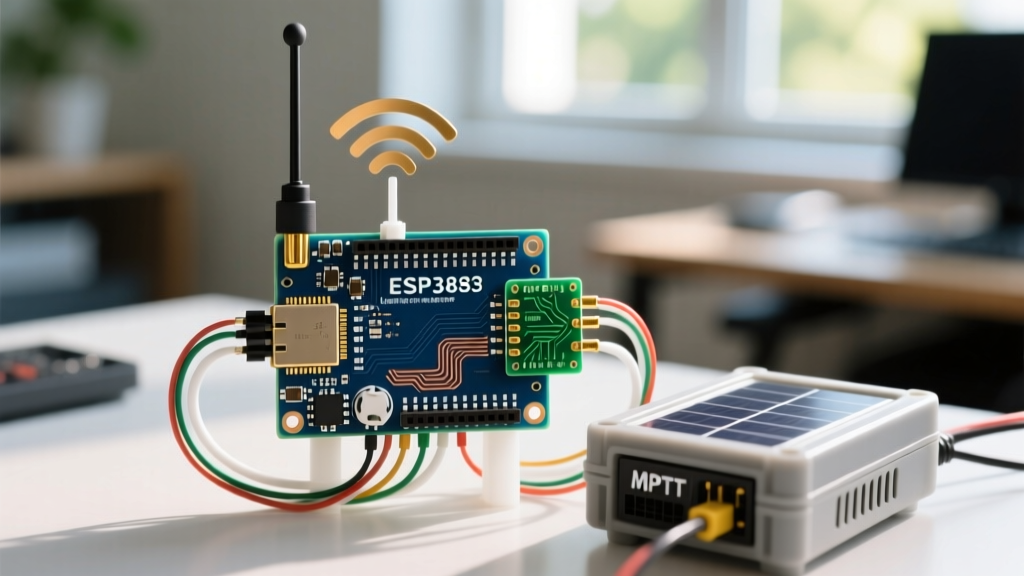
| Power Management | Adafruit Universal Solar Charger (bq24074) | $20.00 | Handles MPPT-like solar regulation and seamless LiPo charging. |
Power Budget and Ultra-Low Sleep Architecture
The most common failure point in remote IoT deployments is premature battery death due to poor power budgeting. The MKR WAN 1310 is capable of extreme efficiency, but only if the firmware explicitly manages peripheral states.
Quiescent vs. Active Current Draw
- Deep Sleep (Stop Mode): The STM32L072 draws roughly 1.5µA in Stop mode. However, the MKR board's onboard LDO and USB interface chip add a quiescent overhead, bringing the total board sleep current to ~10µA.
- BME688 Sleep: When not actively sampling, the Bosch BME688 draws an impressive 0.15µA.
- TX Burst (Spreading Factor 12): During a LoRa transmission at 14dBm, the SX1276 PA (Power Amplifier) spikes to ~120mA for roughly 50-150ms, depending on payload size and SF.
Engineering Insight: Never power the BME688 directly from the board's continuous 3.3V rail if you are optimizing for microamp-level sleep. Instead, wire the sensor's VIN to a digital GPIO pin configured as an OUTPUT. Drive the pin HIGH only during the 2-second wake window to power the sensor, then drive it LOW before returning to deep sleep. This eliminates the sensor's voltage regulator quiescent draw entirely.
Assembly and Critical RF Edge Cases
Physical assembly of LoRa hardware requires strict adherence to RF safety protocols. The Semtech SX1276 transceiver is highly sensitive to antenna mismatch.
The VSWR and PA Burnout Risk
Voltage Standing Wave Ratio (VSWR) measures how efficiently power is transferred from the transceiver to the antenna. If you power on the MKR WAN 1310 and initiate a transmit sequence without an antenna attached, or with an antenna tuned for the wrong frequency band (e.g., using a 433 MHz antenna on a 915 MHz board), the VSWR will exceed 3.0. This causes RF energy to reflect back into the SX1276's power amplifier, leading to catastrophic thermal failure. Always verify antenna impedance and physically secure the SMA connection before uploading firmware that contains TX commands.
I2C Bus Capacitance Limits
The BME688 communicates via I2C. In advanced builds, makers often use long silicone wires to route the sensor outside of an IP67 enclosure while keeping the MCU inside. Long wires increase bus capacitance. If capacitance exceeds 400pF, the I2C rise times will fail, resulting in NACK errors and corrupted VOC readings.
- Keep SDA and SCL traces/wires under 15cm.
- If longer runs are mandatory, add 2.2kΩ pull-up resistors to the 3.3V line (instead of the standard 4.7kΩ) to provide stronger drive current and sharper signal edges.
Firmware: OTAA Join and CayenneLPP Payloads
To connect to The Things Network (TTN), we utilize Over-The-Air Activation (OTAA). OTAA requires the node to perform a join request, receiving session keys from the network server. This is vastly superior to Activation By Personalization (ABP) for deployed nodes, as it handles roaming and security key rotation dynamically.
Optimizing Payload Size with CayenneLPP
LoRaWAN payloads are strictly limited by the data rate and regional duty cycle laws. Sending raw JSON strings (e.g., {"temp":22.5}) is a rookie mistake that wastes airtime. Instead, we use the Cayenne Low Power Payload (LPP) format. CayenneLPP encodes a temperature reading into just 3 bytes: 1 byte for the channel, 1 byte for the data type, and 1-2 bytes for the actual value.
#include <MKRWAN.h>
#include <CayenneLPP.h>
#include <Adafruit_BME680.h>

LoRaModem modem(Serial1);
Adafruit_BME680 bme;
CayenneLPP lpp(51);

void setup() {
  // Initialize modem and attempt OTAA Join
  if (!modem.begin(EU868)) {
    while (true); // Halt on failure
  }
  modem.joinOTAA("YOUR_APP_EUI", "YOUR_APP_KEY");

  // Initialize BME688
  bme.begin(0x77);
  bme.setTemperatureOversampling(BME680_OS_8X);
  bme.setHumidityOversampling(BME680_OS_2X);
}

void loop() {
  if (bme.performReading()) {
    lpp.reset();
    lpp.addTemperature(1, bme.temperature);
    lpp.addRelativeHumidity(2, bme.humidity);
    lpp.addBarometricPressure(3, bme.pressure / 100.0);

    modem.beginPacket();
    modem.write(lpp.getBuffer(), lpp.getSize());
    modem.endPacket(true); // true = confirmed uplink
  }

  // Enter deep sleep for 15 minutes (900,000 ms)
  LowPower.deepSleep(900000);
}
Real-World Troubleshooting and Failure Modes
Even with perfect code, environmental deployments introduce physical failure modes that must be engineered around.
1. The Watchdog Timer (WDT) Reset Loop
The STM32L0 series has an internal watchdog. If your code hangs during a LoRa join request (common in areas with poor gateway coverage), the MCU will lock up and drain the battery via a continuous 15mA idle draw. Solution: Always implement a hardware Watchdog Timer set to 30 seconds. If the join request fails after 30 seconds, the WDT resets the board, allowing it to re-enter deep sleep and retry later.
2. TTN Fair Access Policy (Duty Cycle Limits)
TTN enforces a strict 30-second airtime limit per 24 hours on its public community servers. If you configure your node to transmit every 5 minutes at Spreading Factor 12 (which has a very slow data rate and long time-on-air), you will be banned from the network within hours. Solution: Use a dynamic data rate (ADR - Adaptive Data Rate). When the node is close to a gateway, the network will instruct it to drop to SF7, drastically reducing airtime and allowing for 15-minute transmission intervals without violating Fair Access limits.
3. Condensation on the BME688
The BME688's gas sensor relies on a micro-hotplate. In high-humidity outdoor enclosures, morning condensation can pool on the sensor's vent hole, causing a short circuit or wildly inaccurate VOC readings. Solution: Mount the sensor on a secondary PCB riser and place a breathable PTFE (Gore-Tex) membrane patch over the enclosure vent to allow barometric equalization while blocking liquid water.
Conclusion
Building truly cool projects with Arduino means graduating from breadboard prototypes to robust, power-optimized, and RF-compliant systems. By leveraging the MKR WAN 1310, encoding payloads efficiently with CayenneLPP, and respecting the physics of LoRa RF propagation, you can deploy autonomous sensor networks that rival commercial industrial solutions. The next step is integrating this telemetry data into a Grafana dashboard via TTN's MQTT integration to visualize your environmental data in real time.