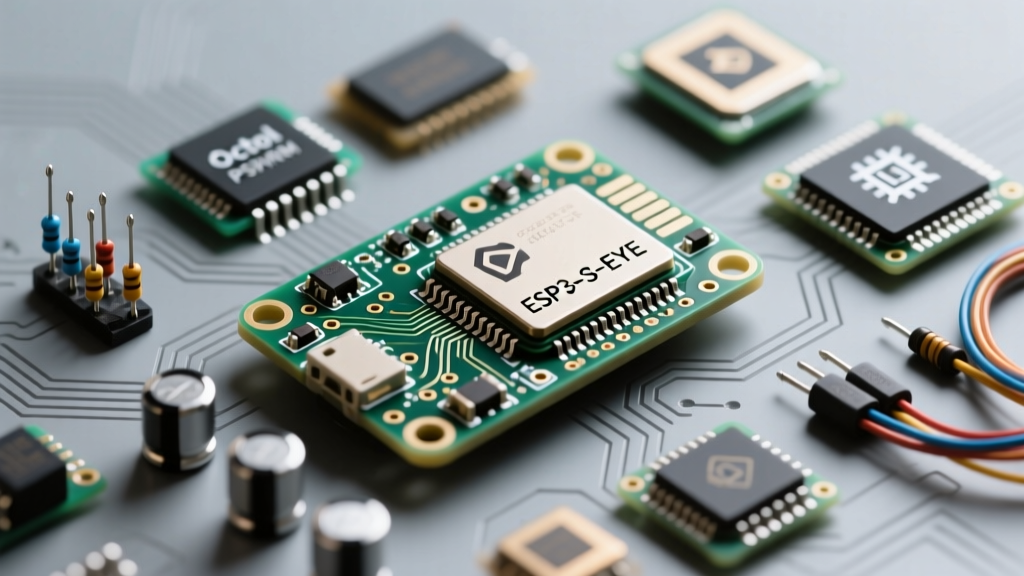

The transition from simple IoT telemetry to localized edge computing has fundamentally changed how makers and engineers approach embedded vision. At the center of this shift is the ESP32-S3-EYE, a compact development board that moves beyond basic Wi-Fi camera streaming into the realm of real-time, on-device neural network inference. Unlike its predecessors, which relied on cloud processing for image recognition, the ESP32-S3-EYE processes Convolutional Neural Networks (CNNs) directly on the silicon.
The Silicon Core: Xtensa LX7 and Vector Instructions
To understand why the ESP32-S3-EYE is capable of edge AI, we must look past the camera sensor and examine the underlying ESP32-S3-WROOM-1 module. The standard ESP32 utilized Tensilica LX6 cores, which were excellent for general-purpose RTOS tasks but lacked dedicated hardware acceleration for machine learning math.
The ESP32-S3 upgrades to dual-core Xtensa LX7 processors clocked at 240 MHz. More importantly, Espressif integrated 128-bit SIMD (Single Instruction, Multiple Data) vector instructions. In the context of edge AI, neural networks rely heavily on MAC (Multiply-Accumulate) operations to process tensor matrices. The SIMD instructions allow the ESP32-S3 to process multiple data points in a single clock cycle, accelerating vector and matrix computations by up to 3x compared to the original ESP32. This hardware-level optimization is what makes running quantized MobileNet or FOMO (Faster Objects, More Objects) models viable on a microcontroller.
Memory Bandwidth: The Octal PSRAM Advantage
Processing vision data requires massive temporary memory buffers. A single VGA (640x480) RGB565 frame consumes over 600 KB of RAM. The internal SRAM of the ESP32-S3 (roughly 512 KB) is insufficient for holding the frame buffer, the neural network weights, and the RTOS heap simultaneously.
Solving the Bottleneck with Octal SPI
The ESP32-S3-EYE typically ships with 8MB of Octal SPI PSRAM. This is a critical architectural divergence from older boards that used Quad SPI PSRAM. Quad SPI bottlenecks memory bandwidth at roughly 40-80 MB/s, leading to severe frame tearing and DMA (Direct Memory Access) overflows when the camera captures an image while the NPU reads model weights. Octal SPI doubles the data bus width, pushing bandwidth past 160 MB/s. This ensures that the OV2640 sensor can write to the PSRAM frame buffer via the DVP (Digital Video Port) interface without starving the CPU cores fetching inference data.
Hardware Showdown: ESP32-CAM vs. ESP32-S3-EYE
When sourcing components for a vision project, engineers frequently debate between the ubiquitous AI-Thinker ESP32-CAM and the ESP32-S3-EYE. Below is a technical comparison highlighting why the S3 variant commands a higher price point (typically $18-$24 vs. $6-$9).
| Feature | Standard ESP32-CAM (AI-Thinker) | ESP32-S3-EYE |
|---|---|---|
| MCU Core | Dual-core Xtensa LX6 (32-bit) | Dual-core Xtensa LX7 (32-bit) + Vector Instructions |
| Max Clock | 240 MHz | 240 MHz |
| PSRAM Type | 4MB Quad SPI | 8MB Octal SPI |
| AI Acceleration | None (Software MAC only) | 128-bit SIMD Vector Instructions |
| USB Interface | CP2102/CH340 UART Bridge | Native USB OTG (No external bridge required) |
| Typical Use Case | Cloud-streaming security camera | Local Edge AI, Face Recognition, Object Tracking |
Edge AI Benchmarks: Real-World Inference
Theoretical specs are useful, but real-world inference times dictate whether a board can be used for continuous tracking or intermittent detection. Based on testing with Espressif's ESP-WHO framework and quantized INT8 models, here is how the ESP32-S3-EYE performs:
- Human Face Detection (MTMN Model): Processes a 320x240 frame in approximately 45ms (~22 FPS). This is fast enough for real-time pan/tilt servo tracking.
- FOMO Object Detection (MobileNetV2 backbone): Capable of identifying multiple distinct objects (e.g., cups, laptops, people) in a QVGA frame in roughly 30ms. The standard ESP32 struggles to push past 150ms per frame for similar architectures.
- Person Detection (YOLO-Fastest): Inference takes roughly 80ms. While not suitable for high-speed motion tracking, it is highly efficient for battery-powered PIR-triggered security logging.
Software Ecosystem: ESP-WHO vs. Edge Impulse
Hardware is only half the battle; deploying models to the ESP32-S3-EYE requires a robust software pipeline. Currently, two primary ecosystems dominate this space.
Espressif ESP-WHO and esp-dl
ESP-WHO is Espressif’s native, open-source image processing framework. It relies heavily on the esp-dl (Deep Learning) library, which is highly optimized for the Xtensa LX7 SIMD instructions. ESP-WHO is built on the ESP-IDF (C/C++ environment) and offers the lowest latency and smallest memory footprint. However, it requires developers to manually manage memory allocation and understand RTOS task pinning.
Edge Impulse Integration
For makers and engineers who prefer a streamlined machine learning operations (MLOps) pipeline, Edge Impulse provides official support for the ESP32-S3. You can train custom FOMO or MobileNet models in the browser, export them as an Arduino or ESP-IDF library, and flash them directly. While Edge Impulse abstracts away the complex tensor math, the resulting binary is slightly larger and may incur a 5-10ms latency penalty compared to hand-tuned ESP-WHO implementations.
Expert Insight on Memory Allocation: When writing custom inference loops on the ESP32-S3-EYE, never use standard
malloc()for your input tensors or frame buffers. Standard malloc allocates from internal SRAM, which will instantly trigger a panic when dealing with 300KB+ image arrays. Always useheap_caps_malloc(size, MALLOC_CAP_SPIRAM)to force allocation into the Octal PSRAM. Furthermore, align your tensor buffers to 16-byte boundaries to fully exploit the 128-bit SIMD vector instructions.
Thermal Management and Power Profiling
Running dual cores at 240 MHz while executing intensive MAC operations and streaming data over Wi-Fi generates significant heat. The ESP32-S3-WROOM-1 module on the ESP32-S3-EYE is shielded, but thermal throttling is a real failure mode in enclosed 3D-printed cases.
During peak inference combined with Wi-Fi transmission, the board can draw upwards of 380mA to 450mA at 5V. If powered via a standard USB port or a weak 3.3V LDO, the voltage droop will trigger the internal Brownout Detector (BOD), causing spontaneous reboots. To mitigate this:
- Ensure your power supply can deliver a continuous 1A at 5V.
- Disable Wi-Fi during the actual inference pass. Capture the frame, turn off the RF radio, run the CNN, and then power the radio back on to transmit the metadata. This duty-cycling drastically reduces thermal output and peak current draw.
- Apply a small copper heatsink or thermal pad directly to the top of the WROOM shield if operating in environments exceeding 35°C ambient.
Common Failure Modes and Debugging
When integrating the ESP32-S3-EYE into custom PCBs or enclosures, engineers frequently encounter specific hardware-level bugs:
- Camera Initialization Failures (I2C Contention): The OV2640 uses the SCCB protocol (an I2C variant) for configuration. If external I2C sensors (like a BME280) are placed on the same bus without proper pull-up resistors or bus multiplexing, the camera will fail to handshake, returning a
0x00or0xFFPID. - XCLK Frequency Overclocking: The ESP32-S3 drives the camera's XCLK pin. While the OV2640 datasheet supports up to 24 MHz, pushing the XCLK beyond 20 MHz on the ESP32-S3-EYE can cause DMA line-buffer overflows, resulting in green or purple horizontal banding across the captured image. Stick to 20 MHz for stable, artifact-free captures.
- PSRAM Cache Misses: If the CPU attempts to execute code directly from PSRAM (XIP) while the camera DMA is heavily saturating the Octal bus, the instruction cache will thrash, leading to Watchdog Timer (WDT) resets. Always ensure inference code resides in internal IRAM or Flash-mapped cache, reserving PSRAM strictly for data buffers.
For comprehensive register-level details on the camera interface and memory bus arbitration, engineers should consult the ESP32-S3 Technical Reference Manual.
Final Verdict for Makers and Engineers
The ESP32-S3-EYE is not merely an iterative upgrade; it represents a paradigm shift in embedded vision. By combining the raw throughput of Octal PSRAM with the mathematical efficiency of SIMD vector instructions, it allows developers to untether their vision projects from the cloud. Whether you are building an offline wildlife tracker, a privacy-centric smart home sensor, or an automated quality-control rig, understanding the architectural nuances of this board is the first step toward reliable, high-performance edge AI.