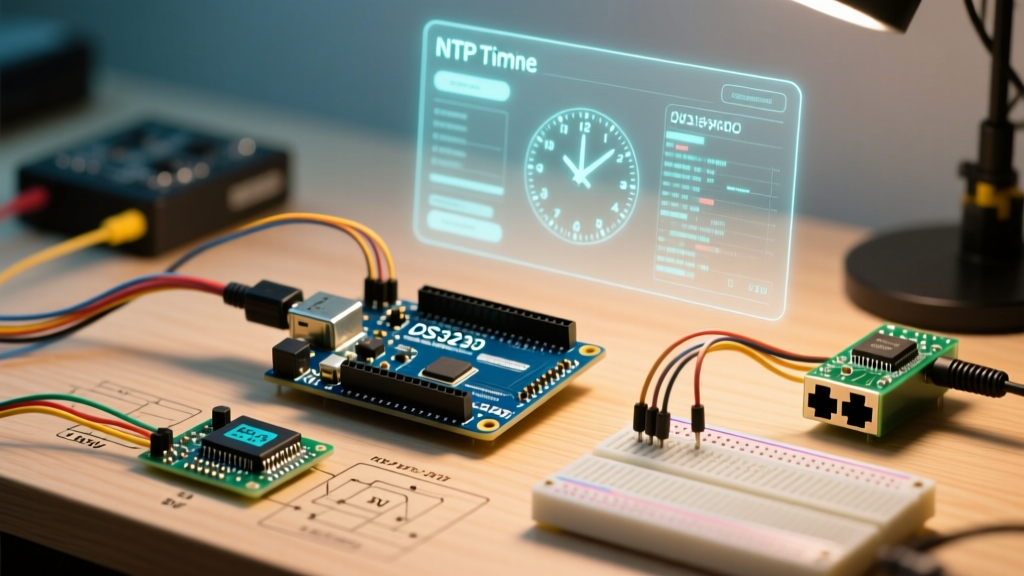

The Hidden Cost of Manual Timekeeping
Every experienced maker has encountered the same frustrating scenario: a remote datalogger, smart home controller, or automated greenhouse system suddenly logs data at the wrong hour, or triggers an actuator 60 minutes late. The culprit is almost always a hardcoded UTC offset that failed to account for the biannual clock shift. Managing arduino daylight savings time manually by updating firmware twice a year is a massive workflow bottleneck, especially for deployed IoT fleets or remote off-grid sensors.
As of 2026, global timekeeping rules remain fragmented. While the European Union's proposal to abolish seasonal clock changes remains stalled in legislative limbo, and regions like Arizona, Hawaii, and parts of Australia maintain their own exceptions, hardcoding time offsets is a guaranteed path to technical debt. To optimize your development workflow, you must transition from manual offset math to automated, rules-based time localization.
Rule Zero: The Epoch Architecture
The foundational rule of MCU timekeeping is simple: Never store or transmit local time. Local time is a fluid, politically dependent construct. Your Arduino or ESP32 should only ever calculate, store, and transmit time in Unix Epoch (seconds elapsed since January 1, 1970, 00:00:00 UTC).
By standardizing your internal architecture around Epoch time, you completely decouple your core logic from timezone rules. Time localization—converting Epoch to human-readable local time—should only occur at the very edge of your workflow, specifically at the display layer (OLED/LCD) or the logging export layer (SD card CSV). This ensures that your sensor polling intervals, PID control loops, and sleep cycles remain perfectly stable regardless of DST transitions.
Networked Workflow: POSIX Strings and NTP
For networked microcontrollers like the ESP32, ESP8266, or Raspberry Pi Pico W, the most efficient workflow leverages the Network Time Protocol (NTP) combined with POSIX timezone strings. This completely eliminates the need for third-party DST libraries.
According to the POSIX Standard (IEEE Std 1003.1), timezone rules can be defined using a standardized string format that the C standard library's tzset() function can parse natively.
Decoding the POSIX TZ String
Consider the POSIX string for US Eastern Time: EST5EDT,M3.2.0,M11.1.0. Here is the exact breakdown of this syntax:
- EST5EDT: Standard time is EST, 5 hours behind UTC. Daylight time is EDT.
- M3.2.0: DST begins in Month 3 (March), Week 2 (the second occurrence of the specified day), Day 0 (Sunday).
- M11.1.0: DST ends in Month 11 (November), Week 1, Day 0 (Sunday).
By passing this string to your ESP32 environment variables, the underlying lwIP stack handles the exact mathematical transition down to the second. Your workflow simply requires fetching the UTC Epoch from an NIST Internet Time Service server, and calling localtime(&epoch) when you need to print the time to a display.
Offline Workflow: AVR and the DS3231
What if your project is strictly offline? Standard Arduino Uno, Nano, or Mega boards lack native WiFi, relying instead on I2C Real-Time Clock (RTC) modules like the DS3231. Because the DS3231 hardware only tracks raw UTC or local time without an internal DST rule engine, you must handle the logic in software.
The optimal offline workflow utilizes Jack Christensen’s Timezone library. Instead of hardcoding dates, you define TimeChangeRule objects that calculate the exact transition timestamps dynamically for the current year.
For projects requiring global deployment without manual region-specific coding, advanced makers pull the IANA Time Zone Database (tzdata) during their CI/CD pipeline, compiling a localized lookup table into the AVR's PROGMEM. This ensures that a single firmware binary can be deployed globally, with the specific DST rules selected via a hardware DIP switch or EEPROM configuration byte on first boot.
Hardware Comparison Matrix
Choosing the right hardware and workflow combination depends on your project's connectivity and precision requirements. Below is a comparison of common MCU timekeeping workflows for DST handling.
| MCU Platform | RTC Hardware | DST Workflow Strategy | Accuracy / Drift | Approx. BOM Cost (2026) |
|---|---|---|---|---|
| ESP32 / Pico W | Internal RTC + NTP | POSIX TZ Strings via configTime() |
±10ms (NTP synced) | $4.00 (MCU only) |
| Arduino Nano | Genuine DS3231MZ | Timezone Lib + TimeChangeRules |
±2ppm (TCXO) | $6.50 (MCU + RTC) |
| Arduino Uno | DS3231 Clone | Timezone Lib + TimeChangeRules |
±20ppm (Tuning Fork) | $2.50 (MCU + RTC) |
| ESP32-S3 | PCF8523 + NTP | NTP Sync + POSIX Fallback | ±5ppm (when offline) | $8.00 (MCU + RTC) |
Edge Cases and Hardware Failure Modes
Automating your DST workflow is only half the battle; hardware anomalies can still corrupt your timekeeping. Understanding these failure modes is critical for E-E-A-T level troubleshooting.
The Clone Crystal Problem
Genuine Analog Devices (formerly Maxim) DS3231 chips utilize an integrated MEMS resonator and a Temperature-Compensated Crystal Oscillator (TCXO). However, the market is flooded with $0.90 counterfeit clones that substitute the MEMS resonator with a cheap 32.768 kHz tuning fork crystal. These tuning fork crystals exhibit severe parabolic drift at temperature extremes. If your outdoor datalogger experiences freezing winter temperatures, the clone RTC will drift significantly. When the DST transition occurs, the accumulated hardware drift combined with the software offset shift can cause your logs to misalign by several minutes, ruining data correlation.
I2C Bus Capacitance and Time Skips
When reading the time from an RTC module exactly at the moment of a DST transition, I2C bus noise can cause corrupted byte reads. If your code lacks CRC or sanity checks, a corrupted hour byte (e.g., reading 0x25 instead of 0x02) will cause your local time conversion to overflow. Always implement a sanity check in your I2C read function to verify that hours are < 24 and minutes are < 60 before passing the Epoch value to your localization layer.
The NTP Server Block
Many institutional and corporate firewalls block outbound UDP port 123, which NTP relies on. If your ESP32 fails to sync, it falls back to its internal RTC, which can drift by seconds per day. To optimize your networked workflow, always configure a fallback pool (e.g., pool.ntp.org, time.nist.gov, time.google.com) and implement a flag in your UI that alerts the user if the device has been running on unsynced internal time for more than 48 hours.
Future-Proofing Your Workflow
Optimizing your approach to arduino daylight savings time is ultimately about shifting from reactive maintenance to proactive architecture. By enforcing an Epoch-first internal logic, leveraging POSIX standard strings for networked devices, and utilizing dynamic rule libraries for offline AVR boards, you eliminate the biannual headache of manual firmware updates. This workflow not only saves hours of debugging but ensures your embedded systems remain robust, professional, and resilient against the unpredictable nature of global timekeeping legislation.