
The HC-06 in 2026: Why Serial Library Choice Dictates Success
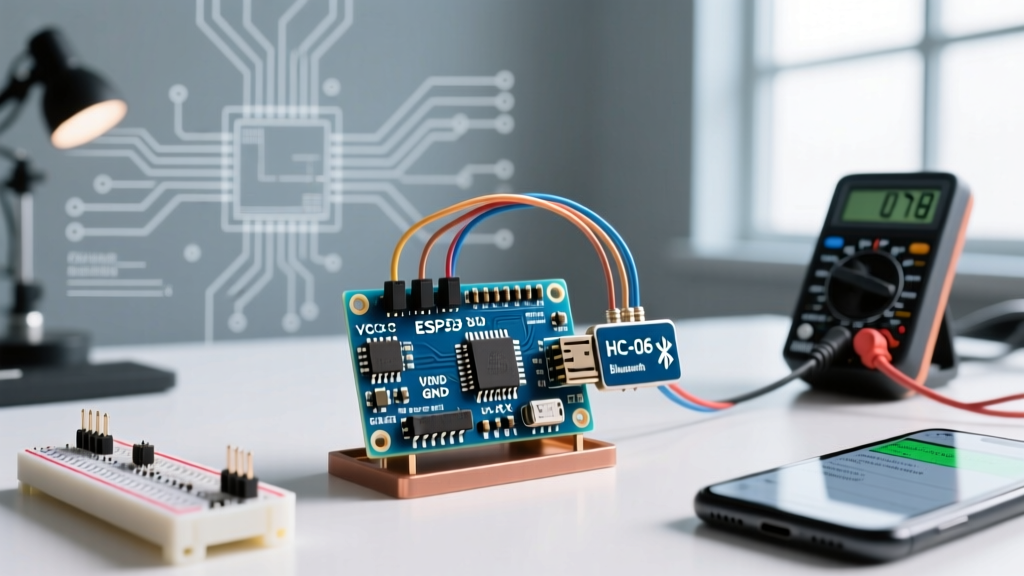
Despite the proliferation of BLE (Bluetooth Low Energy) modules like the ESP32 and nRF52, the classic bluetooth module hc 06 arduino integration remains a staple in industrial retrofits, legacy robotics, and low-cost educational kits. Priced between $3.50 and $5.00 in 2026, the HC-06 operates on the Bluetooth 2.0 Serial Port Profile (SPP). However, treating it as a simple "plug-and-play" serial pipe is a recipe for dropped packets and frozen microcontrollers.
The true bottleneck in any HC-06 project isn't the RF environment; it is the Arduino serial library managing the UART buffer. This deep dive dissects the software architecture required to make the HC-06 bulletproof, moving beyond basic Serial.read() loops into interrupt-safe buffering, custom AT command state machines, and non-blocking data ingestion.
The Core Library Dilemma: HardwareSerial vs. SoftwareSerial
The Arduino Uno and Nano (ATmega328P) possess only one hardware UART, which is typically monopolized by the USB-to-Serial converter for debugging. This forces developers to use software-based serial libraries to communicate with the HC-06. Choosing the right library is critical for maintaining timing accuracy in your main loop.
Library Comparison Matrix
| Library | Interrupt Impact | Max Reliable Baud | Pin Restrictions | Best Use Case |
|---|---|---|---|---|
HardwareSerial |
None (Hardware buffered) | 115,200 | Pins 0/1 (Blocks USB debug) | Mega2560, Teensy, ESP32 |
SoftwareSerial |
Disables interrupts on TX/RX | 38,400 (9,600 ideal) | None | Simple AT config, low-speed telemetry |
AltSoftSerial |
Uses Hardware Timers (Safe) | 38,400 | Blocks PWM on Pin 10 (Uno) | Motor control, encoder reading + BT |
According to the Arduino SoftwareSerial Reference, the standard SoftwareSerial library disables global interrupts while transmitting and receiving bytes. If your project relies on attachInterrupt() for wheel encoders or uses Servo.h (which relies on Timer1 interrupts), SoftwareSerial will cause severe jitter and missed pulses.
For projects requiring simultaneous motor control and Bluetooth telemetry, PJRC's AltSoftSerial Documentation provides the definitive alternative. By leveraging hardware timer input-capture and output-compare registers, AltSoftSerial allows background serial processing without freezing the CPU, albeit at the cost of Pin 10's PWM functionality on the Uno.
Deep Dive: Building a Custom AT Command Parser
One of the most pervasive myths in the maker community is that the HC-06 uses the same AT command syntax as the HC-05. It does not. The HC-05 requires Carriage Return and Line Feed (\r\n) terminators. The HC-06 requires no terminators and responds with concatenated strings.
Expert Insight: Sending
AT+BAUD8\r\nto an HC-06 will result in anERRORor no response. You must send the raw stringAT+BAUD8. Furthermore, the HC-06 does not have a dedicated KEY/EN pin to enter AT mode; it enters AT mode automatically only when unpaired and powered on, defaulting to 9600 baud (or 38400 on older firmware).
Rather than relying on bloated third-party wrapper libraries, writing a lightweight, non-blocking AT parser ensures your microcontroller remains responsive. Below is a structural approach to parsing HC-06 responses:
- Command:
AT| Response:OK - Command:
AT+VERSION| Response:OKlinvorV1.8 - Command:
AT+BAUD4(9600) | Response:OKsetBAUD - Command:
AT+NAMEFluxBot| Response:OKsetname
When coding the parser, implement a timeout mechanism. The HC-06 typically responds within 500ms. If your buffer reads nothing after 1000ms, the module is either paired (and thus deaf to AT commands) or wired incorrectly.
Non-Blocking Data Ingestion: The Ring Buffer Approach
The standard while(Serial.available()) loop is a blocking anti-pattern that starves your main application logic. When streaming sensor data from an Android device to an Arduino via the HC-06 at 9600 baud, you receive roughly 1 byte per millisecond. A 20-byte command takes 20ms to arrive—enough time to miss critical sensor readings.
Implementing a Software Ring Buffer
To handle burst data without blocking, implement a software ring buffer that decouples byte reception from packet parsing.
- Interrupt/Timer Level: Read incoming bytes into a fixed-size array (e.g., 128 bytes) and update the
headpointer. - Main Loop Level: A separate function checks if the
headandtailpointers differ, extracting bytes and looking for a delimiter (like\nor a specific hex header like0xFF 0xAA).
This architecture guarantees that your Arduino can process a 50-byte Bluetooth payload while simultaneously updating a PID loop for a balancing robot, completely eliminating the "stutter" effect common in naive SoftwareSerial implementations.
The 2026 Mobile OS Reality: SPP Limitations
Hardware and firmware are only half the battle. As of 2026, the mobile operating system landscape has severely restricted Classic Bluetooth SPP.
- iOS / iPadOS: Apple completely blocks access to the Serial Port Profile for non-MFi (Made for iPhone) certified devices. You cannot connect an HC-06 to an iPhone using standard terminal apps. iOS requires BLE (GATT profile).
- Android 14/15: Android still supports SPP, but background scanning and connection permissions have been heavily locked down. Developers using MIT App Inventor or native Kotlin must explicitly request and handle runtime permissions for
BLUETOOTH_CONNECTandBLUETOOTH_SCAN. For detailed implementation, refer to the official Android Bluetooth Permissions Guide.
If your project requires iOS compatibility, abandon the HC-06 immediately and pivot to an ESP32 running BLE UART or an HM-10 module. The HC-06 is strictly an Android, Windows, and Linux SPP solution.
Hardware Edge Cases: Voltage Translation and Baud Drift
Even with perfect library implementation, physical layer mismatches will corrupt your data. The HC-06 (whether based on the legacy CSR8645 or modern BK8000L clone chips) operates at 3.3V logic.
The Voltage Divider Mandate
Feeding 5V from an Arduino Uno's TX pin directly into the HC-06's RX pin will degrade the module's internal ESD diodes over time, leading to phantom characters and eventual silicon death. You must use a voltage divider:
- R1 (Series): 1kΩ resistor from Arduino TX to HC-06 RX.
- R2 (Shunt): 2kΩ resistor from HC-06 RX to GND.
This configuration drops the 5V logic high down to a safe ~3.33V. The HC-06's TX pin outputs 3.3V, which is reliably recognized as a logic HIGH by the Arduino's 5V ATmega328P RX pin, requiring no level shifting on the return path.
Baud Rate Drift at High Speeds
While the HC-06 supports baud rates up to 1382400 via AT commands, SoftwareSerial cannot reliably sample above 38400 baud due to CPU cycle limitations and oscillator tolerances. At 115200 baud, the ATmega328P's internal UART has a known -3.5% error rate, which, combined with the HC-06's crystal tolerance, results in framing errors. For the bluetooth module hc 06 arduino ecosystem, 9600 baud remains the undisputed standard for stability, while 38400 is the absolute ceiling for AltSoftSerial reliability.
Summary: Architecting for Reliability
Mastering the HC-06 requires looking past its low price tag and treating it as a strict, timing-sensitive UART peripheral. By migrating away from blocking SoftwareSerial calls, implementing custom non-blocking ring buffers, respecting the quirks of its terminator-less AT command set, and adhering to 3.3V logic translation, you can extract enterprise-level reliability from this legacy SPP module in your modern embedded projects.