
The Core Mechanism: How to Test Voltage With a Digital Multimeter
Voltage is the electrical potential difference between two points—essentially the "pressure" pushing electrons through a conductor. If you are wondering how to test voltage with a digital multimeter, the process hinges on understanding the difference between alternating current (AC) and direct current (DC), and selecting a tool with the right input protection for your environment.
Step-by-Step Voltage Testing Protocol
- Probe Placement: Insert the black test lead into the
COM(Common) jack. Insert the red test lead into theV/Ω(Voltage/Ohms) jack. Never leave the red lead in the current (Amps) jack when testing voltage, as this creates a dead short across the circuit and will blow the multimeter's internal fuse—or worse, cause an arc flash. - Select the Correct Mode: Turn the rotary dial to
V⎓for DC voltage (batteries, automotive, PCB logic) orV~for AC voltage (mains outlets, HVAC, appliances). - Range Selection: If your DMM is manual-ranging, start at the highest voltage setting (e.g., 600V or 1000V) and step down to increase resolution. Auto-ranging meters will handle this automatically, though they may take 1-2 seconds to lock onto the correct scale.
- Measure and Read: Place the probes in parallel with the component or circuit you are testing. For AC mains, probe the hot and neutral slots. For DC, ensure red touches positive and black touches negative; reversing them will simply yield a negative reading on a digital display.
The "Ghost Voltage" Phenomenon and LoZ Mode
When testing AC voltage in multi-conductor cables, you may read 40V to 90V on a disconnected wire. This is "ghost voltage" caused by capacitive coupling from adjacent live wires. Standard digital multimeters have a high input impedance (typically 10MΩ), meaning they draw almost zero current and are highly susceptible to picking up this phantom voltage.
To solve this, advanced meters feature a LoZ (Low Impedance) mode. LoZ drops the meter's input impedance to roughly 3kΩ, bleeding off the ghost voltage and revealing the true state of the circuit (0V). This is a critical feature for HVAC technicians and industrial electricians troubleshooting control wiring.
Equipment Roundup: Choosing the Right DMM for Voltage Testing
Not all multimeters are created equal. The accuracy, sampling rate, and safety architecture vary wildly between a $30 hobbyist meter and a $400 industrial tool. Here is our curated roundup of the best equipment for voltage testing across three distinct disciplines.
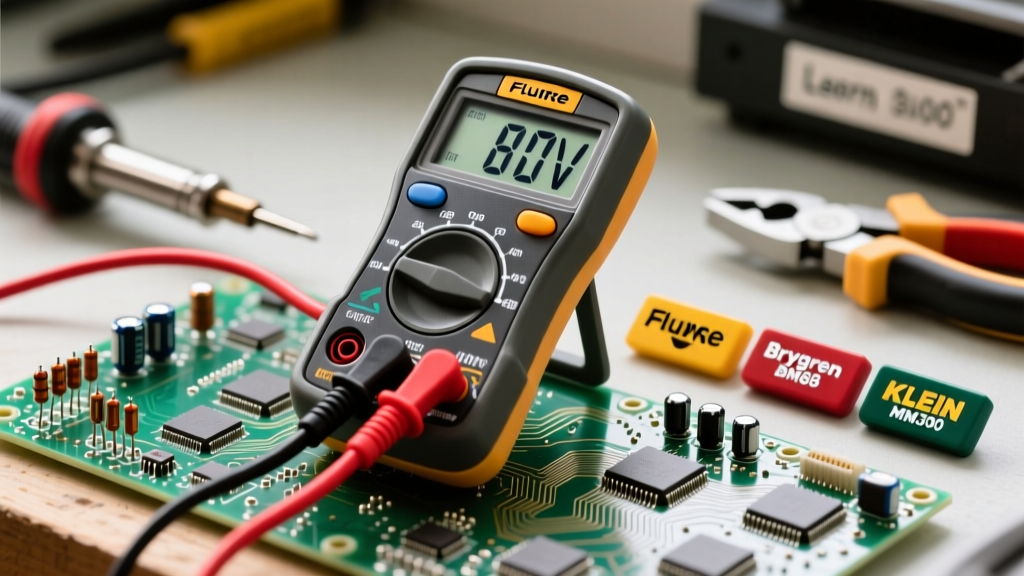
1. The Industrial Standard: Fluke 87V
For high-energy environments, the Fluke 87V remains the undisputed king. Priced around $420, it is an investment, but its voltage testing capabilities are unmatched. It features a built-in thermometer, a LoZ mode for eliminating ghost voltages, and a unique "Min/Max" capture mode that records voltage transients as fast as 250 microseconds—essential for catching voltage sags that cause motor contactors to drop out.
- Best For: Industrial electricians, HVAC troubleshooting, heavy machinery.
- Standout Feature: 20,000-count resolution in Min/Max mode; true-RMS AC+DC measurement.
2. The Electronics Bench Champion: Brymen BM235
Popularized by the EEVblog community, the Brymen BM235 (approx. $125) offers incredible value for electronics hobbyists and engineers. When testing low-voltage DC on a PCB, you need high resolution and fast continuity beeps. The BM235 delivers 6000-count resolution and exceptional build quality, including dual PTC thermistors that protect the meter's sensitive voltage circuitry from accidental overloads.
- Best For: PCB diagnostics, Arduino/Raspberry Pi projects, automotive 12V systems.
- Standout Feature: Exceptional input protection for the price point; highly accurate low-voltage DC readings.
3. The Budget DIY Kit: Klein Tools MM400
If you only need to check 120V household outlets, test AA batteries, and troubleshoot basic 12V car wiring, the Klein Tools MM400 (approx. $45) is a capable entry-level tool. It lacks LoZ and true-RMS capabilities, meaning it will struggle with non-linear loads like LED drivers or variable frequency drives (VFDs), but it handles basic sine-wave AC and steady DC voltage perfectly well.
- Best For: Homeowners, automotive beginners, basic DIY repairs.
- Standout Feature: Rugged drop-protection casing; highly accessible price point.
Comparative Breakdown: Voltage Testing Specs That Matter
| Feature / Model | Fluke 87V | Brymen BM235 | Klein MM400 |
|---|---|---|---|
| Price (Est.) | $420 | $125 | $45 |
| CAT Rating | CAT III 1000V / CAT IV 600V | CAT III 600V | CAT III 600V |
| DC Voltage Accuracy | ±(0.05% + 1) | ±(0.5% + 3) | ±(1.0% + 3) |
| True-RMS AC | Yes (AC+DC) | Yes (AC) | No (Average-Responding) |
| LoZ (Low Impedance) | Yes | No | No |
| Input Protection | HRC Fuses, PTCs | PTCs, Sacrificial Resistors | Glass Fuses |
Real-World Failure Modes & Safety Protocols
Understanding how to test voltage with a digital multimeter also requires understanding how multimeters fail. According to Fluke's official safety guidelines, the most catastrophic failures occur when a user tests high-energy AC voltage with the test leads plugged into the current (Amp) jacks, or when using a meter with an inadequate CAT rating on the mains supply.
Safety Warning: Never use a CAT II rated multimeter on a CAT III or CAT IV circuit, such as outdoor service entrances or industrial distribution panels. The CAT rating does not just measure maximum voltage; it defines the meter's ability to withstand high-energy transient spikes (like a nearby lightning strike or capacitor bank switching) without internal arcing. For deep electrical panel work, consult OSHA's electrical safety standards regarding PPE and arc flash boundaries.
The Danger of Glass Fuses
Budget multimeters often use cheap glass fuses for internal protection. If you accidentally subject the meter to a high-energy fault while testing voltage, a glass fuse can shatter inside the casing, ionizing the air and creating a conductive plasma path. This turns the multimeter into a bomb. Professional meters like the Fluke 87V use HRC (High Rupturing Capacity) ceramic fuses filled with sand to extinguish the arc instantly. If you are testing mains voltage regularly, upgrading to a meter with HRC fuses and upgrading your test leads to silicone, shrouded banana plugs (like Pomona or Amprobe) is a non-negotiable safety requirement.
Final Verdict on Building Your Voltage Testing Kit
Mastering voltage testing is a foundational skill for any electrical or electronics workflow. If your work involves life-safety circuits, high-energy mains, or industrial HVAC, bypass the budget options and invest in the Fluke 87V; its LoZ mode and transient capture will pay for themselves on the first complex diagnostic job. For the electronics hobbyist building a home lab, the Brymen BM235 offers the perfect intersection of safety, resolution, and price. Finally, for the casual DIYer keeping a kit in the kitchen drawer for checking dead outlets and car batteries, the Klein MM400 is a reliable, low-cost companion. Choose the tool that matches your environment's energy levels, respect the CAT ratings, and always verify your meter on a known live source before testing a dead circuit.