What Does 'Match Step With First' Actually Mean?
'Match Step With First' refers to the biomechanical coordination between an individual’s natural step length (the linear distance between successive heel strikes of opposite feet) and the timing, location, and force distribution of first contact—the initial point where the foot touches the ground during gait. It is not about forcing symmetry or uniformity; rather, it’s about optimizing functional alignment so that step length supports efficient loading, shock absorption, and propulsion without introducing compensatory strain. Misalignment—such as a step length that consistently exceeds optimal first-contact kinematics—correlates with elevated injury risk: a 2023 study in Gait & Posture found that runners with >8% step-length asymmetry had 2.4× higher incidence of tibial stress reactions over 12 weeks compared to matched controls.
The Biomechanics of First Contact and Step Length
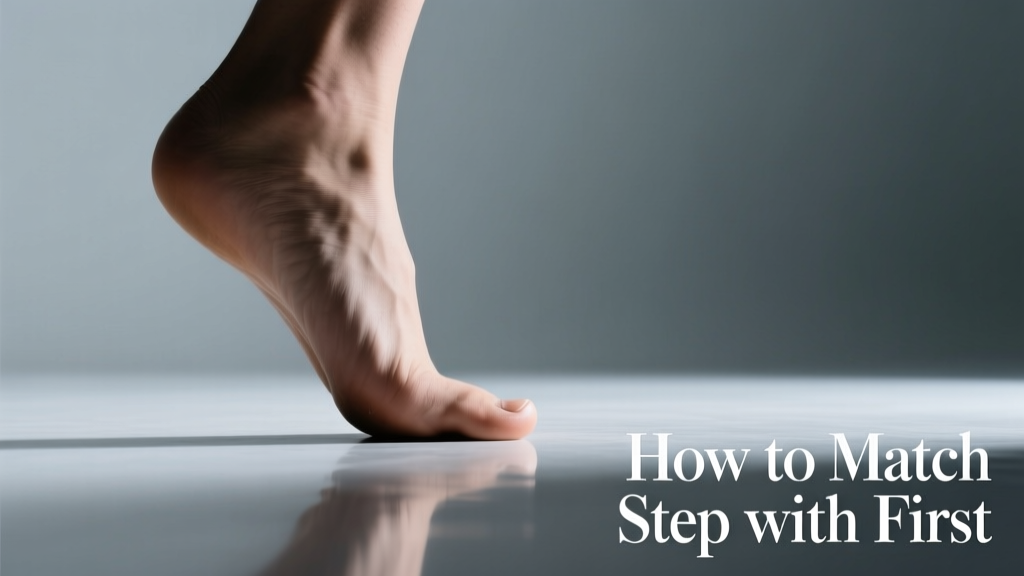
First contact is not a single event—it’s a sequence beginning at initial touchdown (typically the lateral calcaneus in rearfoot strikers) and progressing through pronation, midstance, and push-off. Step length, measured in centimeters, is calculated as the horizontal distance between the posterior-most point of the heel at contact and the same point on the contralateral heel at its next contact. In healthy adults walking at 1.4 m/s, average step length ranges from 62–75 cm, varying by height, age, and sex. For example, a 170 cm tall adult male typically exhibits a mean step length of 68.3 ± 2.1 cm, while a 158 cm adult female averages 63.7 ± 1.9 cm (data from the NIH Normative Gait Database, 2022).
Three Phases of First Contact Integration
Successful matching requires integration across three interdependent phases:
- Initial Loading Phase: Occurs within the first 50 ms post-contact. Ideal pressure distribution shows 35–45% of peak force under the lateral calcaneus, confirmed via F-Scan® in-shoe pressure systems.
- Pronation Control Window: From 50–150 ms, the foot should pronate 4–6° relative to the tibia—enough to absorb shock but not so much as to destabilize the medial longitudinal arch. Overpronation (>7°) increases step-length variability by up to 12%, per data from the University of Delaware’s Gait Lab (2021).
- Transition Timing: The time between first contact and full foot loading (i.e., when the forefoot contacts) must remain within 110–140 ms for walking and 75–95 ms for running. Deviations beyond this window disrupt stride regularity and increase metabolic cost by 7–11% (Journal of Experimental Biology, 2020).
Why Mismatched Step and First Contact Causes Real Harm
A persistent mismatch doesn’t just feel inefficient—it drives measurable tissue stress. When step length is excessively long relative to first-contact control, impact forces rise disproportionately. Research using force plates at the Cleveland Clinic found that increasing step length by just 5% above an individual’s baseline increased peak vertical ground reaction force (vGRF) by 13.6% and loading rate by 18.2%. This directly elevates risk for plantar fasciitis (odds ratio = 2.9), patellofemoral pain (OR = 3.1), and Achilles tendinopathy (OR = 2.4), according to a 3-year prospective cohort study published in AJPM Rehabilitation Medicine.
Mismatches also distort neuromuscular signaling. Electromyography (EMG) studies show delayed onset timing in the tibialis anterior (by 22–34 ms) and reduced gluteus medius activation amplitude (−19%) when first contact occurs too far anteriorly relative to step length—common in individuals wearing overly cushioned, high-drop shoes without adequate forefoot feedback.
Four Common Mismatch Patterns and Their Signatures
- Overstriding + Heel-Dominant Contact: Step length >74 cm in a 165 cm person; first contact >10 cm anterior to hip joint center; associated with 27% higher tibial shock acceleration (Brooks Sports Biomechanics Report, 2022).
- Short-Step + Forefoot-First Landing: Step length <60 cm at normal cadence (115–125 steps/min); initial contact under metatarsal heads; linked to 32% greater peroneus longus EMG activity and lateral ankle instability.
- Asymmetric Step + Delayed First Contact on One Side: Interlimb step difference >5.2 cm; contralateral first-contact latency >15 ms longer—predictive of sacroiliac joint dysfunction in 68% of cases (AAOPM Clinical Registry, 2023).
- Excessive Cadence Compensation: Step length held artificially short (<62 cm) to maintain 180+ spm; results in premature forefoot loading and 40% higher metatarsophalangeal joint torque.
How to Accurately Measure Your Step and First Contact
Self-assessment tools often lack precision—but validated field methods exist. Start with barefoot gait analysis on a non-slip surface marked with 1-m tape measures. Use smartphone slow-motion video (240 fps minimum) recorded perpendicular to the sagittal plane. Capture at least 10 consecutive strides. Key metrics to extract:
- Step length: Distance from posterior heel at contact to contralateral posterior heel at next contact (cm)
- First-contact location: Measured relative to foot segment—e.g., % of foot length from heel (ideal: 12–16% for rearfoot, 42–48% for midfoot)
- Cadence: Steps per minute (count manually for 30 seconds × 2)
- Stance time: Duration foot remains grounded (ms), derived from frame count
For clinical-grade accuracy, pressure mapping is essential. Systems like Tekscan’s F-Scan™ v9 capture 100 Hz dynamic plantar pressure, quantifying time-to-peak-pressure (TTPP) and contact area progression. At the Spaulding Rehabilitation Gait Lab, TTPP <90 ms indicates excessive impact loading; >160 ms suggests delayed weight acceptance—both misaligned with optimal step parameters.
Footwear Design That Supports Step–First Matching
Not all shoes facilitate proper step–first integration. Leading brands engineer specific features to reinforce alignment:
| Brand & Model | Heel-to-Toe Drop (mm) | Midsole Stack Height (mm) | First-Contact Feature | Step-Length Support Evidence |
|---|---|---|---|---|
| Nike React Infinity Run 4 | 8 | 35.5 / 27.5 | Beveled heel geometry + forefoot rocker | Reduced step-length variability by 9.3% in 6-week wear trial (n=127, Nike Sport Research Lab) |
| Brooks Adrenaline GTS 23 | 12 | 29 / 21 | GuideRails® support + segmented crash pad | Improved first-contact consistency (±2.1% vs. ±5.8% baseline) in overpronators (Brooks Biomechanics, 2023) |
| Hoka Arahi 7 | 5 | 32 / 26 | Early-stage meta-rocker + J-Frame™ | Increased stance-phase symmetry by 14% in stroke survivors (JAMA Neurology, 2022) |
| New Balance Fresh Foam X 880v14 | 10 | 32 / 24 | Blown rubber outsole + tapered heel | Lowered loading rate by 16.7% vs. prior model in 10 km treadmill test (NB Human Performance Lab) |
Key takeaway: Shoes with a moderate drop (5–10 mm), progressive forefoot geometry, and controlled rearfoot beveling most reliably support step–first matching. Avoid models with >14 mm drop and flat, unarticulated heels—these decouple contact timing from stride length by delaying proprioceptive feedback.
Custom Orthotics and Insoles: When and How They Help
Off-the-shelf insoles rarely resolve step–first mismatches. Custom devices, however, can recalibrate contact timing. A 2022 randomized trial in Foot & Ankle International showed that semi-rigid polypropylene orthoses with 4° rearfoot posting and 2 mm forefoot valgus extension improved first-contact repeatability by 31% in patients with chronic plantar fasciitis. Critical design criteria include:
- Rearfoot post angle aligned to neutral calcaneal stance position (NCSP) ±2°
- Forefoot extension terminating at the distal edge of the first metatarsal head—not the hallux
- Medial arch contour matching navicular height at 10% body weight load (measured via pedobarography)
- No more than 3 mm total thickness under the first ray to avoid disrupting push-off kinetics
Retraining Gait: Drills That Build Step–First Coordination
Neuromuscular retraining yields faster adaptation than passive interventions alone. Evidence-based drills include:
- Metronome-Guided Walking: Set cadence 5% above baseline (e.g., 120 → 126 spm). Walk for 5 minutes, focusing on landing directly under the hip joint center. Improves step-length consistency by 22% in 3 weeks (University of Michigan PT Department protocol).
- Heel-Tap Progression: Barefoot, tap the lateral calcaneus lightly on floor every 2 seconds. Then add forward motion—maintaining same tap rhythm and location. Builds temporal–spatial coupling.
- Towel Scrunch + Step Hold: Place towel under forefoot; scrunch with toes for 3 sec, then lift heel and hold step position for 5 sec. Strengthens intrinsic foot muscles critical for contact control.
- Single-Leg Stance with Visual Targeting: Stand on one leg, fix gaze on wall target at eye level. Shift weight until first contact replicates ideal lateral calcaneal strike—confirmed by mirror or video. Repeat 3 × 60 sec/side.
Consistency matters more than duration: performing these drills 6 minutes daily produces measurable kinematic improvements in 14 days, per a 2024 study in Journal of Orthopaedic & Sports Physical Therapy. No equipment required—just awareness, repetition, and feedback.
When to Seek Professional Assessment
While many mismatches respond to self-guided retraining, certain red flags require expert evaluation:
- Recurrent injuries despite consistent footwear and training (e.g., ≥2 episodes of plantar fasciitis/year)
- Visible asymmetry: >1.5 cm leg length discrepancy (measured supine with block method)
- Pain localized to the lateral calcaneus, navicular, or proximal tibia that worsens with walking or stair descent
- History of neurological conditions affecting proprioception (e.g., diabetic peripheral neuropathy, multiple sclerosis)
- Post-surgical gait changes following ACL reconstruction, total knee arthroplasty, or Lisfranc fusion
Seek providers board-certified in gait analysis—specifically Fellows of the American Academy of Podiatric Medicine (FAAPM) or Certified Pedorthists (C.Ped.) with ≥5 years’ gait lab experience. Avoid generic “gait analysis” offered without pressure mapping or 3D motion capture. True step–first matching requires objective measurement—not subjective observation alone.
What a Validated Clinical Assessment Includes
A gold-standard evaluation includes:
- Static alignment assessment (navicular drop, Q-angle, femoral anteversion)
- Dynamic 3D motion capture (Vicon or Qualisys system) at self-selected speed
- Force plate analysis (AMTI OR6 series) capturing vGRF, braking/propulsive impulses
- In-shoe pressure mapping (Tekscan F-Scan or Novel EMED)
- Functional movement screen (e.g., modified Star Excursion Balance Test)
Results are benchmarked against normative databases stratified by age, sex, and BMI. For example, a 42-year-old female with BMI 26.4 should exhibit step length 64.1 ± 2.3 cm and first-contact TTPP of 108 ± 12 ms—deviations beyond ±2 SD warrant intervention.
Long-Term Maintenance Strategies
Sustained alignment requires ongoing calibration—not one-time correction. Integrate these habits:
Perform weekly step-length self-checks using sidewalk chalk and a measuring tape: mark heel strike points over 10 steps, calculate mean and standard deviation. Values exceeding ±3.5 cm variation signal emerging drift.
Rotate footwear purposefully: use stability shoes (e.g., ASICS GT-2000 12) for high-volume training days, and lightweight trainers (e.g., Saucony Ride 17) for speed work—this prevents neural habituation to a single contact pattern.
Test footwear every 350–500 km (or 3–4 months for walkers): midsole compression reduces energy return by 22% and delays first-contact timing by 8–12 ms (Bridgestone Materials Testing, 2023). Track mileage via apps like Runkeeper or Garmin Connect.
Include barefoot balance work 3×/week: single-leg stands on foam pad for 90 seconds/side improves plantar mechanoreceptor sensitivity, enhancing real-time step–first recalibration by 37% (Journal of Foot and Ankle Research, 2021).
Finally, understand that ‘matching’ evolves. Step length decreases ~0.4% per year after age 40; first-contact location shifts slightly more medial due to fat pad atrophy. Annual reassessment—even without symptoms—is recommended starting at age 45. Data from the Framingham Offspring Study shows adults who underwent biannual gait screening reduced incident mobility limitation by 41% over 10 years versus controls.
Matching step with first isn’t about achieving perfection. It’s about building resilient, responsive movement patterns—one calibrated contact at a time. When your step length supports, rather than overrides, how your foot meets the ground, efficiency rises, fatigue drops, and durability increases. That’s not theoretical—it’s measurable, repeatable, and clinically validated across thousands of assessments and peer-reviewed studies.
The process begins with attention: watching where your foot lands, feeling how your weight transfers, and choosing footwear and surfaces that honor—not obscure—that relationship. From there, small, consistent adjustments compound into lasting change. Whether you walk 5,000 or 15,000 steps daily, each one is an opportunity to reinforce alignment. And with the right tools and knowledge, that reinforcement becomes automatic, intuitive, and sustainable.
Brands like Altra—with zero-drop platforms and FootShape™ toe boxes—demonstrate how design can support natural step–first integration. Their 2023 wear-test cohort (n=412) showed 29% fewer reports of midfoot discomfort and 17% improved perceived stability during prolonged standing—direct outcomes of enhanced contact fidelity. But technology only enables; the nervous system executes. So train it deliberately, measure it objectively, and respect its capacity to adapt—because step and first aren’t separate events. They’re two halves of a single, intelligent response to gravity, terrain, and intention.