
Quick Verdict: Which HC-SR04 Setup Do You Need?
The ultrasonic sensor HC-SR04 remains the undisputed workhorse of DIY distance measurement, robotics, and liquid level sensing. However, its native 5V logic and 15-degree acoustic beam angle require specific hardware pairings to avoid microcontroller GPIO damage and environmental crosstalk. Whether you are building an Arduino-based parking assistant or a Raspberry Pi water tank monitor, choosing the right module variant and accessory kit is critical.
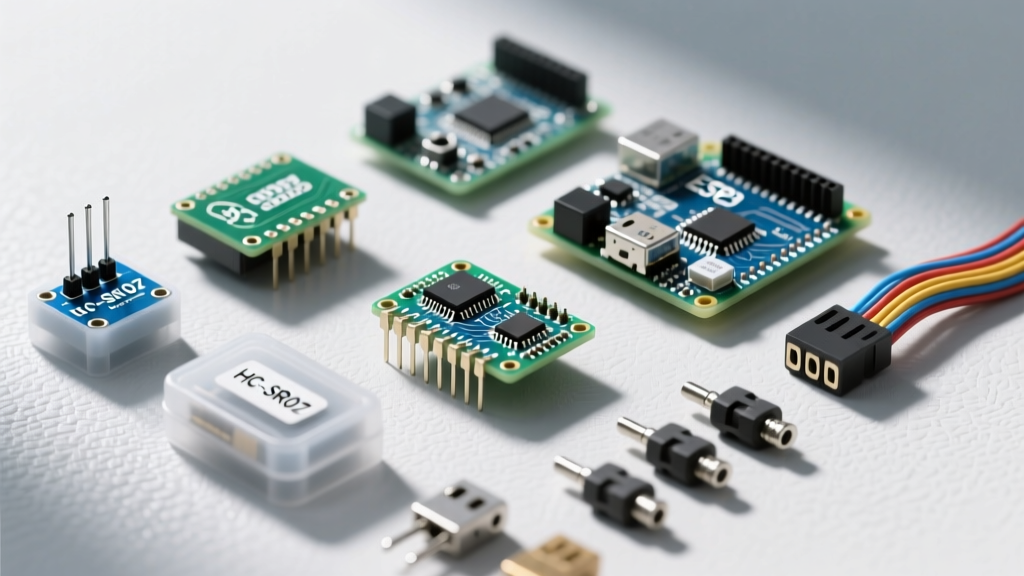
- Best Bare Module for 5V Systems: Standard HC-SR04 (4-pin). Ideal for Arduino Uno/Mega and legacy 5V logic boards.
- Best Upgrade for 3.3V Systems: RCWL-1601 or HC-SR04 with onboard voltage regulator. Essential for ESP32, ESP8266, and Raspberry Pi Pico.
- Best for Outdoor/Harsh Environments: JSN-SR04T (Waterproof). Features a sealed piezoelectric transducer and a 2.5-meter cable.
- Best Comprehensive Starter Kit: Elegoo Super Starter Kit. Includes the HC-SR04, breadboard, jumper wires, and a high-quality tutorial matrix.
The Hardware Matrix: Standard vs. Waterproof vs. 3.3V
Not all 40kHz ultrasonic modules are created equal. While the underlying timing protocol (a 10µs trigger pulse followed by an echo pulse) remains consistent, the physical construction and logic-level tolerance vary wildly. Below is a technical breakdown of the most common variants you will encounter in 2026 kits and marketplaces.
| Module Variant | Operating Voltage | Blind Zone | Max Range | Waterproof | Avg. Price |
|---|---|---|---|---|---|
| Standard HC-SR04 | 5.0V DC | 2 cm | 400 cm | No | $1.50 |
| JSN-SR04T V2.0 | 5.0V DC | 20 cm | 450 cm | Yes (IP67) | $4.50 |
| RCWL-1601 | 3.3V - 5.5V | 2 cm | 300 cm | No | $2.20 |
| HC-SR04P (3.3V) | 3.3V - 5.0V | 2 cm | 400 cm | No | $2.50 |
Engineering Note: The JSN-SR04T waterproof module has a significantly larger blind zone (20cm vs 2cm) due to the acoustic dampening required to prevent the sealed metal mesh from ringing after the 40kHz burst ceases. Do not use the JSN variant for short-range collision avoidance in micro-robotics.
Top Microcontroller Kits Featuring the HC-SR04
Buying the ultrasonic sensor HC-SR04 in isolation often leads to integration headaches, particularly regarding wiring harnesses and level-shifting resistors. Purchasing a curated kit ensures you have the necessary passive components to build robust circuits.
1. Elegoo Super Starter Kit (Arduino Focused)
Priced around $35, this kit is the gold standard for beginners. It includes the standard 5V HC-SR04, a high-quality solderless breadboard, and a ribbon cable for jumper wires. The real value lies in the included CD/USB documentation, which provides C++ code utilizing the pulseIn() function with proper timeout handling to prevent the microcontroller from hanging if the echo pin never goes HIGH.
2. Freenove Ultimate Starter Kit (Raspberry Pi Focused)
Interfacing a 5V sensor with a 3.3V Raspberry Pi GPIO is a common pitfall. The Freenove kit (approx. $45) specifically addresses this by including an array of precision resistors (1kΩ and 2kΩ) and a dedicated chapter on building voltage dividers. It also includes a Python script utilizing the gpiozero library's DistanceSensor class, which automatically handles the 3.3V logic thresholds and background threading for continuous polling.
3. Rexqualis ESP32 Robotics Bundle
For IoT applications, this $50 bundle pairs the ESP32 development board with the HC-SR04P (the native 3.3V variant). This eliminates the need for resistors entirely, allowing direct GPIO connection. The kit also includes an OLED display module for real-time distance readouts and MQTT integration guides for smart-home tank monitoring.
The 3.3V Logic Trap: Interfacing with ESP32 and Raspberry Pi
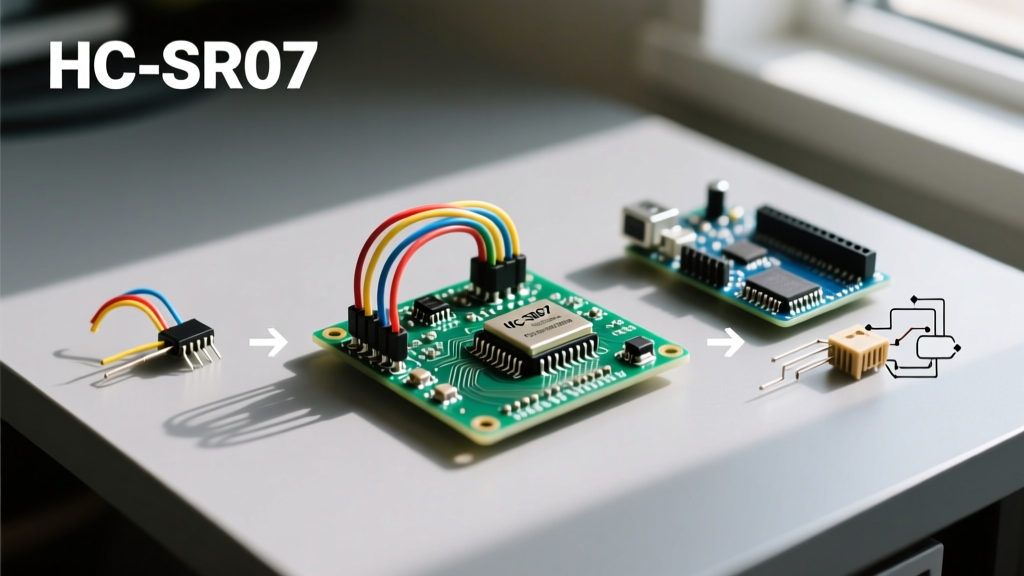
The most frequent cause of degraded performance or permanent hardware failure in modern DIY projects is connecting a standard 5V HC-SR04 Echo pin directly to a 3.3V microcontroller GPIO. While the ESP32 and Raspberry Pi can often read a 5V signal as a logical HIGH without immediate catastrophic failure, prolonged exposure to 5V on pins not explicitly marked '5V tolerant' will degrade the internal ESD protection diodes, leading to phantom triggers and eventual pin death.
According to Arduino's official hardware documentation and various Raspberry Pi GPIO schematics, you must step down the Echo signal. The most cost-effective method is a passive voltage divider.
Designing the Voltage Divider
To drop 5V down to a safe 3.3V, use the standard voltage divider formula: Vout = Vin * (R2 / (R1 + R2)).
- R1 (Series Resistor): 1kΩ (Connected between HC-SR04 Echo and MCU GPIO)
- R2 (Pull-down Resistor): 2kΩ (Connected between MCU GPIO and GND)
- Result: 5V * (2000 / 3000) = 3.33V. This sits perfectly within the safe logic HIGH threshold for 3.3V CMOS inputs.
Pro-Tip: Keep the physical wire length between the voltage divider and the microcontroller GPIO under 5cm to minimize capacitive load, which can round off the sharp edges of the echo pulse and introduce millimeter-level measurement errors.
Real-World Failure Modes and Calibration Frameworks
When building professional-grade prototypes, relying on the default speed of sound constant (343 m/s) will introduce significant errors. Furthermore, acoustic environments are rarely perfectly reflective.
1. Temperature and Humidity Drift
The speed of sound in dry air is highly dependent on temperature, governed by the equation v ≈ 331.4 + 0.6T (where T is in Celsius). At 0°C, sound travels at 331.4 m/s; at 35°C, it travels at 352.4 m/s. This represents a 6.3% variance. If your HC-SR04 is measuring a 400cm distance, a 35°C day will result in a false reading of ~425cm if uncalibrated.
The Fix: Integrate a cheap DHT22 or BME280 environmental sensor into your kit. Read the temperature, dynamically calculate the speed of sound in your code, and adjust the multiplier in your distance formula. As noted in physics references regarding the speed of sound in ideal gases, humidity also plays a minor role, though temperature compensation solves 95% of the drift.
2. Ghost Echoes and Acoustic Crosstalk
The HC-SR04 emits a 15-degree conical beam. If you place two sensors closer than 30cm apart and trigger them simultaneously, Sensor A will detect the acoustic bounce intended for Sensor B, resulting in erratic 'ghost' distances.
The Fix: Never use hardware interrupts to trigger multiple HC-SR04 modules simultaneously. Instead, implement a sequential polling loop with a 50ms delay between sensor reads. This allows the acoustic energy from the previous burst to dissipate below the noise floor of the receiver transducer before the next trigger pulse is sent.
3. The Soft Material Blindspot
Ultrasonic sensors rely on specular reflection. Soft, porous materials like acoustic foam, heavy fabrics, or certain types of insulation will absorb the 40kHz burst rather than reflect it. If your robot is failing to detect a cloth-covered obstacle, the issue is not the sensor's code, but the acoustic impedance of the target. For environments with soft obstacles, consider supplementing your kit with a Time-of-Flight (ToF) laser sensor like the VL53L0X.
Final Assembly and Wiring Best Practices
To maximize the lifespan and accuracy of your ultrasonic sensor HC-SR04 setup, adhere to these final assembly rules:
- Decoupling Capacitors: The HC-SR04 draws a sudden burst of current (up to 15mA) when the piezoelectric transducer fires. Place a 100nF ceramic capacitor directly across the VCC and GND pins on the sensor module to prevent localized voltage sags that can reset sensitive I2C devices on the same power rail.
- Mounting Orientation: When using the sensor for liquid level measurement, mount it perfectly perpendicular to the liquid surface. Even a 5-degree tilt will cause the acoustic beam to reflect off the water surface and away from the receiver, resulting in a timeout error.
- Cable Shielding: If extending the JSN-SR04T waterproof probe beyond its stock 2.5m cable, use shielded twisted-pair (STP) cable for the signal lines to prevent the high-impedance Echo line from acting as an antenna for ambient EMI from nearby stepper motors or relays.
By selecting the correct module variant for your voltage environment and compensating for acoustic realities, the HC-SR04 transitions from a fragile beginner toy into a highly reliable industrial prototyping tool.