Electricity can kill you because electrical current passing through the human body disrupts the natural electrical signals controlling the heart and respiratory muscles, leading to ventricular fibrillation or asphyxiation. When you accidentally touch an energized conductor, your body becomes a parallel path to ground, and the resulting current flow—driven by the source voltage and limited by your skin's resistance—dictates whether you walk away with a minor tingle or require immediate defibrillation.
The Lethal Thresholds: How Much Current Actually Kills?
The severity of an electrical shock is not determined by the voltage of the source you touched, but by the exact milliamps (mA) of current flowing through your vital organs. The International Electrotechnical Commission (IEC) standard 60479-1 maps out the physiological effects of 50/60Hz AC current passing through the human body from hand to foot. Understanding these thresholds is the foundation of all modern electrical safety codes and protective device design.
| Current (mA RMS) | Physiological Effect | Physical Consequence | Time to Effect |
|---|---|---|---|
| 0.5 mA | Perception Threshold | Mild tingling sensation at the contact point. | Instantaneous |
| 10 mA | "Let-Go" Threshold | Muscle tetany; forearm flexors contract, making it impossible to release the conductor. | 1 - 3 seconds |
| 30 mA | Respiratory Paralysis | Chest and diaphragm muscles lock; asphyxiation begins if current is not interrupted. | 10 - 30 seconds |
| 50 mA - 100 mA | Ventricular Fibrillation (VF) | Heart rhythm breaks down into chaotic quivering; blood circulation stops. Highly lethal. | 1 - 5 seconds |
| > 1,000 mA (1A) | Cardiac Arrest & Burns | Heart completely clamps; severe internal tissue burns; often fatal even if current is removed. | Instantaneous |
The Math of a Shock: A 120V Mains Worked Example
To understand how a standard household outlet pushes lethal current through the body, we have to look at Ohm’s Law ($I = V / R$). The human body is not a fixed resistor; it is a complex impedance network where the skin provides the vast majority of the resistance, while the internal tissues (blood, muscle, nerves) are highly conductive due to their electrolyte content.
Let’s calculate the current flow if a person touches a bare 120V AC hot wire while standing on a grounded surface. We will assume an internal body resistance of 500 Ω, which is standard for the path from one hand to the feet.
Scenario A: Dry, Intact Skin
Dry, calloused skin has a high resistance, typically around 100,000 Ω (100 kΩ).
Total Resistance: 100,000 Ω (skin) + 500 Ω (internal) = 100,500 Ω.
Current: $I = 120V / 100,500 Ω = 1.19 mA$.
Result: You feel a mild tingle (above the 0.5 mA perception threshold), but you are well below the 10 mA let-go threshold. You pull your hand away instinctively.
Scenario B: Wet, Sweaty, or Broken Skin
Water, sweat, or a minor cut bypasses the skin's dielectric barrier, dropping contact resistance to roughly 1,000 Ω.
Total Resistance: 1,000 Ω (skin) + 500 Ω (internal) = 1,500 Ω.
Current: $I = 120V / 1,500 Ω = 80 mA$.
Result: 80 mA is squarely in the ventricular fibrillation zone (50-100 mA). Your forearm muscles instantly lock (tetany), preventing you from letting go of the wire. Within two seconds, your heart enters fibrillation. Without intervention, this is fatal.
This mathematical reality is exactly why working on live panels with sweaty hands or in damp environments is a leading cause of residential electrocutions. The voltage didn't change; the skin's dielectric barrier failed.
Where You Meet This in Practice: Designing for Human Survival
Because we know the exact current thresholds that cause fibrillation and respiratory paralysis, electrical codes and tool manufacturers engineer specific fail-safes to interrupt the circuit before those thresholds are reached. Here is how this theory dictates real-world installations and tool selection.
Ground Fault Circuit Interrupters (GFCI)
A standard thermal-magnetic breaker in your panel is designed to protect the wire from melting, tripping at 15A or 20A. By the time a 15A breaker trips, a human body in the circuit would be vaporized. A GFCI, however, is designed to protect people. It continuously monitors the current on the hot and neutral wires. If it detects an imbalance as small as 5 mA (± 1 mA)—meaning 5mA is leaking to ground, potentially through a human—it trips the internal solenoid in under 25 milliseconds. This 5mA threshold is intentionally set below the 10mA let-go threshold, ensuring you can still release the conductor before muscle tetany locks your grip.
Class II (Double Insulated) Tools
When you look at a modern cordless drill or a two-prong soldering iron, you will see a symbol of two concentric squares. This indicates Class II insulation. Instead of relying on a ground wire (Class I) to trip a breaker if an internal short touches the metal casing, Class II tools use two independent layers of insulation. If the primary layer fails, the secondary layer prevents the chassis from ever becoming energized, entirely eliminating the shock hazard without needing a ground pin.
Multimeter CAT Ratings and Arc Blast
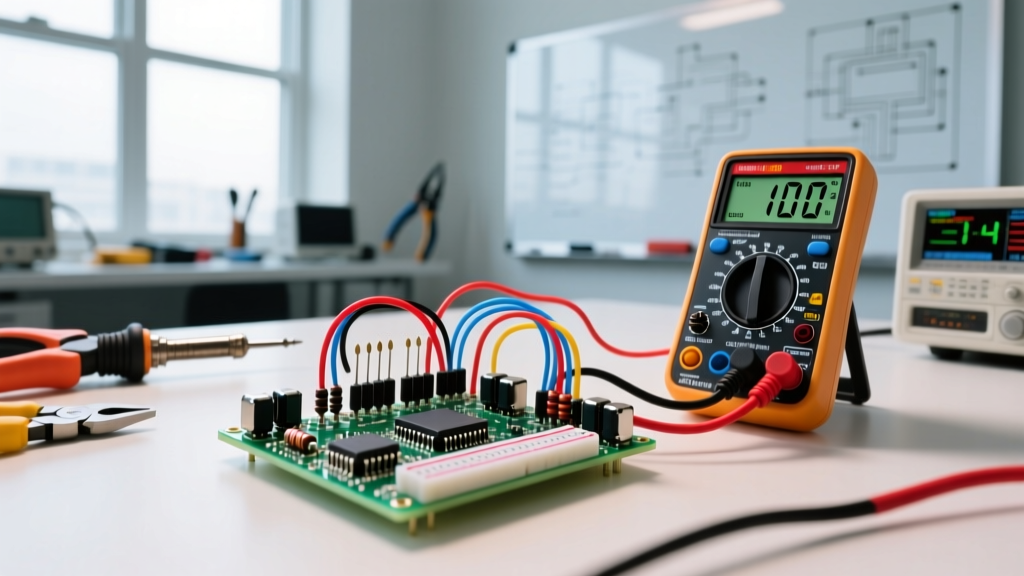
Electricity doesn't just kill via shock; it kills via arc flash. When measuring mains power, a cheap multimeter lacking proper internal clearances can short out, causing the meter to explode in your hands. Meters rated for CAT III 600V or CAT IV 600V (as defined by IEC 61010-1) contain High Rupturing Capacity (HRC) fuses and physical air gaps designed to safely interrupt transient voltage spikes up to 8,000V without shrapnel ejection. Always verify your meter's CAT rating matches the panel you are probing.
Common Confusions: Voltage vs. Current and the "Static" Myth
Ask any hobbyist about electrical safety, and they will inevitably recite the old adage: "It's not the volts that kill you, it's the amps." While technically true that current causes the biological damage, this phrase is dangerously misleading and leads to fatal complacency.
The Voltage Misconception
Voltage is the electromotive force—the pressure—required to push current through a given resistance. A 5V DC power supply might be capable of delivering 100 Amps, but it lacks the "pressure" to push that current through your 100,000 Ω dry skin. Conversely, a high voltage source is dangerous precisely because it can overcome skin resistance. Thinking "amps kill, so low-amp high-voltage is safe" is a fatal error. If the voltage is high enough to push 50mA through your specific skin resistance at that exact moment, it will kill you, regardless of the source's maximum current rating.
The Static Electricity Paradox
People often confuse static electricity shocks with mains power hazards. Walking across a carpet in dry winter air can build up a static charge of 15,000 Volts. When you touch a doorknob, that 15,000V easily breaks down the air gap and your skin's resistance. So why doesn't it kill you?
The answer lies in total energy and time. Static discharge involves incredibly low capacitance, delivering only a few micro-coulombs of charge over a fraction of a microsecond. The current spike is high for a nanosecond, but the average current over the critical milliseconds required to disrupt the heart's rhythm is virtually zero. Mains power, by contrast, is connected to an infinite bus (the power grid) that can sustain that lethal 80mA flow indefinitely.
Frequently Asked Questions
Can a 12V DC car battery kill you?
No. 12V DC cannot overcome the dielectric breakdown voltage of intact human skin. Even with wet skin, the resistance is too high for 12V to push the 50mA required for fibrillation. However, a short circuit across a car battery can deliver hundreds of amps, causing severe thermal burns or melting metal jewelry to your skin.
Why does AC shock feel worse and cause more muscle tetany than DC?
Alternating Current (50/60Hz) crosses zero 100 or 120 times per second. This rapid cycling perfectly matches the natural frequency of human nerve impulses, causing sustained, continuous muscle contraction (tetany). Direct Current (DC) typically causes a single, sharp muscle spasm that often physically throws the victim away from the source, though DC arcs are notoriously harder to extinguish and cause deeper thermal burns.
What PPE is required for live panel work?
For any diagnostic work where live parts are exposed, the NFPA 70E Standard for Electrical Safety in the Workplace mandates specific Arc Thermal Performance Value (ATPV) rated clothing, voltage-rated rubber insulating gloves with leather protectors, and polycarbonate face shields based on the calculated incident energy (cal/cm²) of the specific panel.