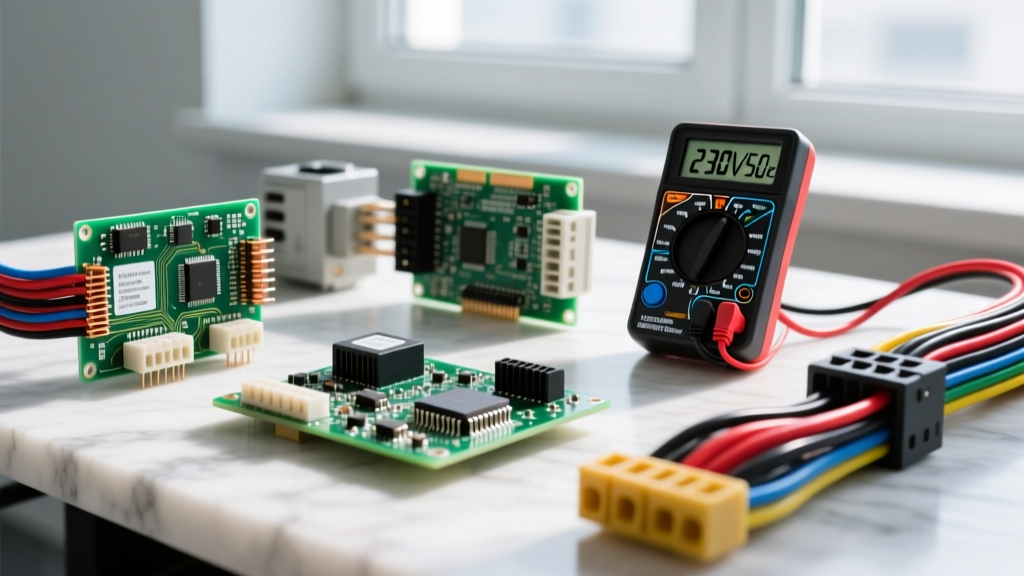
Direct Current (DC) is the unidirectional flow of electric charge, meaning electrons move steadily in one continuous direction from the negative to the positive terminal. Think of DC like a one-way street with a steady flow of traffic, whereas AC is a road where traffic constantly reverses direction. While the utility grid delivers Alternating Current (AC), figuring out what uses DC current is critical because almost every modern solid-state device internally converts that AC to DC. In a real circuit, using DC changes the rules: polarity becomes strictly enforced (reverse it and you fry the silicon), and you lose the complex impedance of AC, leaving only pure resistance to fight. People commonly confuse DC with 'low voltage,' assuming a 24V AC HVAC control wire behaves like a 24V DC battery circuit, which leads to disastrous component mismatches.
Where You Meet DC in Practice: The Modern Load Table
If you are wiring a home, building a solar array, or designing a bench power supply, you need to know exactly which loads demand direct current. According to research on DC microgrids and building loads by NREL, the proliferation of LED lighting, EV chargers, and smart electronics means the modern home is essentially a DC environment masquerading as an AC one.
| Device Category | Specific Example (2026 Models) | Nominal DC Voltage | Conversion Method |
|---|---|---|---|
| Smart Home Hubs | Philips Hue Bridge / Thread Border Routers | 5V to 24V DC | External AC/DC wall adapter |
| High-Performance Laptops | Dell XPS / MacBook Pro (USB-C PD 3.1) | 20V to 48V DC | External GaN AC/DC brick |
| Solar Off-Grid Control | Victron Cerbo GX & MultiPlus Inverters | 12V / 24V / 48V DC | Direct from battery busbar |
| Architectural LED Lighting | WAC InvisiLED Pro Tape Light | 24V DC | Remote dimmable DC driver |
| EV Charging Logic | Tesla Wall Connector (Control Board) | 12V DC | Internal Switch-Mode Power Supply (SMPS) |
The Math: A Worked Numeric Example on DC Voltage Drop
Because DC circuits lack the reactive components (inductance/capacitance) that complicate AC power factor calculations, voltage drop in a DC circuit is strictly a function of wire resistance and current. This makes wire sizing aggressively important, especially at lower voltages.
The Scenario: You are installing a 12V DC LED strip under a kitchen cabinet. The strip draws 5A at full brightness. The run from the 12V DC power supply to the strip is 30 feet one-way (60 feet total loop). You decide to use standard 14 AWG copper wire.
The Calculation:
- Wire Resistance: 14 AWG copper has a resistance of approximately 2.525 ohms per 1,000 feet.
- Total Loop Resistance: (60 ft / 1,000) * 2.525 Ω = 0.1515 Ω.
- Voltage Drop (V = I × R): 5A * 0.1515 Ω = 0.7575V dropped across the wire.
- Percentage Drop: (0.7575V / 12V) * 100 = 6.31% drop.
Bench War Story: When a 12V DC Fridge Setup Fails
Theory is clean; the jobsite is not. Here is a real-world scenario walkthrough demonstrating what happens when you size DC wiring for running current but forget about starting surges.
The Setup: A DIY camper van build using a 12V LiFePO4 battery bank (100Ah) powering a Dometic CFX3 45L 12V DC compressor fridge. The installer ran 25 feet of 10 AWG marine wire from the main busbar to the fridge receptacle.
The Numbers: The fridge draws a nominal 5A at 12V (60W) while the compressor is running. The 10 AWG wire was sized perfectly for this continuous 5A load, well within its ampacity rating.
The Outcome: On a 95°F day, the fridge compressor attempted to start, clicked rapidly, and threw an E1 (voltage drop) error code on the display, shutting down completely and risking hundreds of dollars in groceries.
What Went Wrong: The installer sized the wire for the running current, not the starting surge. DC compressor motors can pull 3 to 5 times their rated running current for a few hundred milliseconds to overcome initial rotor inertia. The surge hit 22A.
At 22A, the 50-foot total loop of 10 AWG wire dropped 1.12V just in the copper. Add connection resistances across the crimps, busbar, and battery terminals (roughly 0.02 Ω total), and that is another 0.44V lost. Total drop = 1.56V. Because the battery was partially discharged (resting at 12.2V), the voltage at the fridge terminals sagged to 10.64V. This tripped the fridge's internal 10.8V low-voltage cutoff protection.
The Fix: We upgraded the run to 6 AWG wire, cleaned the busbar terminals with DeoxIT, and torqued the lugs to spec. This dropped the total circuit resistance, keeping the starting voltage above 11.8V during the surge. For more on proper DC wire sizing and busbar management, the Victron Energy Wiring Unlimited whitepapers are the gold standard reference.
Sizing Protection for DC Loads: A Step-by-Step Approach
Protecting DC circuits requires different hardware than AC circuits. DC arcs do not have a 'zero-crossing' point to naturally extinguish, meaning a standard AC breaker can melt or catch fire if asked to interrupt a high-current DC fault. Follow these steps to properly protect your DC loads:
- Identify the Maximum Continuous Current: Calculate the total amperage of all loads on the branch circuit, then multiply by 1.25 per NEC continuous load guidelines.
- Select a DC-Rated Breaker or Fuse: Never use a standard residential AC breaker (like a Square D Homeline) on a battery bus. Use specifically rated DC breakers (e.g., Midnite Solar MNEPV or Bussmann CNN fuses) that feature magnetic blowouts or arc chutes to extinguish DC faults.
- Verify the AIC Rating: Lithium batteries can deliver massive short-circuit currents (often 3,000A to 10,000A+). Ensure your DC breaker or fuse has an Ampere Interrupting Capacity (AIC) that exceeds your battery bank's maximum fault current.
- Place Protection at the Source: In DC systems, overcurrent protection must be placed as close to the positive battery terminal as possible (ideally within 7 inches, or 18 inches if the wire is inside a conduit), not at the load end.
FAQ: Common DC Current Misconceptions
Can I use standard AC wire (like Romex NM-B) for DC circuits?
Physically, the copper conducts just fine, but code and safety practices differ. NM-B is rated for 600V AC. For DC, the insulation and arc-suppression characteristics of the termination hardware matter more. More importantly, DC requires strict color coding (usually red/black or positive/negative) and overcurrent protection rated specifically for DC. Always use DC-rated breakers for battery circuits to prevent arc fires.
Is all 'low voltage' wiring DC?
No, and this is a dangerous assumption. Landscape lighting often uses 12V or 24V AC from a magnetic transformer. HVAC thermostats use 24V AC. Mixing these up with DC loads will destroy the electronics or cause the AC transformer to overheat if it attempts to feed a DC-rectified load without proper smoothing.
Do solar panels output pure DC?
Yes, photovoltaic cells generate pure, unidirectional DC. However, the moment you connect an MPPT charge controller or a string inverter, high-frequency AC switching occurs internally to step up or step down the voltage. The panel wiring is DC, but the internal topology of modern power electronics relies on high-frequency AC conversion to achieve maximum efficiency.