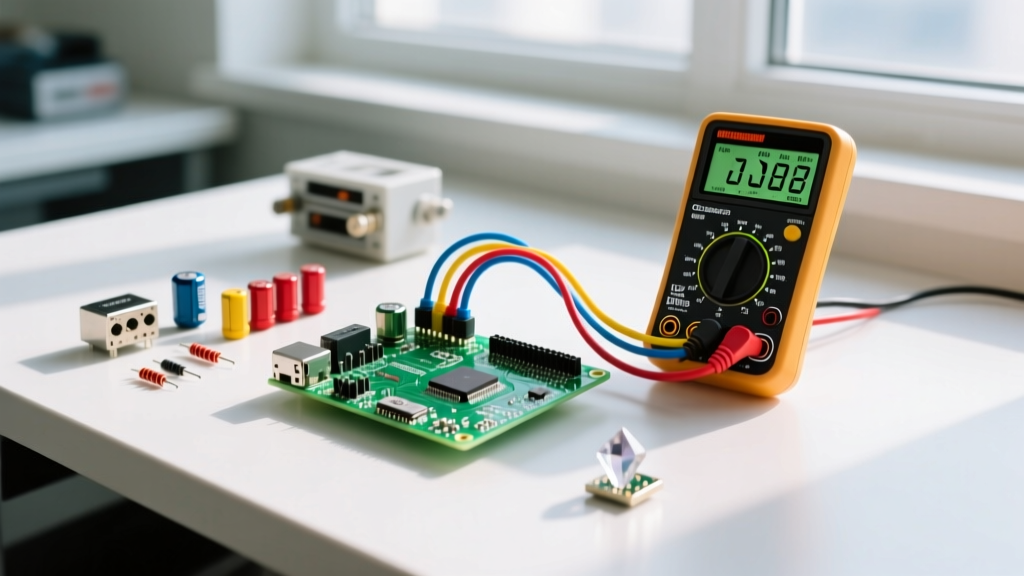

The direct answer is the Hertz (Hz), which is defined as one complete cycle per second. Whether you are troubleshooting a 60 Hz mains power grid, tuning a 32.768 kHz real-time clock crystal, or debugging a 20 kHz PWM signal on an ESP32, Hertz is the universal unit of frequency. In practical electronics and electrical work, knowing the unit is only half the battle; knowing how to accurately measure it with a digital multimeter (DMM) or oscilloscope is what actually gets the job done.
The Direct Answer: Hertz (Hz) and Its Multiples
Named after the German physicist Heinrich Hertz, the unit measures how often a periodic signal repeats its waveform in one second. According to the National Institute of Standards and Technology (NIST), the Hertz is the standard SI derived unit for frequency. In alternating current (AC) theory, one cycle consists of the voltage rising from zero to a positive peak, falling through zero to a negative peak, and returning to zero.
Because electronic signals span vastly different speeds, we use standard metric prefixes. Here is how the units break down in real-world applications:
| Unit | Abbreviation | Cycles per Second | Common Application |
|---|---|---|---|
| Hertz | Hz | 1 | AC Mains power (50 Hz or 60 Hz), audio bass frequencies |
| Kilohertz | kHz | 1,000 | AM radio broadcasts, switching power supply oscillators, RTC crystals |
| Megahertz | MHz | 1,000,000 | FM radio, microcontroller clock speeds (e.g., Arduino Uno at 16 MHz) |
| Gigahertz | GHz | 1,000,000,000 | WiFi (2.4 GHz / 5 GHz), modern CPU processing speeds |
For a deeper theoretical breakdown of sine waves and cycles, All About Circuits provides an excellent foundational text on AC waveform mechanics.
Multimeter Setup and Probe Placement for Frequency Testing
Most modern True-RMS digital multimeters (like the Fluke 87V or Brymen BM235) include a built-in frequency counter. The meter calculates frequency by detecting the zero-crossing points of the AC voltage waveform. Here is exactly how to configure your bench or jobsite gear.
Meter Setup Block
- Dial Position: Turn the dial to V~ (AC Voltage). Frequency is almost always measured as a secondary parameter alongside AC voltage. You cannot measure frequency in the Ohms (Ω) or DC Voltage (V⎓) modes.
- Lead Jacks: Insert the black lead into the COM jack. Insert the red lead into the V/Ω/Hz jack. Never use the high-current Amps jack for frequency testing.
- Range: Leave the meter on Auto-Range. If your meter has a dedicated "Hz" button, press it once to toggle the primary display from Volts to Hertz.
When measuring frequency on mains-energized circuits (120V/230V AC), your meter and test leads must be rated for the environment. Use a minimum of CAT III 600V for branch circuits and receptacles, or CAT IV 600V for service entrance panels. De-energize the circuit to verify your probe condition before testing live. Local electrical codes and OSHA regulations dictate that only qualified personnel should perform live panel measurements.
Probe Placement per Test Point
- AC Mains Receptacles: Place the black probe on the Neutral slot (or Ground U-slot) and the red probe on the Hot slot. The meter needs a reference potential to detect the zero-crossing.
- Variable Frequency Drives (VFDs): Place the black probe on the motor ground or DC bus negative, and the red probe on the VFD output phase (T1, T2, or T3). Crucial: If your meter has a Low-Pass Filter (LPF) button, engage it. VFDs output high-frequency PWM carrier waves that will confuse standard DMM zero-crossing detectors.
- Low-Voltage Digital/PWM (e.g., ESP32 GPIO): Black probe to the microcontroller GND pin. Red probe to the specific PWM output pin. Ensure your DMM can read low-voltage logic levels (some meters require at least 1V RMS to trigger the frequency counter).
Expected Readings: Good vs. Bad Values Across Common Circuits
A reading is only useful if you know what it should be. DMM frequency counters are highly accurate for clean sine waves but can be easily fooled by noise. Below is a reference table for common test points.
| Test Point | Nominal Target | Acceptable (Good) Range | Bad / Fault Value | Common Cause of Bad Reading |
|---|---|---|---|---|
| US Mains (120V) | 60.00 Hz | 59.50 - 60.50 Hz | < 58.0 Hz or > 62.0 Hz | Generator governor failure, severe grid instability, or heavy harmonic distortion triggering the meter early. |
| EU/UK Mains (230V) | 50.00 Hz | 49.50 - 50.50 Hz | < 48.0 Hz | Grid overload, inverter misconfiguration in off-grid solar setups. |
| VFD Motor Output | 45.00 Hz | 44.80 - 45.20 Hz | Erratic jumping (e.g., 12 Hz to 800 Hz) | Measuring the PWM carrier frequency instead of the fundamental. Fix: Enable the meter's LPF mode. |
| 32.768 kHz RTC Crystal | 32.768 kHz | 32.760 - 32.776 kHz | 0.00 Hz | Dead crystal, missing load capacitors, or DMM probe capacitance loading down the high-impedance circuit. |
| 555 Timer PWM | 1.00 kHz | 0.95 - 1.05 kHz | 0.00 Hz or 50/60 Hz | Timer not oscillating (bad wiring), or meter is picking up ambient mains hum due to a floating ground. |
Mistakes That Give Misleading Readings
The most common mistake makers and technicians make is ignoring harmonic distortion. A standard DMM measures frequency by counting how many times the voltage crosses 0V. If a signal has high-frequency noise or voltage spikes riding on top of the fundamental sine wave, the meter's internal comparator will trigger on the noise spike, registering a frequency that is double or triple the actual fundamental frequency.
Another frequent error is measuring across a DC-blocking capacitor without a proper ground reference. If the circuit lacks a DC bias path, the meter's input impedance can cause the waveform to float, resulting in a 0 Hz reading or erratic ghost numbers. Always verify your ground reference is solid.
Frequently Asked Questions About Frequency Measurement
What is the difference between measuring frequency and measuring RPM?
Frequency (Hertz) measures electrical or electronic cycles per second, while RPM (Revolutions Per Minute) measures mechanical rotation. However, they are mathematically linked in AC motors. The synchronous speed of an AC motor is dictated by the frequency of the power supply. For example, a 4-pole AC motor running on 60 Hz power has a synchronous speed of 1,800 RPM. The formula is: RPM = (120 × Frequency) / Number of Poles. If your multimeter reads 58 Hz on a VFD, your motor will run proportionally slower than its nameplate rating.
Why does my multimeter show 50 Hz or 60 Hz when the probes are not touching anything?
This is caused by capacitive coupling and phantom voltage. Digital multimeters have a very high input impedance (typically 10 Megohms). When the red probe is left floating in the air, it acts like an antenna, picking up the electromagnetic field radiating from nearby AC mains wiring in your walls or bench. The meter detects this induced AC voltage and calculates the frequency of the ambient grid power. To eliminate this, short the red and black probe tips together; the reading should immediately drop to 0.00 Hz.
Can I measure frequency on a pure DC circuit?
No. Pure, steady Direct Current (DC) has a frequency of exactly 0 Hz because the voltage never changes polarity or magnitude; there are no zero-crossings for the meter to count. However, if you are measuring pulsed DC—such as a PWM (Pulse Width Modulation) signal from a microcontroller, a buck converter switching node, or a fuel injector driver—there is a frequency. In these cases, the signal swings between 0V and a positive DC voltage (like 5V or 12V). Ensure your meter's AC coupling or Hz mode can handle signals that do not cross below 0V.
What tool is better than a multimeter for measuring high-frequency signals?
While a high-end DMM like the Fluke 87V can measure up to 200 kHz (or 50 MHz on specialized models), multimeters are generally the wrong tool for radio frequencies (RF) or high-speed digital clocks. For signals above 100 kHz, you should use an oscilloscope or a dedicated frequency counter. An oscilloscope allows you to visually verify the waveform shape, check for ringing, and measure the exact duty cycle, whereas a DMM only provides a single averaged number. For GHz-range signals (like WiFi or cellular), a spectrum analyzer is required.


