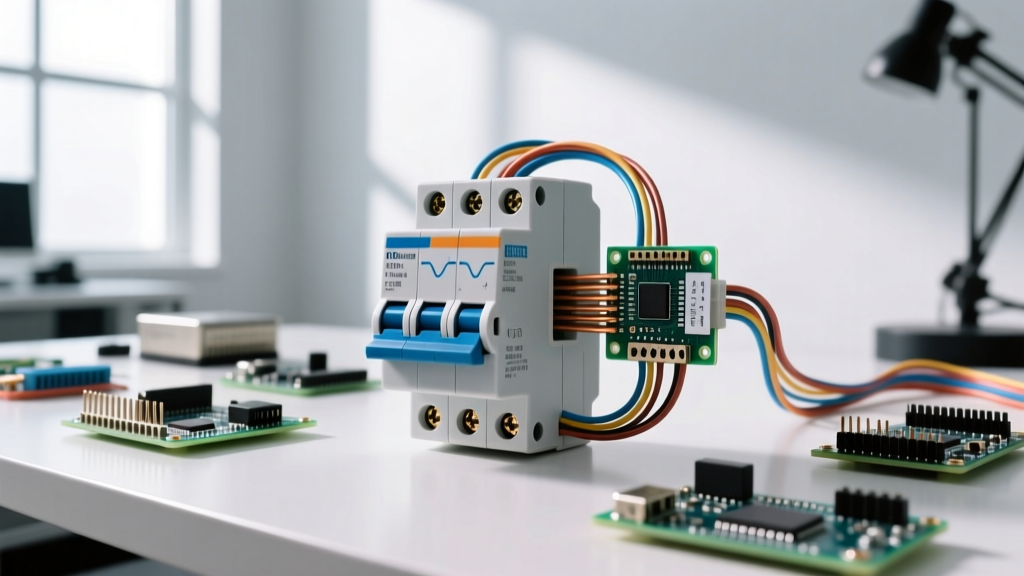

An MCB (Miniature Circuit Breaker) is an automatically operated electromechanical switch that protects a low-voltage electrical circuit from damage caused by overcurrent or short circuits by interrupting the current flow. Before MCBs became the standard, a fault meant tracking down a blown fuse and replacing a melted wire element. What the MCB changes in a real installation is the ability to instantly reset a tripped branch circuit without replacing components, while providing precise, repeatable trip thresholds that isolate specific faults without taking down the entire panel.
The Core Mechanics: Thermal and Magnetic Tripping
An MCB doesn’t just "break" when current gets too high; it uses two distinct physical mechanisms to handle two different types of overcurrent events. Understanding these is critical for selecting the right breaker for your load.
1. The Thermal Mechanism (Overloads): Inside the MCB, current passes through a bimetallic strip. When a sustained overload occurs (e.g., drawing 25A on a 20A breaker), the strip heats up and bends. Once it bends far enough, it unlatches the mechanical spring, opening the contacts. This is an inverse-time mechanism: a 10% overload might take an hour to trip, while a 50% overload trips in seconds.
2. The Magnetic Mechanism (Short Circuits): A short circuit dumps massive current (hundreds or thousands of amps) into the circuit instantly. The thermal strip is too slow to react before wires melt. Instead, the current passes through a small solenoid coil. The massive magnetic field instantly pulls a plunger that trips the latch in milliseconds (typically under 10ms).
Analogy: Think of the thermal trip like a highway toll booth slowly backing up traffic until the gate is forced to close; the magnetic trip is like a massive multi-car crash that instantly drops the barrier before traffic can even process it.
Where You Meet This in Practice
In residential and light commercial environments, you will find MCBs clipped onto standard 35mm DIN rails inside consumer units, subpanels, and industrial control enclosures. They are modular, typically 18mm wide per pole (in IEC regions) or varying widths in North American bolt-on panels.
Common industry workhorses include the Schneider Electric Acti9 iC60N, the ABB S200 series, and the Eaton FAZ line. While a standard 1-pole 20A residential MCB costs between $5 and $12, industrial variants with higher short-circuit breaking capacities (like 10kA or 15kA IC) and specialized trip curves can run $30 to $60 per pole.
Worked Numeric Example: Sizing an MCB for a Continuous Load
Let’s size an MCB for a 2400W resistive space heater running on a standard 120V single-phase branch circuit. Because this heater will run for 3 hours or more, it qualifies as a continuous load under NEC Article 210.20(A).
- Calculate Base Current: I = P / V → 2400W / 120V = 20 Amps.
- Apply the Continuous Load Multiplier: 20A × 1.25 = 25 Amps.
- Select the MCB Rating: The next standard breaker size above 25A is 30A. (A 25A breaker exists but is non-standard in many residential catalogs; 30A is the safe, code-compliant choice).
- Size the Conductor: The wire must also be rated for 125% of the continuous load (25A). 10 AWG copper THHN (rated 35A at 75°C) is the correct choice, safely handling the 30A MCB protection limit.
Real-World Scenario Walkthrough: The Nuisance Trip Failure
Theory is clean; the bench and jobsite are messy. Here is a classic scenario where ignoring MCB trip curves leads to endless frustration.
The Setup: A woodworker adds a 1.5 HP (approx. 11A Full Load Amps) air compressor to an existing workshop circuit protected by a 16A Type B MCB. The circuit uses 12 AWG wire, which is perfectly sized for the 16A breaker.
The Numbers: When an induction motor starts, it draws Locked Rotor Amps (LRA), which is typically 6 times the FLA. For this compressor, the inrush current is roughly 66 Amps for a fraction of a second. A Type B MCB has a magnetic trip threshold of 3× to 5× its rated current (In). For a 16A breaker, that magnetic trip zone is between 48A and 80A.
The Outcome: Every time the compressor kicks on, the MCB instantly trips with a loud mechanical click. The woodworker resets it, and it trips again on the next cycle. The running current (11A) is well below the 16A thermal limit, so the user assumes the breaker is defective.
What Went Wrong: The 66A inrush current fell squarely inside the lower bound of the Type B magnetic trip curve (48A). The breaker did exactly what it was designed to do: it interpreted the motor startup as a short circuit.
The Fix: Swap the Type B MCB for a Type C MCB (e.g., ABB S201-C16). Type C breakers have a magnetic trip threshold of 5× to 10× In (80A to 160A for a 16A breaker). This allows the 66A inrush to pass through harmlessly, while still providing instantaneous short-circuit protection if a true fault (e.g., 300A from a crushed cable) occurs.
What People Commonly Confuse It With
Misidentifying protective devices is a primary cause of unsafe installations. Here is how the MCB stacks up against its lookalikes.
| Device | Primary Function | Protects Against Shock? | Typical Application |
|---|---|---|---|
| MCB (Miniature Circuit Breaker) | Overcurrent & Short Circuit | No | Branch circuit wiring protection |
| RCD / GFCI (Residual Current Device) | Earth Leakage / Ground Fault | Yes (typically 5mA - 30mA) | Wet locations, personnel protection |
| RCBO (Residual Current Breaker with Overcurrent) | Overcurrent + Earth Leakage | Yes | Combined wiring and shock protection |
| MCCB (Molded Case Circuit Breaker) | High Overcurrent & Short Circuit | No | Main feeders, high-load industrial panels |
An MCB will never protect you from a ground fault or electric shock. If you drop a plugged-in hairdryer into a sink, a 20A MCB will not trip unless the water creates a dead short drawing hundreds of amps. For shock protection, you must pair the MCB with an RCD/GFCI, or use an RCBO. For deeper reading on trip characteristics and coordination, refer to the All About Circuits guide on breaker trip curves, and always consult the NFPA codes and standards for local NEC compliance.
FAQ: MCB Selection and Troubleshooting
Can I use a DC-rated MCB on an AC circuit, or vice versa?
No. AC current naturally crosses zero 120 times a second (in a 60Hz system), which helps extinguish the electrical arc that forms when the breaker contacts open. DC current has no zero-crossing. DC MCBs have specialized internal arc chutes and often feature strict polarity markings (e.g., "+" to "+"). Using an AC MCB on a DC solar string can result in an internal arc flash and melted housing.
Why is my MCB hot to the touch?
A slight warmth is normal when running near 80% capacity. However, if the plastic housing is too hot to comfortably keep your finger on (typically >60°C / 140°F), you have a problem. This is usually caused by loose terminal screws creating high contact resistance, or a daisy-chained busbar that is overloaded. Tighten the terminals to the manufacturer's specified torque (usually 2.0 to 2.5 Nm for standard 1-pole breakers) using a calibrated torque screwdriver.
What does the kA rating (e.g., 6kA vs 10kA) printed on the breaker mean?
This is the Short Circuit Breaking Capacity (Icn). It defines the maximum fault current the MCB can safely interrupt without welding its contacts shut or exploding. In a residential setting near a utility transformer, available fault current might reach 5,000A (5kA). A 6kA MCB is sufficient. In heavy industrial settings or close to large substations, fault currents can exceed 8kA, requiring a 10kA rated MCB. Always ensure the breaker's kA rating exceeds the available short-circuit current at the panel. For more on industrial breaker selection, see the ABB Miniature Circuit Breaker catalog.


