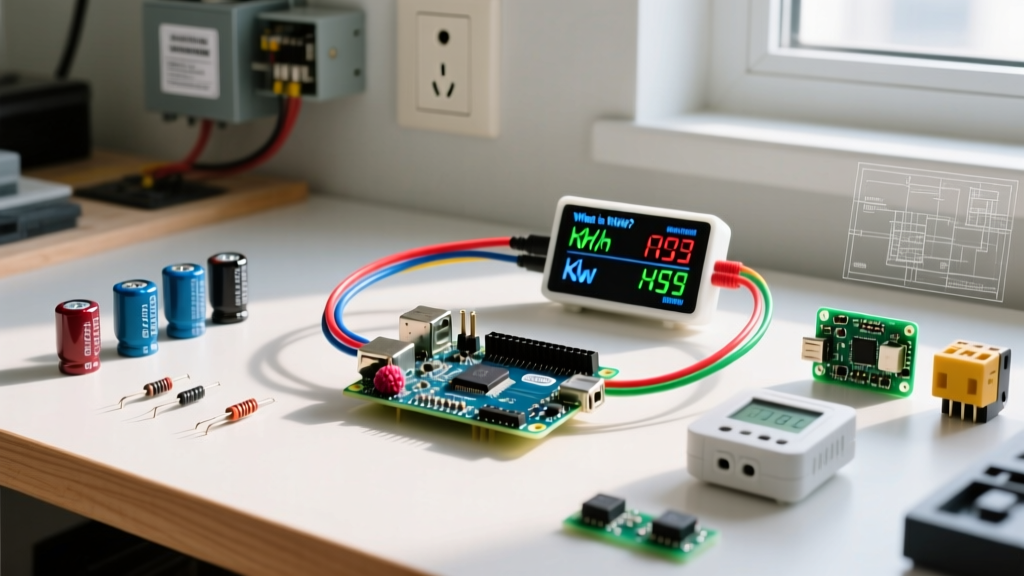

A kilowatt-hour (kWh) is a unit of electrical energy representing the consumption of 1,000 watts of power sustained continuously for one full hour. If you are searching for 'what is kw/h', you have likely spotted a common notational error on a forum, an inverter display, or a utility bill. The slash is a typo; the correct term for energy billing and consumption is kWh. Technically, 'kW/h' (kilowatts per hour) describes a ramp rate—how fast a power plant changes its output—but in 99% of home electrical, solar, and DIY contexts, you are actually dealing with kilowatt-hours.
The Difference Between kW, kWh, and the 'kW/h' Myth
To understand your electrical system, you must separate power from energy. This is where most DIYers and homeowners get tripped up.
- Kilowatts (kW): This is power—the instantaneous rate at which electricity is doing work right now. It dictates the size of the wires, breakers, and inverters you need.
- Kilowatt-hours (kWh): This is energy—the total volume of electricity consumed over time. This is what your utility company bills you for, and what your battery bank stores.
- Kilowatts per hour (kW/h): A measure of how quickly power output changes. Unless you are programming the governor on a utility-scale gas turbine, you will never use this metric.
Think of it like a garden hose filling a bucket. The water pressure and the diameter of the hose determine the flow rate right now (kW). The total gallons that end up in the bucket after an hour of watering is your energy (kWh). You cannot size the hose based on the bucket's final volume alone; you need to know the instantaneous flow rate to ensure the hose doesn't burst.
According to the U.S. Energy Information Administration (EIA), the average residential utility customer consumes roughly 899 kWh per month. Your utility meter does not measure kW; it continuously integrates your instantaneous power draw over time to tally your total kWh.
Worked Example: Calculating Appliance Energy Use
Let's look at real-world numbers to see how power (kW) translates to energy (kWh) and ultimately to your wallet. We will use a standard US residential electricity rate of $0.165 per kWh.
Scenario A: The Space Heater
You plug a standard 1,500W (1.5 kW) ceramic space heater into a 120V bedroom outlet. You run it for 4 hours while working at your desk.
- Power (kW): 1.5 kW
- Time: 4 hours
- Energy (kWh): 1.5 kW × 4 h = 6.0 kWh
- Cost: 6.0 kWh × $0.165 = $0.99
Scenario B: Level 2 EV Charger
You install a 48-amp Level 2 EV charger on a 240V circuit. The charger pulls a maximum of 7,200W (7.2 kW). You plug in your vehicle with a depleted battery and it charges for 8 hours.
- Power (kW): 7.2 kW
- Time: 8 hours
- Energy (kWh): 7.2 kW × 8 h = 57.6 kWh
- Cost: 57.6 kWh × $0.165 = $9.50
Notice how the space heater and the EV charger both run on standard household circuits, but the EV charger consumes nearly ten times the energy because of its higher instantaneous power draw sustained over a long period.
Where You Meet This in Practice
Understanding the boundary between kW and kWh dictates how you design, wire, and troubleshoot real electrical installations. Here is what this unit changes on the jobsite or the workbench:
Battery Bank Sizing: When building a 48V solar backup system, your batteries are rated in kWh (or Amp-hours, which convert to kWh). A single Tesla Powerwall 3 holds roughly 13.5 kWh of energy. If your house pulls an average of 2 kW of continuous power during an outage, that battery will theoretically last 6.75 hours (13.5 kWh / 2 kW = 6.75 h). You cannot size a battery bank using kW alone; you must calculate your daily kWh requirements.
Solar Panel Yield: Solar panels are rated in Watts (e.g., a 400W REC Alpha panel). But you buy them to generate energy. If your location gets 5 peak sun hours a day, that single 400W (0.4 kW) panel will generate roughly 2 kWh per day (0.4 kW × 5 h = 2 kWh). To offset a home using 30 kWh a day, you need at least fifteen 400W panels, assuming perfect efficiency.
Inverter Limitations: A 5,000W (5 kW) off-grid inverter can handle a maximum instantaneous load of 5 kW. However, the duration it can run that load depends entirely on the kWh capacity of the battery bank attached to its DC bus. Confusing the inverter's kW rating with the battery's kWh rating is the most common reason beginners end up with systems that shut down prematurely.
Frequently Asked Questions About Kilowatt-Hours
Why does my solar inverter say kW but my utility meter says kWh?
Your solar inverter display shows kW because you need to know your real-time power generation to ensure you aren't overloading the system or to see how well the panels are performing at this exact second under the current sun conditions. Your utility meter displays kWh because the utility company only cares about the total accumulated volume of energy you have exported to the grid or imported from it over the billing cycle.
How many kWh does an average house use per day?
In the United States, the average home consumes about 899 kWh per month, which breaks down to roughly 29.5 kWh per day. However, this varies wildly by region and climate. A home in Louisiana running central air conditioning might use 45 kWh a day in July, while a highly efficient, all-electric home in California with a heat pump and solar might pull less than 15 kWh a day from the grid. When sizing a backup generator or battery system, always calculate your specific daily kWh usage rather than relying on national averages.
Can I measure kWh with a standard digital multimeter?
No. A standard multimeter measures instantaneous Voltage, Current (Amps), and Resistance. To find kW, you can multiply Volts by Amps (on a purely resistive DC circuit or an AC circuit with a power factor of 1.0), but a multimeter cannot track this value over time to integrate it into kWh. To measure kWh at the appliance level, you need a watt-hour meter, commonly sold as a 'Kill A Watt' plug-in monitor, which samples the voltage and current hundreds of times per second and accumulates the total energy.
Is a higher kWh battery always better for solar backup?
Not necessarily, because you must look at usable kWh versus nameplate kWh. A 10 kWh lead-acid battery bank should only be discharged to 50% (Depth of Discharge) to prevent sulfation and premature death, giving you only 5 usable kWh. A 10 kWh Lithium Iron Phosphate (LiFePO4) battery can safely be discharged to 80% or 90%, yielding 8 to 9 usable kWh. Furthermore, if your inverter is only rated for 3 kW of continuous output, having a massive 50 kWh battery bank won't help you run a 5 kW electric oven; the inverter will trip its overload protection long before the battery is drained.


