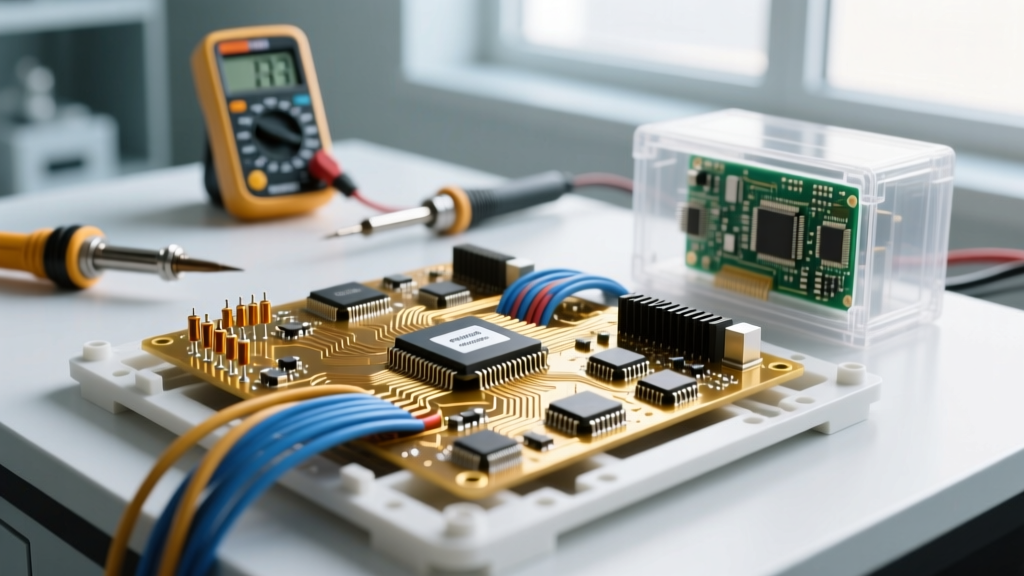
Electronic technology is the branch of engineering and applied physics that uses active components—like transistors, diodes, and integrated circuits—to control electron flow for processing information, amplifying signals, or intelligently managing power. While traditional electrical systems simply generate or distribute bulk energy, electronic systems manipulate that energy at the semiconductor level to perform logic, regulate voltage with high precision, and interface with digital microcontrollers.
The Physics of Active Control
To understand what electronic technology actually does on a workbench, you have to look at the semiconductor physics that makes it possible. In a purely electrical circuit, current flow is dictated by Ohm’s Law and the fixed physical properties of the conductors. If you want to change the current, you have to physically swap a resistor or change the source voltage.
Electronic technology introduces the concept of gain and switching via semiconductor bandgaps. A transistor, for example, allows a tiny control current (or voltage, in the case of a MOSFET) to dictate a massive load current. This means a 3.3V logic signal drawing mere microamps from a microcontroller GPIO pin can command a power circuit handling dozens of amps. This ability to use a small signal to control a large power flow is the foundational pillar of all modern automation, computing, and power electronics.
Numeric Example: Passive Electrical vs. Active Electronic Voltage Dropping
The difference between passive electrical distribution and active electronic control is best illustrated with a real-world power supply scenario. Suppose you are building an off-grid sensor node powered by a 12V LiFePO4 battery, and you need to step that voltage down to 5V to power an ESP32-WROOM-32 microcontroller that draws a peak current of 240mA (0.24A).
The Passive (Electrical) Approach: Series Resistor
If you rely purely on passive electrical components, you would use a series dropping resistor.
Math: Voltage to drop = 12V - 5V = 7V.
Resistance needed: R = V / I = 7V / 0.24A = 29.17 Ω.
Power dissipated by resistor: P = V × I = 7V × 0.24A = 1.68W.
You would need a bulky, expensive 3W or 5W wirewound resistor just to burn off the excess energy as heat. The overall system efficiency is a dismal 41.6%.
The Active (Electronic) Approach: Switching Buck Converter
Electronic technology solves this using a switching regulator like the Texas Instruments LM2596 buck converter. This IC uses an internal transistor to switch the 12V input on and off at 150 kHz, paired with an inductor and a Schottky diode to smooth the output.
| Metric | Passive Resistor (Electrical) | LM2596 Buck (Electronic) |
|---|---|---|
| Output Power (Load) | 1.20W | 1.20W |
| Input Power Drawn | 2.88W | 1.41W (assuming 85% efficiency) |
| Power Wasted as Heat | 1.68W | 0.21W |
| Battery Current Draw | 240mA | 117.5mA |
| System Efficiency | 41.6% | ~85.0% |
By utilizing active electronic switching, you cut the battery current draw in half and eliminate the need for a massive heat-dissipating resistor. Furthermore, if the battery voltage sags to 11V as it discharges, the passive resistor approach will cause the ESP32 to brownout and crash, whereas the electronic buck converter dynamically adjusts its duty cycle to maintain a rock-solid 5.0V output.
Where You Meet Electronic Technology in Practice
You interact with electronic technology constantly in modern electrical installations and maker projects, often without realizing the semiconductor complexity hiding inside the enclosures.
- Smart Home Relays: Traditional lighting used heavy, loud mechanical contactors. Modern smart relays (like the Shelly 1PM) use electronic TRIACs or power MOSFETs to switch AC loads silently, while an internal microcontroller handles WiFi communication and power monitoring via a shunt resistor and ADC.
- Solar MPPT Charge Controllers: Instead of just connecting a solar panel directly to a battery (which wastes power when the panel voltage exceeds the battery voltage), Maximum Power Point Tracking (MPPT) controllers use high-frequency electronic switching and microprocessors to constantly sample the panel's V-I curve, extracting maximum wattage.
- Motor Drives and ESCs: Running a 3-phase BLDC drone motor or an industrial VFD (Variable Frequency Drive) requires electronic technology. These devices use arrays of IGBTs (Insulated-Gate Bipolar Transistors) to synthesize precise, variable-frequency AC waveforms from a DC bus, allowing for exact speed and torque control that is physically impossible with standard electrical wiring.
Frequently Asked Questions
What is the difference between electrical and electronic technology?
Electrical technology focuses on the generation, transmission, and distribution of electrical power using passive components like copper wire, transformers, relays, and resistors. It deals with bulk energy flow. Electronic technology focuses on the control of that energy using active semiconductor components (diodes, transistors, ICs) to process information, amplify weak signals, or regulate power with high precision. A copper wire is electrical; the silicon chip that decides when to send current through that wire is electronic.
How does electronic technology change a real circuit installation?
Electronic technology changes a circuit by introducing intelligence, regulation, and efficiency. In a purely electrical installation, a 120V AC branch circuit simply delivers power until a breaker trips. When you introduce electronic technology—such as an AFCI (Arc-Fault Circuit Interrupter) breaker or a smart dimmer—the circuit gains the ability to monitor high-frequency current signatures, detect dangerous arcing conditions in milliseconds, and actively sever the connection before a fire starts. It shifts the installation from a "dumb pipe" delivering energy to a "smart system" managing safety and load profiles.
What are the foundational components of electronic technology?
The foundation rests on semiconductors. The most critical components include:
Diodes: Allow current to flow in only one direction, used for rectification and voltage clamping.
Transistors (BJTs and MOSFETs): Act as electrically controlled switches or amplifiers, forming the basis of all digital logic and power switching.
Integrated Circuits (ICs): Complex assemblies of millions of transistors on a single silicon die, including microcontrollers (like the ATmega328P or ESP32), operational amplifiers (op-amps), and voltage regulators.
Optoelectronics: Components like LEDs and photodiodes that convert electrical signals into light, or vice versa, enabling isolation and communication.