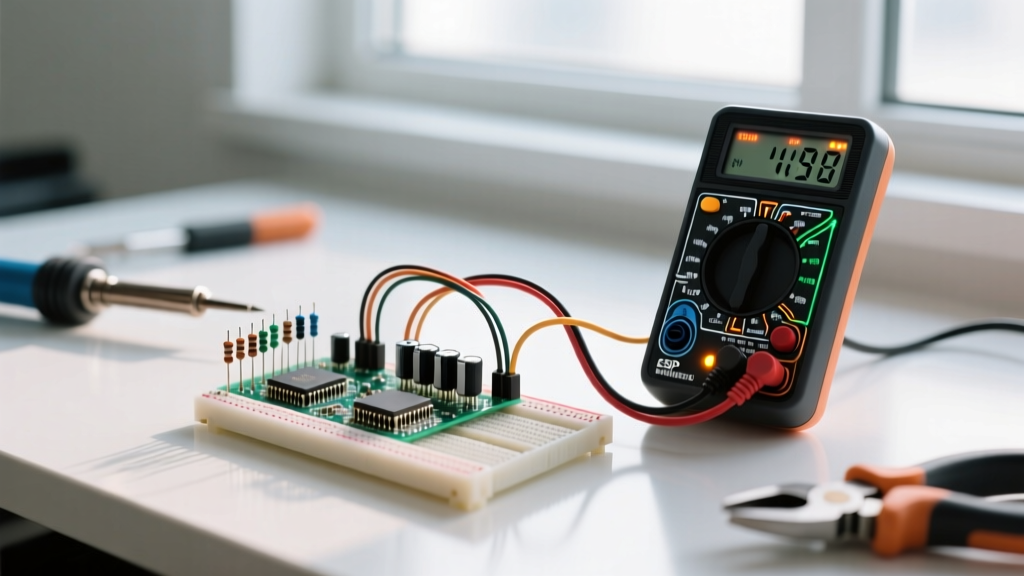
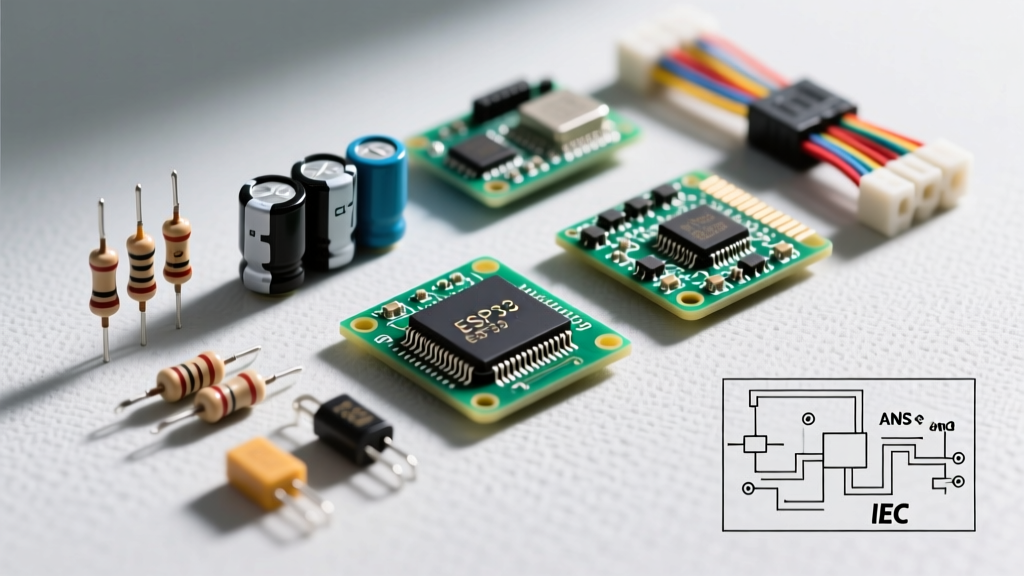
Electromagnetics is the study of how moving electric charges generate magnetic fields and how changing magnetic fields induce electric currents, forming the foundational mechanism for motors, transformers, and wireless energy transfer. When you close a switch and current flows through a wire, you aren't just moving electrons; you are projecting a magnetic field into the space around that conductor. When that field collapses or moves across another conductor, it forces electrons to move, generating voltage. This two-way street between electricity and magnetism dictates everything from the torque of a BLDC motor to the electromagnetic interference (EMI) radiating off an ESP32 SPI bus.
The Core Mechanism: Moving Charges and Changing Fields
At the bench, electromagnetics is governed by two primary rules that you must internalize to debug circuits effectively:
- Ampere's Law (Current creates magnetism): Any current flowing through a conductor generates a concentric magnetic field around it. Coil the wire, and the fields stack, creating a concentrated magnetic flux (the basis of solenoids, relays, and inductors).
- Faraday's Law of Induction (Changing magnetism creates voltage): A changing magnetic field passing through a loop of wire induces a voltage across that loop. This is how transformers step down 120V AC to 5V DC, and how alternators charge your car battery.
The Common Confusion: Makers and junior engineers frequently confuse electromagnetics with electrostatics. Electrostatics deals with stationary charges, voltage potentials, and capacitance (like the static shock from a doorknob or the energy stored in a ceramic capacitor). Electromagnetics strictly requires moving charges (current) and deals with inductance, magnetic flux, and radiation. If the current isn't changing or moving, you are in the realm of electrostatics, not electromagnetics.
Worked Example: The Destructive Power of Inductive Kickback
To understand why electromagnetics matters in a real circuit, let's look at inductive kickback. Inductance is the electrical equivalent of a mechanical flywheel: it takes energy to get the current flowing, and the magnetic field violently resists any attempt to stop it instantly.
Imagine you are using an ESP32 to switch a 12V automotive relay via a logic-level MOSFET. The relay coil has an inductance (L) of 50 mH and draws a steady-state current (I) of 100 mA. When the ESP32 pulls the MOSFET gate low, the transistor turns off in roughly 1 microsecond (dt = 1 µs).
We calculate the induced voltage spike using Faraday's derivative form:
V = -L × (di / dt)
- L = 0.050 H (50 mH)
- di = 0.1 A (current dropping from 100 mA to 0)
- dt = 0.000001 s (1 µs switching time)
V = -0.050 × (0.1 / 0.000001) = -5,000 V
The collapsing magnetic field generates a 5,000V reverse-polarity spike across the MOSFET drain.
Where You Meet Electromagnetics in Practice
Electromagnetics isn't just abstract theory; it dictates physical layout, component selection, and safety codes in real-world installations.
1. Home Wiring and NEC Conduit Rules
When AC current flows through a wire, it generates an alternating magnetic field. If you run the 'hot' wire through a metal conduit but leave the 'neutral' wire outside the conduit, the magnetic field from the hot wire will induce eddy currents in the metal conduit. This causes the conduit to heat up, potentially starting a fire. This is why NEC Article 300.3(B) strictly requires all conductors of the same circuit (hot and neutral) to be routed in the same raceway. Their opposing magnetic fields cancel each other out, resulting in a net-zero magnetic flux outside the cable bundle.
2. PCB Design and EMI/EMC
High-speed digital signals, like the 80 MHz SPI clock lines on an ESP32 or Raspberry Pi, act as tiny antennas. If the signal trace is routed far away from its ground return path, the loop area between the signal and the return current becomes large. According to electromagnetic theory, a larger loop area radiates more magnetic flux. This causes Electromagnetic Interference (EMI), which can desensitize onboard 2.4GHz WiFi antennas or fail FCC/CE EMC compliance testing. The fix is routing high-speed traces directly over a solid, unbroken ground plane to minimize the loop area.
3. Power Supplies and Transformers
Switch-mode power supplies (SMPS) rely entirely on electromagnetics. They use high-frequency switching (often 100 kHz to 2 MHz) to rapidly energize and de-energize a ferrite-core inductor or transformer. Because the frequency is so high, the magnetic components can be physically tiny compared to a 60 Hz linear transformer, which is why your modern 65W USB-C laptop charger fits in your pocket.
Frequently Asked Questions
What is the difference between electromagnetics and electrostatics?
Electrostatics deals with stationary electric charges, voltage gradients, and capacitance (energy stored in an electric field). Electromagnetics deals with moving charges (current), inductance, and the generation of magnetic fields. In a PCB, electrostatics dictates your trace capacitance and crosstalk via electric field coupling, while electromagnetics dictates your trace inductance, loop radiation, and magnetic coupling.
How does electromagnetics affect high-voltage home wiring?
Alternating current in home wiring generates constantly expanding and collapsing magnetic fields. If conductors are separated, these fields induce heating in nearby ferrous metals (like steel junction boxes or conduit) via eddy currents. It also causes inductive voltage drop over long runs. Keeping hot and neutral wires tightly bound together (or using properly manufactured NM-B Romex where they are twisted and jacketed together) ensures their magnetic fields cancel out, preventing inductive heating and reducing overall circuit impedance.
Why do we use twisted pair cables for data and low-voltage control?
Twisted pair cables (like Cat6 or RS-485 control wiring) are a direct application of electromagnetic cancellation. By twisting the two signal wires, any external magnetic interference induces an equal and opposite voltage in adjacent twists, effectively canceling out the noise. Furthermore, the magnetic field generated by the outgoing signal is tightly contained and canceled by the return signal, preventing the cable from radiating EMI into nearby sensitive audio or sensor circuits.
Can electromagnetics cause a breaker to trip without a short circuit?
Yes, primarily through inrush current and harmonic distortion. When you energize a large transformer or an AC motor, the initial magnetic flux buildup can draw 10 to 20 times the normal running current for a few milliseconds (magnetizing inrush). If the breaker's magnetic trip curve is too sensitive, it will interpret this electromagnetic surge as a short circuit and trip instantly. Additionally, non-linear loads (like cheap LED drivers) generate high-frequency electromagnetic harmonics that can cause nuisance tripping in AFCI (Arc-Fault) breakers, which are designed to detect the high-frequency electromagnetic signatures of electrical arcing.