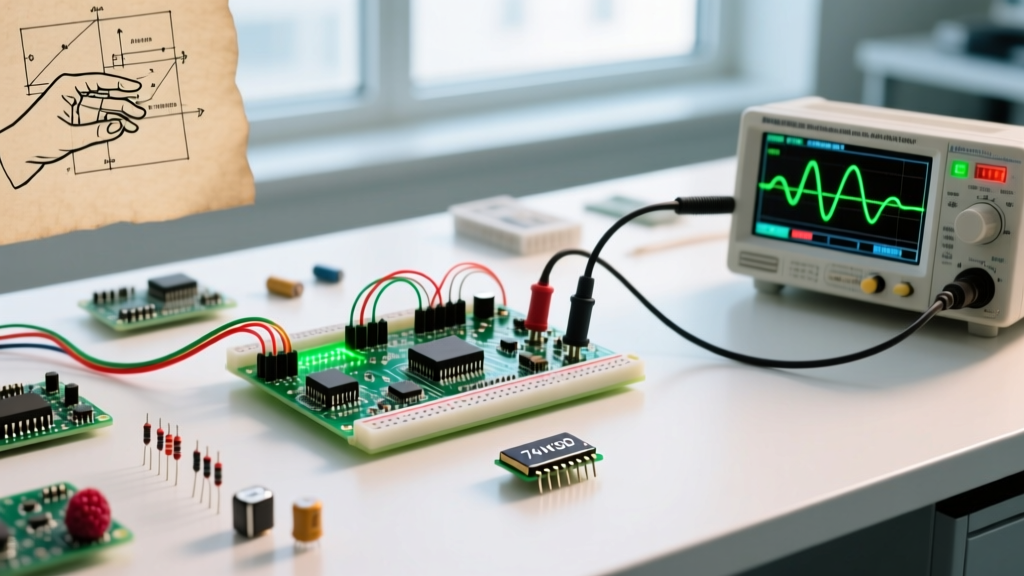
Direct Current (DC) is an electrical current where the flow of electric charge moves strictly in one direction, maintaining a constant polarity over time. Unlike Alternating Current (AC), which reverses direction in a sine wave pattern, DC provides a steady, unidirectional push of electrons from the negative terminal to the positive terminal of the source. This fundamental difference dictates everything from how we size wires to the specific types of circuit breakers required to safely interrupt the flow.
The Core Physics: Unidirectional Electron Flow
In a DC circuit, the voltage source establishes a fixed electric field. Electrons, which carry a negative charge, are repelled from the negative terminal and attracted to the positive terminal. Think of it like water flowing through a pipe equipped with a check valve: the fluid only travels one way, regardless of the pressure pushing it. Because the direction never changes, the frequency of a pure DC signal is exactly 0 Hz.
Beginners commonly confuse pure DC (like the output of a chemical battery) with pulsating DC (the unfiltered, bumpy output of a bridge rectifier before a smoothing capacitor is added). Another dangerous misconception is assuming all DC is 'low voltage.' While your phone charger outputs 5V DC, High-Voltage Direct Current (HVDC) transmission lines operate at 500kV to 800kV DC to move power across continents with lower line losses than AC.
Worked Numeric Example: Sizing a 12V DC Branch Circuit
Because DC systems in homes and workshops often operate at lower nominal voltages (12V, 24V, or 48V), they require significantly higher current to deliver the same wattage as a 120V AC circuit. This makes voltage drop and wire sizing critical.
The Scenario: You are wiring a 400W pure sine wave inverter to a 12V nominal LiFePO4 battery bank. The one-way wire run distance is 5 feet.
- Calculate Base Current: Using the power formula I = P / V, we get 400W / 12V = 33.3 Amps.
- Apply Safety Derating: The NEC (and standard engineering practice) requires a 125% continuous load multiplier for inverter feeds. 33.3A × 1.25 = 41.6 Amps.
- Select Wire Gauge: Looking at the 75°C column of NEC Table 310.16, 8 AWG copper THHN is rated for 50A, which covers our 41.6A requirement. However, we must check voltage drop.
- Calculate Voltage Drop: Using the standard DC voltage drop formula: VD = (2 × K × I × L) / CM.
- K (copper resistivity) = 12.9
- I (current) = 33.3A (using actual load, not derated load for drop calc)
- L (one-way length) = 5 feet
- CM (circular mils for 8 AWG) = 16,510
- Verify Percentage: 0.26V / 12V = 2.16%. This is under the recommended 3% maximum for DC branch circuits.
Where You Meet DC in Practice
You interact with DC constantly, even if your house is wired for AC. Modern electronics and renewable energy systems rely heavily on direct current.
- Solar Power Systems: Photovoltaic panels generate DC. It flows through DC-rated disconnects into a charge controller to charge a DC battery bank, before finally hitting an inverter to become AC for your home panel.
- USB-C Power Delivery (PD): The USB-C PD 3.1 standard negotiates DC power up to 240W (48V at 5A). Your laptop charger is essentially a high-frequency switching power supply converting 120V AC mains to tightly regulated DC.
- Electric Vehicles (EVs): The traction battery in an EV is a massive DC source, typically operating at a nominal 400V or 800V DC. The vehicle's onboard charger converts AC from the grid to DC to replenish the cells.
- Power over Ethernet (PoE): Network switches inject 44V to 57V DC directly into Cat6 ethernet cables to power access points and security cameras, eliminating the need for local AC outlets at the device.
What DC Changes in a Real Installation
Working with DC requires a different mindset than working with standard 120V/240V AC mains. The physics of direct current introduces specific hazards and installation rules.
1. Arc Suppression and Breaker Selection
AC voltage crosses zero 120 times a second (in a 60Hz system), which naturally helps extinguish electrical arcs when a switch opens or a breaker trips. DC never crosses zero. If you open a circuit under load, the DC arc will sustain, potentially melting the breaker contacts or starting a fire. You must use DC-rated breakers (like the Schneider C60H-DC or Midnite Solar MNEPV) which feature internal magnetic blowouts or arc chutes to forcefully extinguish the plasma arc. Never use a standard Square D Homeline AC breaker on a solar DC string.
2. Polarity Sensitivity
AC devices generally do not care which slot is hot and which is neutral at the component level. DC electronics are strictly polarized. Reversing the positive and negative leads on a 12V DC supply feeding an ESP32 dev board or a brushed motor controller will instantly destroy the voltage regulators and MOSFETs. Always use polarized connectors (like Anderson Powerpoles or XT60s) that physically prevent reverse insertion.
3. Galvanic Corrosion
When DC current leaks into a damp environment, it causes rapid electrolytic corrosion. This is why marine DC wiring requires tinned copper wire (like Ancor marine grade) rather than standard bare copper THHN, and why all outdoor DC terminations should be sealed with adhesive-lined heat shrink.
Frequently Asked Questions
What is the difference between AC and DC power?
The fundamental difference is the direction of electron flow. Alternating Current (AC) periodically reverses direction, creating a sine wave voltage profile, which makes it easy to step up to high voltages for transmission using transformers. Direct Current (DC) flows in only one direction at a constant magnitude, making it ideal for chemical energy storage (batteries) and digital electronics that require a steady voltage reference.
Can DC power shock you worse than AC?
Both are lethal at sufficient voltages, but they affect the body differently. AC at standard power frequencies (50/60Hz) is particularly dangerous because it can induce ventricular fibrillation in the heart at relatively low currents (around 30-50mA). DC tends to cause a single, violent muscle contraction that often throws the victim away from the source, whereas AC causes muscles to tetanize (lock on), making it harder to let go. However, high-voltage DC (like from a 400V EV battery or solar string) will cause severe internal burns and is absolutely lethal.
Why is DC used for long-distance transmission lines?
While AC is easier to step up and down via transformers, HVDC (High-Voltage Direct Current) is more efficient for point-to-point transmission over very long distances (typically over 600 km) or underwater. DC eliminates the 'skin effect' (where AC current travels only on the outer edge of the wire) and eliminates reactive power losses caused by the capacitance and inductance of long cables. Modern solid-state converters now make HVDC economically viable for moving gigawatts of power across continents.
Is USB-C power delivery AC or DC?
USB-C Power Delivery is entirely DC. The power brick (or wall adapter) contains a switching power supply that rectifies and steps down the 120V/230V AC mains into a highly regulated DC output. The USB-C cable then carries this DC power, negotiating the exact voltage (5V, 9V, 15V, 20V, 28V, 36V, or 48V) required by the connected device via the CC (Configuration Channel) data pins.