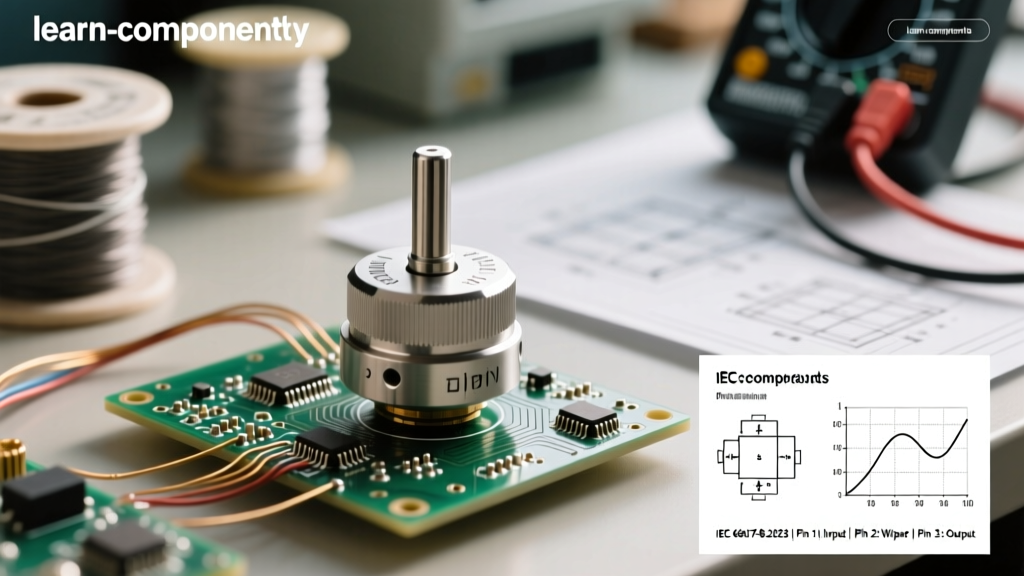
A capacitor (frequently misspelled in search engines as 'compasitor') is a passive electronic component that stores electrical energy in an electric field by accumulating charge on two conductive plates separated by an insulating dielectric. When you type 'what is a compasitor' into a search bar, you are looking for the foundational building block of almost every modern circuit. Unlike a resistor that burns energy as heat, a capacitor hoards it and releases it on demand, acting as a shock absorber for voltage, a gatekeeper for signals, and a stopwatch for timing circuits.
What a Capacitor Actually Changes in a Circuit
A capacitor fundamentally changes how a circuit responds to changes in voltage and frequency. It introduces capacitive reactance ($X_c$), which is inversely proportional to both the capacitance value and the frequency of the signal passing through it. The formula is $X_c = 1 / (2\pi f C)$.
Here is what that math translates to on the bench:
- DC Blocking: At 0 Hz (pure DC), reactance is infinite. A capacitor acts as an open circuit, blocking DC bias while allowing AC audio or data signals to pass through (AC coupling).
- Voltage Smoothing: Because voltage across a capacitor cannot change instantaneously ($I = C \times dV/dt$), placing one in parallel with a power rail absorbs high-frequency voltage spikes and fills in voltage sags.
- Phase Shifting: In AC circuits, current leads voltage by 90 degrees through an ideal capacitor. This property is exploited in single-phase AC motors to create a rotating magnetic field.
Worked Numeric Example: Sizing a 555 Timer Delay
Let's move past theory and calculate a real value. You are building a delayed fan-off circuit using a classic NE555 timer in monostable (one-shot) mode. You need the fan to stay on for exactly 10 seconds after a pushbutton is pressed.
The timing formula for a 555 monostable circuit is:
$t = 1.1 \times R \times C$
We need to solve for $C$ (Capacitance in Farads). First, pick a standard resistor value that keeps the charging current reasonable. Let's use $R = 1\text{ M}\Omega$ ($1,000,000\text{ }\Omega$).
- Rearrange the formula: $C = t / (1.1 \times R)$
- Plug in the target time: $C = 10 / (1.1 \times 1,000,000)$
- Calculate: $C = 0.00000909\text{ Farads}$, or $9.09\text{ }\mu\text{F}$.
Capacitors are manufactured in standard E12 or E24 values. The closest standard value to 9.09 µF is 10 µF. If we plug 10 µF back into the original formula, our actual delay will be $1.1 \times 1,000,000 \times 0.00001 = 11\text{ seconds}$. For a fan delay, an 11-second timeout is perfectly acceptable.
Concrete Part Pick: For this timing application, you need stability. Do not use a high-K ceramic (like Y5V), as its capacitance drops drastically with applied voltage. Instead, select a Panasonic EEU-FR1H100 (10µF, 50V, 105°C radial electrolytic) or a KEMET T350A106K016AT (10µF, 16V tantalum). Both will cost under $0.50 and provide reliable timing.
Where You Meet This in Practice
You will encounter capacitors in three distinct environments, each demanding entirely different physical constructions:
1. PCB Decoupling and Bypass (Logic Level)
Look at any microcontroller breakout board, like an Arduino Nano or ESP32 DevKit. Right next to the VCC pin, you will find a tiny 0.1µF (100nF) ceramic capacitor. Its job is to provide instantaneous current during the nanosecond the microcontroller's internal logic gates switch states, preventing local voltage brownouts that would reset the chip.
2. Power Supply Bulk Filtering (Mains Level)
Inside an ATX computer power supply or a benchtop variable supply, you will find massive aluminum electrolytic capacitors (often 470µF to 4700µF rated at 400VDC on the primary side). These smooth the 120Hz ripple left behind after the bridge rectifier converts AC mains to DC.
3. Motor Start and Run Capacitors (HVAC & Industrial)
Open the electrical panel on your home's outdoor AC condenser. You will find a large, oil-filled or metallized film metal can—typically rated around 45µF / 370VAC. This 'run capacitor' continuously shifts the AC phase to keep the compressor motor spinning efficiently. When these fail (bulging or leaking), the motor hums but won't turn, tripping the breaker.
Decision Tree: Picking the Right Dielectric and Package
Choosing the wrong capacitor chemistry is a leading cause of project failure. Use this decision matrix to select the right type for your specific application.
| If Your Application Is... | Then Choose This Dielectric | Why It Wins Here | Concrete Part Example |
|---|---|---|---|
| High-frequency decoupling (IC VCC pins, RF filtering) | MLCC (Multi-Layer Ceramic Chip) - X7R | Near-zero ESR, handles high ripple current, tiny footprint. X7R offers stable capacitance across temperature. | KEMET C315C104K5R5TA (100nF 50V) |
| Bulk power smoothing, audio coupling, low-frequency timing | Aluminum Electrolytic | Massive capacitance per dollar. Polarized, so watch your DC bias direction. | Panasonic EEU-FR1V101 (100µF 35V) |
| Space-constrained bulk storage (wearables, compact IoT) | Tantalum | High volumetric efficiency, very stable. Warning: Fails short and can catch fire if subjected to reverse voltage or high surge. | AVX TPSA106K016R1800 (10µF 16V) |
| AC line filtering, motor run, high-voltage snubbers | Metallized Polypropylene Film | Non-polarized, self-healing dielectric, handles high AC voltages without breaking down. | Cornell Dubilier 940C6W1P5K-F (1.5µF 600V) |
The Default Bench Recommendation: Stop buying cheap, unbranded capacitor assortments with Y5V ceramics and no-name electrolytics. Stock your bench with a KEMET X7R MLCC kit for all logic decoupling and signal filtering, and a Panasonic FR or FM series low-ESR electrolytic kit for power rails. This combination covers 95% of hobbyist and prototyping needs with professional-grade reliability.
Common Confusions: Capacitor vs. Battery vs. Inductor
Because 'compasitor' searches often stem from beginners mixing up component names, let's clearly separate the big three passive components:
- Capacitor vs. Battery: Both store energy, but a battery stores it chemically and releases it slowly over hours (high energy density). A capacitor stores it electrostatically and dumps it in milliseconds (high power density). A supercapacitor bridges this gap, but still cannot match a lithium cell's total energy capacity.
- Capacitor vs. Inductor: They are electrical opposites. A capacitor opposes changes in voltage and stores energy in an electric field. An inductor opposes changes in current and stores energy in a magnetic field. In a filter circuit, swapping one for the other completely inverts the frequency response.
- Capacitor vs. Resistor: A resistor limits current flow and dissipates power as heat continuously. A capacitor limits AC current flow via reactance but dissipates almost zero real power (ideal capacitors don't get warm).
Frequently Asked Questions
Why do people search for 'compasitor'?
It is a phonetic misspelling. Because the component 'compensates' for voltage drops and is often discussed alongside 'compasses' in early science classes, the brain bridges the gap. Always use 'capacitor' when ordering parts from distributors like Digi-Key or Mouser.
Can I replace a capacitor with a higher voltage rating?
Yes. Replacing a 16V capacitor with a 50V capacitor of the same µF value is perfectly safe and often improves longevity. Never replace it with a lower voltage rating, as the dielectric will break down and short out.
Can I replace a capacitor with a higher µF value?
It depends on the circuit. In a power supply filter, higher µF is usually fine (reduces ripple). In a timing circuit (like our 555 timer example) or an AC motor run circuit, changing the µF changes the timing or the motor phase angle, which will break the device.
Where can I read more about capacitor derating?
For deep dives into how temperature and DC bias affect ceramic capacitance, refer to the KEMET MLCC Basics guide or the SparkFun Capacitor Tutorial for practical breadboarding advice.