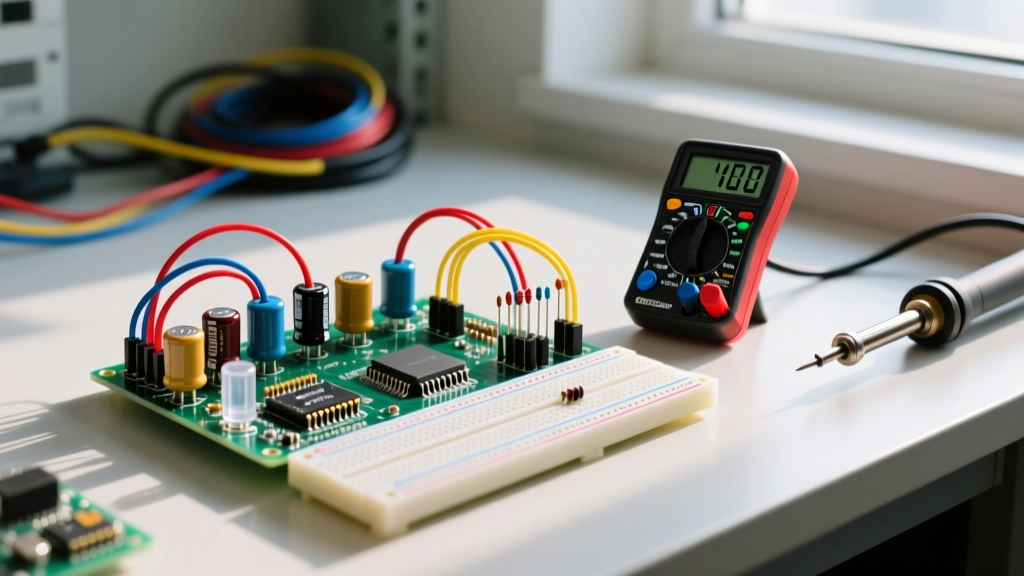

The One-Sentence Definition of Capacitance
Capacitance is the ability of a component to store electrical energy in an electric field when a voltage is applied across it. When you apply a voltage to a capacitor, it pulls electrons onto one conductive plate and pushes them off the other, creating a charge differential that inherently resists sudden changes in voltage.
In a real circuit or installation, capacitance changes how voltage behaves over time. It smooths out the violent voltage ripples from rectified AC power, catches high-frequency noise before it can reset a microcontroller, blocks DC signals while allowing AC audio to pass, and even shifts the phase angle in single-phase AC induction motors to create a starting torque.
The Math: A Worked Numeric Example
To understand capacitance on the bench, we need to look at the relationship between current, time, and voltage drop. The fundamental formula for a discharging capacitor is:
Where: C = Capacitance (Farads), I = Current (Amps), Δt = Time (Seconds), ΔV = Voltage Drop (Volts)
The Scenario: You are designing a battery-powered sensor node using an ESP32-WROOM-32. During a WiFi transmission burst, the module momentarily pulls an extra 200 mA (0.2 A) for 10 milliseconds (0.01 s). Your power rail is nominally 3.3V, but the ESP32 will brownout and reset if the voltage dips below 2.8V. You want to calculate the minimum capacitance required to hold the rail up, allowing a maximum voltage drop (ΔV) of 0.5V.
The Calculation:
- C = (0.2 A × 0.01 s) / 0.5 V
- C = 0.002 / 0.5
- C = 0.004 Farads, or 4,000 µF
The Reality Check: While the math demands 4,000 µF, if you slap a single 4,700 µF aluminum electrolytic capacitor on the breadboard, your ESP32 will likely still reset. Why? Because large electrolytic capacitors have high Equivalent Series Inductance (ESL). At the high-frequency transient speeds of a WiFi burst (nanoseconds), the inductor-like parasitic properties of the electrolytic cap choke the current delivery. In practice, you solve this by placing a 470 µF bulk electrolytic for the macro-energy reserve, paired with multiple 100 nF (0.1 µF) MLCC (Multi-Layer Ceramic Capacitors) placed within 2mm of the ESP32's VCC pins to handle the high-speed nanosecond transients.
Where You Meet Capacitance in Practice
You will encounter capacitance in almost every electrical and electronic system you build or troubleshoot. Here is where it matters most:
- Power Supply Filtering: In a linear power supply, a bridge rectifier converts AC to pulsating DC. A large bulk capacitor (e.g., 2200 µF, 25V) charges to the peak voltage and discharges into the load during the AC zero-crossings, smoothing the ripple.
- Decoupling / Bypass: Digital ICs switch millions of times per second, drawing sharp spikes of current. 100 nF ceramic capacitors placed on every VCC pin act as local, high-speed energy reservoirs, preventing these spikes from propagating through the PCB traces and causing logic errors.
- Motor Start/Run Circuits: Single-phase AC motors (like in your HVAC blower or table saw) cannot create a rotating magnetic field on their own. A start capacitor (often 50-200 µF, 250VAC) shifts the current phase in the auxiliary winding to generate starting torque.
- Parasitic Cable Capacitance: Long runs of NM-B (Romex) or THHN wire in conduit act as giant, unintentional capacitors. A 100-foot run of 12 AWG cable can exhibit 15-20 pF per foot. In high-impedance sensor circuits or long LED dimmer runs, this parasitic capacitance can cause phantom voltages, ghost glowing in LEDs, or nuisance tripping of sensitive AFCI/GFCI breakers.
Bench War Story: The Bypass Capacitor Failure
Theory is clean; the workbench is messy. Here is a real-world scenario demonstrating what happens when you ignore the physical limitations of capacitance.
1. The Setup: I was prototyping a custom 12V motor controller using an STM32 microcontroller and a discrete MOSFET H-bridge. The goal was to drive a 3A inductive DC motor using 16 kHz PWM for silent operation.
2. The Numbers: The 12V-to-5V buck converter was rated for 2A, and I had a 100 µF electrolytic capacitor on the 3.3V logic rail, directly sourced from the STM32's recommended schematic.
3. The Outcome: Every time the motor started, the STM32 hard-faulted and reset. Hooking up an oscilloscope to the 3.3V rail revealed massive voltage sag: the rail was dipping from 3.3V down to 2.1V for about 4 microseconds every time the PWM switched.
4. What Went Wrong: The 100 µF electrolytic capacitor was physically located 15mm away from the STM32 VCC pin. At 16 kHz, the trace inductance and the capacitor's internal ESR (Equivalent Series Resistance) formed an impedance bottleneck. The capacitor simply couldn't deliver electrons fast enough across that distance.
5. The Fix: I kept the 100 µF electrolytic for bulk storage, but I added a 100 nF (0.1 µF) X7R ceramic capacitor and a 10 nF C0G ceramic capacitor in parallel, soldering them directly on top of the STM32's VCC and GND pins (dead-bug style). The ceramic caps had near-zero ESL and responded in nanoseconds. The voltage dip shrank to 40 mV, and the motor ran flawlessly.
Common Confusions: Capacitance vs. Battery Capacity
Beginners frequently confuse capacitance (measured in Farads) with battery capacity (measured in Amp-hours), assuming a 10F supercapacitor can replace a small battery. They both store energy, but their physics dictate entirely different use cases.
| Metric | 10F Supercapacitor (2.7V Max) | 2000mAh Li-Ion Cell (3.7V Nom) |
|---|---|---|
| Total Energy Stored | 36.45 Joules (E = ½CV²) | 26,640 Joules (E = V × I × t) |
| Energy Density | Very Low | Very High |
| Power Delivery | Instantaneous (High Power) | Gradual (Limited by C-Rate) |
| Voltage Profile | Linear drop as it discharges | Relatively flat plateau |
The Takeaway: A battery holds 700 times more total energy than the supercapacitor. You use a battery when you need a device to run for hours. You use capacitance when you need to deliver a massive spike of power in milliseconds, or when you need to survive a brief power interruption without a voltage drop. According to SparkFun's electronics tutorials, attempting to run a continuous microcontroller load directly off a supercapacitor without a buck-boost regulator will result in immediate brownouts because the voltage collapses linearly the moment current is drawn.
Frequently Asked Questions
Does the physical capacitance value change depending on the voltage I apply?
Yes, if you are using Class 2 ceramic capacitors (like X7R or X5R dielectrics). This is known as the DC Bias effect. A 10 µF, 0805-package X7R capacitor rated for 16V might only exhibit 2 µF of actual capacitance when 12V is applied across it. If you need stable capacitance across a voltage range, you must use Class 1 dielectrics (C0G/NP0), or significantly oversize the voltage rating and physical package of your X7R caps. Espressif's hardware design guidelines specifically warn designers to account for DC bias derating on the 3.3V rails of their modules.
What happens if I replace a capacitor with one that has a higher voltage rating?
Electrically, it is perfectly safe and often beneficial, as higher voltage caps generally have lower DC bias derating and better surge survivability. The only penalty is physical size and cost. Never replace a capacitor with one that has a lower voltage rating than the original, as the dielectric layer will break down, leading to a short circuit, venting, or in the case of tantalums, a violent thermal runaway fire.
Why do we measure capacitance in microfarads (µF) instead of just Farads?
One Farad is a massive amount of capacitance in the context of standard electronics. A 1-Farad capacitor capable of handling 50V would be the size of a car battery. For standard PCB decoupling and filtering, we deal in microfarads (10⁻⁶), nanofarads (10⁻⁹), and picofarads (10⁻¹²). Only in the realm of supercapacitors for memory backup or regenerative braking do you see whole Farads on the bench.


