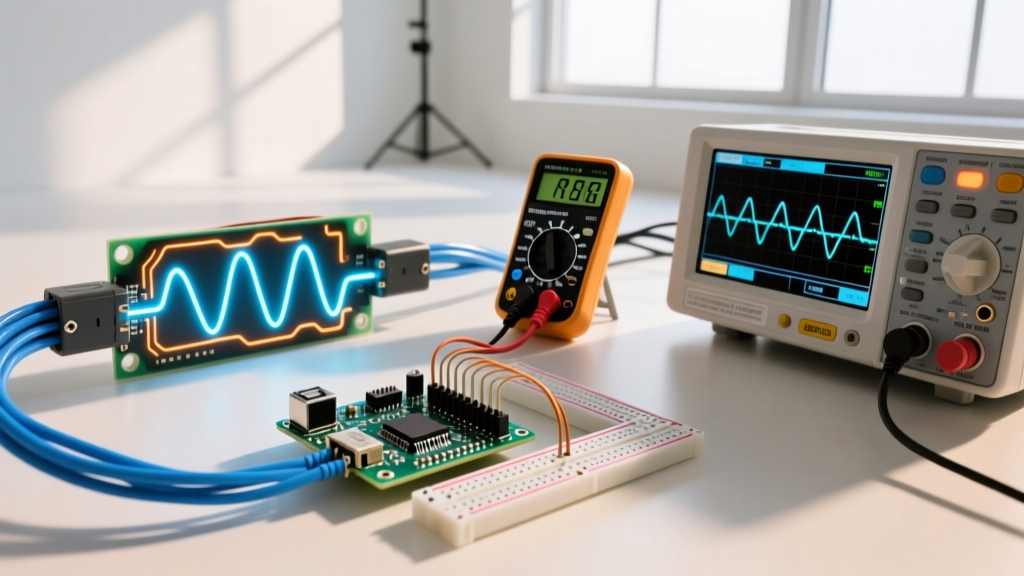

Alternating current (AC) is an electrical current that periodically reverses direction and changes its magnitude continuously with time, typically following a sinusoidal waveform. Unlike direct current (DC), which pushes electrons in a single direction like water flowing steadily through a garden hose, AC oscillates back and forth, transferring energy through electromagnetic fields rather than bulk electron transport. This oscillation is the foundation of the global power grid because it allows voltage to be easily stepped up for efficient long-distance transmission and stepped down for safe residential use via transformers.
The Math Behind the Sine Wave: Peak vs. RMS Voltage
When you measure a standard North American wall outlet with a multimeter, it reads 120V AC. However, the voltage is not a flat 120V; it is constantly moving from zero to a positive peak, back through zero, to a negative peak, and back to zero 60 times a second (60 Hz).
The 120V reading is the Root Mean Square (RMS) voltage, not the peak voltage. RMS is a mathematical method used to express AC voltage in terms of the equivalent DC voltage that would produce the same heating effect in a resistive load. To find the actual peak voltage hitting your insulation and components, you multiply the RMS value by the square root of 2 (approximately 1.414).
- Nominal RMS Voltage: 120V
- Peak Voltage Calculation: 120V × 1.414 = 169.7V
- Peak-to-Peak Voltage: 169.7V × 2 = 339.4V
This means the insulation on a standard 14 AWG NM-B cable must withstand nearly 170V to ground at the absolute peak of every single sine wave cycle, even though your meter reads 120V.
Understanding this distinction is critical when selecting components like capacitors and varistors (MOVs) for AC circuits. A capacitor rated for 150V DC will catastrophically fail if placed directly across a 120V AC line, because the 169.7V peak exceeds its dielectric breakdown limit. For AC filtering, you must always select components with a voltage rating at least 20% above the peak AC voltage, not the RMS voltage. For deeper waveform analysis, All About Circuits provides an excellent breakdown of AC waveform mathematics.
Where You Meet AC in Practice
On the workbench and the jobsite, AC fundamentally changes how circuits behave compared to DC. In a DC circuit, opposition to current flow is simply resistance (R). In an AC circuit, you must account for impedance (Z), which combines resistance with reactance (the opposition created by inductors and capacitors as the voltage constantly changes).
- Mains Wiring and Skin Effect: Because AC current tends to travel along the outer edge (the "skin") of a conductor rather than uniformly through its cross-section, large AC feeders experience the skin effect. This reduces the effective ampacity of large wires at 60Hz, requiring physical derating or the use of stranded conductors in parallel for high-amperage service entrances.
- Induction Motors: HVAC compressors, shop dust collectors, and ceiling fans rely on the alternating magnetic field created by AC to induce current in a rotor, causing it to spin without any physical electrical connection to the rotating part.
- Transformers: Doorbell chimes, smart thermostats, and microwave oven high-voltage stages all use AC's changing magnetic field to step voltages up or down. A transformer will output 0V if fed DC, and will likely overheat and burn out its primary winding due to the lack of inductive reactance.
Real-World Scenario Walkthrough: Sizing a Breaker for an AC Compressor
To understand how AC theory impacts physical installation, let us look at a common mistake made when wiring a 240V single-phase 5HP air compressor in a home workshop.
The Setup: A 5HP motor operates at 240V AC. The nameplate lists the Full Load Amps (FLA) at 18A and the Locked Rotor Amps (LRA)—the current drawn when the motor is starting from a dead stop and has not yet generated back-EMF—at 90A.
The Mistake (What Went Wrong): An apprentice calculates the running wattage (roughly 3730W) and divides by 240V to get 15.5A. They install a standard 20A double-pole breaker and run 12 AWG THHN wire. When the compressor kicks on, it draws the 90A LRA for about two seconds. The 20A breaker interprets this as a dead short and trips instantly. The apprentice resets it repeatedly, eventually welding the breaker contacts and damaging the motor windings from repeated high-current inrush stalling.
The Correct Procedure:
- Size the Wire for Running Current: NEC requires conductors to be sized at 125% of the motor FLA. (18A × 1.25 = 22.5A). According to the 75°C ampacity table, 10 AWG copper THHN (rated 35A) is the correct minimum wire size.
- Size the Breaker for Starting Current: For an inverse-time breaker, the NEC allows sizing up to 250% of the FLA to accommodate the AC inrush. (18A × 2.5 = 45A).
- Select the Standard Size: The next standard breaker size up is 45A or 50A. You install a 45A double-pole breaker.
- Install Overload Protection: The motor starter or internal thermal overload is set to trip at 115% of FLA (20.7A) to protect the motor if it jams, since the 45A breaker is too large to protect the windings directly.
Common Confusions on the Bench
When troubleshooting AC circuits, hobbyists and junior technicians frequently confuse three specific concepts:
1. AC vs. Pulsating DC
If you pass AC through a bridge rectifier but do not use a smoothing capacitor, the output waveform looks like a series of humps. This is not AC. It is pulsating DC. True AC must cross the zero-voltage line and enter a negative polarity phase. Pulsating DC never reverses direction; it just drops to zero and rises again.
2. Averaging vs. True-RMS Multimeters
Cheap multimeters measure AC voltage by reading the average value of the rectified waveform and multiplying it by a fixed constant (1.11) to guess the RMS value. This only works for pure, perfect sine waves. If you are measuring the AC output of a modified sine wave inverter or a circuit with heavy harmonic distortion, an averaging meter will give you wildly inaccurate readings. You must use a True-RMS meter, like the Fluke 87V, which samples the waveform and calculates the actual heating value regardless of distortion.
3. Frequency vs. Voltage
People often assume that 50Hz (European standard) and 60Hz (North American standard) represent different "amounts" of power. Frequency is simply the cycle rate. A 230V/50Hz system delivers the same fundamental power as a 240V/60Hz system, but the lower frequency means transformers and motors must be built with slightly more iron mass to prevent core saturation.
FAQ: Alternating Current on the Workbench
Q: Can I use a DC power supply to test an AC transformer?
A: No. A transformer relies on a changing magnetic field to induce voltage in the secondary winding. DC provides a static magnetic field once the initial inrush settles. If you apply DC to a transformer primary, it will act as a simple low-resistance wire, draw massive current, and burn out.
Q: Why does AC shock feel different than DC shock?
A: AC at 50/60Hz is particularly dangerous because the frequency aligns closely with the human nervous system's electrical signaling. It causes sustained muscle tetany (the "can't let go" effect) at much lower current thresholds (around 10-20mA) compared to DC, which typically causes a single sharp muscle spasm that may throw the victim clear of the circuit.
Q: What happens to the neutral wire in an AC circuit?
A: In a single-phase 120V circuit, the neutral carries the exact same current as the hot wire, completing the AC loop back to the transformer. However, in a split-phase 240V system (like a dryer outlet), the neutral only carries the imbalance current between the two hot legs. If Leg A draws 10A and Leg B draws 12A, the neutral carries exactly 2A.


