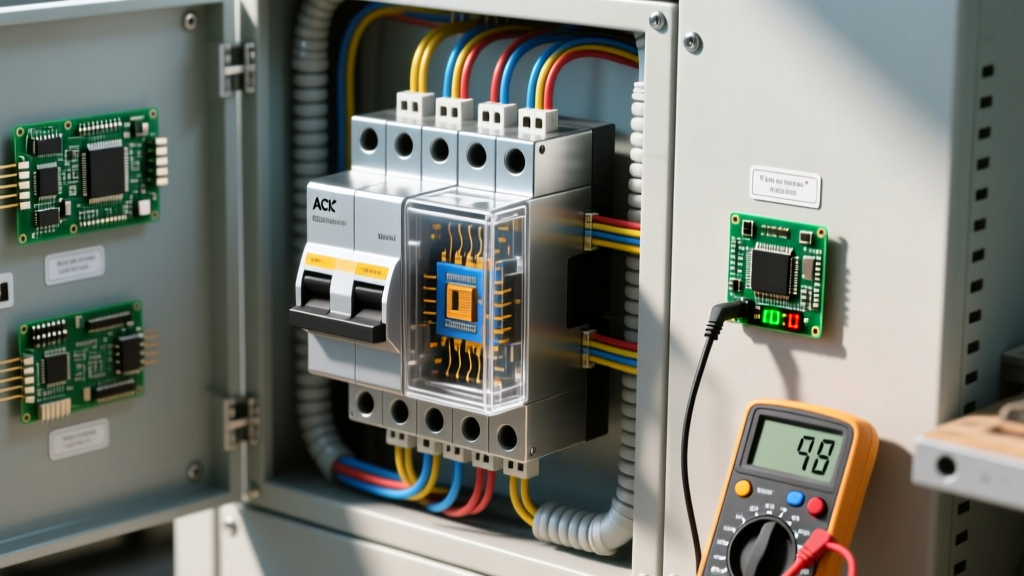

An Air Circuit Breaker (ACB) is a heavy-duty electrical protection device that uses atmospheric air as the dielectric medium to extinguish the arc formed when interrupting high currents in low-voltage (typically up to 1000V AC) power distribution systems. Unlike standard residential breakers, an ACB fundamentally changes a commercial or industrial installation by replacing fixed, single-use fuses at the main switchboard with a resettable, digitally adjustable, and network-communicative main disconnect capable of safely clearing massive fault currents up to 150kA.
The Core Physics: How Air Extinguishes a 65kA Arc
When an ACB's silver-tungsten main contacts separate under a heavy load, the current doesn't just stop; it ionizes the air between the contacts, creating a plasma arc that can reach temperatures exceeding 10,000°C. If left unchecked, this arc will melt the copper busbars and vaporize the switchgear.
To stop this, ACBs utilize a massive, multi-chambered arc chute positioned directly above the contacts. When the contacts part, the magnetic field generated by the fault current (and sometimes assisted by a pneumatic blowout coil) drives the arc upward into the chute. The chute is packed with closely spaced, insulated steel splitter plates. Think of these splitter plates like a multi-lane highway suddenly narrowing into dozens of tight, walled alleyways; the arc is forced into these narrow channels, stretching, cooling, and losing the thermal energy required to sustain the plasma. Once the arc is chopped into smaller series arcs and cooled below the ionization threshold, it extinguishes at the next AC current zero-crossing.
ACB vs. MCCB vs. VCB: Clearing Up the Confusion
People commonly confuse ACBs with Molded Case Circuit Breakers (MCCBs) and Vacuum Circuit Breakers (VCBs). While all three protect circuits, their physical construction, voltage domains, and maintenance profiles are entirely different.
| Feature | ACB (Air Circuit Breaker) | MCCB (Molded Case) | VCB (Vacuum Circuit Breaker) |
|---|---|---|---|
| Voltage Range | Low Voltage (up to 1000V AC) | Low Voltage (up to 1000V AC) | Medium Voltage (1kV to 38kV) |
| Interrupting Medium | Atmospheric Air (Arc Chute) | Air / De-ionizing grids in molded case | Vacuum Bottle |
| Current Rating | 800A to 6300A | 15A to 2500A (rarely 3000A) | 630A to 4000A |
| Draw-out Chassis | Standard (allows isolation & testing) | Rare (usually fixed bolt-on) | Standard for medium voltage switchgear |
| Trip Settings | Fully adjustable LSIG via digital trip unit | Fixed or basic adjustable thermal/magnetic | External protective relay required |
The defining physical trait of an ACB is its draw-out mechanism. A 4000A ACB weighs hundreds of pounds and is mounted on a cradle with a mechanical hand-crank. This allows facility engineers to physically disconnect the breaker from the live busbars (racking it out to the "Test" or "Disconnected" position) to perform secondary injection testing on the trip unit without de-energizing the rest of the switchgear.
Worked Numeric Example: Sizing an ACB for a 2500 kVA Transformer
Let's size a main ACB for a new commercial facility fed by a 2500 kVA, 480V, 3-phase, 60Hz dry-type transformer. We need to determine the continuous current rating and the required short-circuit breaking capacity (Icu).
- Calculate Full Load Current (FLA):
Formula:I = S / (√3 × V)
I = 2,500,000 VA / (1.732 × 480V) = 3,007 Amps. - Select the Frame Size:
Standard ACB frame sizes step up at 1600A, 2500A, 3200A, 4000A, and 6300A. Since our FLA is 3,007A, we must select a 4000A frame (e.g., the Schneider Electric MasterPact MTZ2 or ABB Emax 2 E4.2). Expect to pay between $14,000 and $22,000 for a fully equipped 4000A draw-out unit with a premium digital trip unit. - Calculate Available Fault Current:
Assume the transformer has a standard impedance (Z) of 5.5%.
Isc = FLA / Z = 3,007A / 0.055 = 54,672 Amps (or ~55kA). - Select the Breaking Capacity (Icu):
The ACB's ultimate short-circuit breaking capacity must exceed the available fault current. We will specify an ACB with an Icu of 65kA at 480V. Selecting a 100kA rated breaker here would be an unnecessary expense, as 65kA provides a safe 18% margin above the calculated 55kA fault.
Where You Meet This in Practice
You will almost never see an ACB in residential or light commercial work. They are strictly the domain of heavy power distribution. You will find them in:
- Main Distribution Boards (MDBs): Acting as the primary service entrance disconnect for large buildings, hospitals, and manufacturing plants.
- Generator Outputs: Serving as the main breaker on the output side of 1MW+ diesel backup generators, handling the high inrush currents of motor starting.
- Bus Tie Applications: Used to connect two separate switchboard bus sections, allowing power to be routed from one transformer to another during maintenance.
- Large Motor Control Centers (MCCs): Feeding massive industrial loads like 1000HP mining crushers or district cooling chillers.
Real-World Scenario Walkthrough: The Data Center Main Bus Fault
To understand what happens when ACB settings are misconfigured, consider a real-world commissioning failure at a 2MW data center.
The Setup: The facility's 480V main switchboard utilized a 4000A main ACB equipped with an LSIG (Long, Short, Instantaneous, Ground) digital trip unit. Downstream, a 800A MCCB fed a row of server racks. To ensure selectivity (so a branch fault doesn't drop the whole data center), the ACB's Short-Time delay (S) was set to 250ms, giving the downstream MCCB time to clear a fault first. The design also specified Zone Selective Interlocking (ZSI), a hardwired daisy-chain that allows the downstream breaker to send a "block" signal to the ACB, telling it to hold its instantaneous trip threshold.
The Numbers: During load-bank testing, a loose lug on the 800A MCCB caused a phase-to-phase fault drawing 38,000 Amps. This fault current exceeded the MCCB's short-time threshold but was below the main ACB's Instantaneous (I) pickup setting of 40,000A.
The Outcome: The downstream MCCB successfully cleared the fault in 18ms. However, the main 4000A ACB also tripped instantly, plunging the entire data center into darkness and dropping all cooling systems.
What Went Wrong: The physical ZSI control wire between the MCCB and the ACB trip unit had been left disconnected inside the switchgear wiring trough by the factory assembler. Without the ZSI block signal, the ACB's internal logic defaulted to a conservative instantaneous override to protect itself from prolonged thermal damage. Because the 38kA fault lingered for the 18ms it took the MCCB to clear, the ACB's unprotected instantaneous threshold was breached, and it dropped the main bus. The fix required a full switchgear shutdown to trace and terminate the ZSI twisted-pair wiring, highlighting that an ACB's digital brain is only as good as its physical field wiring.
FAQ: Air Circuit Breaker Nuances
Do ACBs require SF6 gas to interrupt faults?
No. ACBs rely strictly on atmospheric air and mechanical arc chutes. Sulfur Hexafluoride (SF6) gas is used in Gas Insulated Switchgear (GIS) and some medium/high-voltage breakers due to its superior dielectric strength, but it is heavily regulated due to its extreme global warming potential. Low-voltage ACBs do not use it.
What is the difference between Icu and Ics on an ACB nameplate?
Icu (Ultimate Short-Circuit Breaking Capacity) is the maximum fault current the breaker can safely interrupt, though it may require maintenance or replacement afterward. Ics (Service Short-Circuit Breaking Capacity) is a lower value (often 50%, 75%, or 100% of Icu) representing a fault the breaker can clear and then immediately be reclosed to continue normal service without internal damage. For critical infrastructure, always specify an ACB where Ics = 100% of Icu.
How often should an ACB be maintained?
Unlike sealed MCCBs, ACBs are open-frame mechanical machines. They require annual mechanical exercising (racking in and out, manual charging) to keep greases from hardening. Every 3 to 5 years, a qualified technician must inspect the arc chute splitter plates for pitting, clean out conductive metallic dust using dielectric-safe vacuums, and perform secondary injection testing on the trip unit to verify the LSIG curves.


