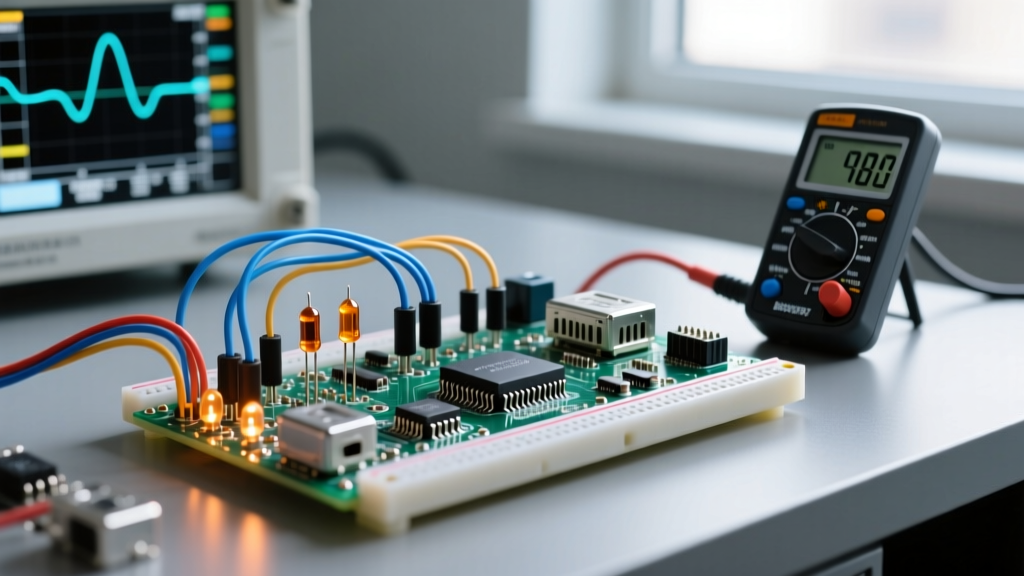
An electric current always produces a magnetic field around its conductor and generates heat due to the electrical resistance of the material. This is a fundamental law of physics that governs everything from the microscopic traces on an ESP32 development board to the 4/0 AWG aluminum feeders supplying a 200-amp residential service panel. When charge carriers (electrons) move through a conductive medium, they trigger two unavoidable physical phenomena: the creation of a concentric magnetic flux field and the dissipation of thermal energy.
In a real installation, this dual production changes the physical environment of the circuit. The heat production changes the ambient temperature inside a conduit or enclosure, forcing electrical designers to apply ampacity derating factors to prevent insulation meltdown. Simultaneously, the magnetic field changes the electromagnetic compatibility (EMC) profile of the space, which can induce noise in nearby low-voltage data cables or trigger Hall-effect sensors.
The Two Universal Byproducts of Current Flow
To understand circuit behavior on the bench or the jobsite, you have to separate the two distinct byproducts of electron flow. They operate under different physical laws and present entirely different engineering challenges.
1. The Magnetic Field (Ampere’s Law)
Whenever electrons drift through a wire, they generate a magnetic field that wraps concentrically around the conductor. The strength of this field is directly proportional to the magnitude of the current and inversely proportional to the distance from the wire. Think of the magnetic field like the wake behind a boat moving through water—the wake only exists because the boat is moving, and its shape is dictated by the hull. Similarly, the magnetic field only exists while charge carriers move, forming closed loops around the wire axis.
2. Heat Generation (Joule’s First Law)
Standard conductors like copper and aluminum are not perfect; they possess atomic lattice structures that impede electron flow. As electrons collide with these lattice ions, kinetic energy is transferred into thermal energy. This is known as Joule heating (or ohmic heating), and it scales with the square of the current. Double the current, and you quadruple the heat produced. According to All About Circuits, this relationship is absolute in non-superconducting materials at standard operating temperatures.
Makers and students frequently confuse the production of a magnetic field with electromagnetic induction. An electric current always produces a magnetic field, but a magnetic field only induces a voltage in a neighboring conductor if the field is changing (AC current) or if there is relative physical motion. A steady 12V DC current produces a robust, static magnetic field, but it will induce exactly zero voltage in a stationary wire sitting an inch away.
Worked Numeric Example: Calculating Heat Production
Let’s look at what this heat production actually means for a standard branch circuit. Suppose you are wiring a 120V receptacle using 12 AWG THHN solid copper wire on a 20-amp breaker. The one-way distance from the panel to the outlet is 50 feet.
- Current (I): 20 Amps (continuous maximum load for calculation)
- Wire Length: 50 feet out, 50 feet back (neutral) = 100 feet total loop
- Resistance (R): Per NEC Chapter 9, Table 8, 12 AWG uncoated copper at 75°C has a resistance of approximately 1.98 ohms per 1,000 feet. For 100 feet, R = 0.198 Ω.
Using Joule’s First Law ($P = I^2R$), we can calculate the exact thermal energy dissipated into the wall cavity:
$P = (20A)^2 \times 0.198\Omega$
$P = 400 \times 0.198$
$P = 79.2 \text{ Watts}$
That means 79.2 Watts of pure heat is being generated along that 50-foot wire run. In a single wire in free air, this heat dissipates easily. But if you pull four of those circuits into a single 1-inch PVC conduit, you are now dumping over 300 Watts of heat into a confined, sealed plastic tube. This is exactly why the NEC requires ampacity derating when bundling current-carrying conductors.
Where You Meet This in Practice
You interact with the byproducts of current flow constantly, whether you are debugging a microcontroller or roughing-in a subpanel. Here is where these physics principles manifest in daily electrical work.
Clamp Meters and Current Measurement
A clamp meter measures current without breaking the circuit by reading the magnetic field the current produces. However, the type of clamp meter matters. Standard AC clamp meters use a current transformer, which relies on a changing magnetic field to induce a measurable current in the meter's jaw. If you clamp an AC meter around a DC wire, it will read zero, even though a massive static magnetic field is present. To measure DC current, you must use a clamp meter equipped with a Hall-effect sensor, which physically detects the presence of a static magnetic flux field.
Conduit Derating and Thermal Runaway
Because current always produces heat, the National Electrical Code (NEC) mandates derating under Article 310.15(C)(1). If you pull more than three current-carrying conductors in a single raceway, the heat produced by each wire compounds, raising the ambient temperature inside the conduit. If you have 4 to 6 conductors, you must multiply the wire's base ampacity by 80%. If you ignore this and load a 12 AWG wire to a full 20 amps in a tightly packed conduit, the insulation will eventually soften, degrade, and fail, leading to a short circuit or fire.
Electromagnetic Interference (EMI) in Low-Voltage Wiring
The magnetic field produced by AC current expands and collapses 60 times a second (in a 60Hz system). If you run a Cat6 Ethernet cable or an unshielded audio signal wire parallel to a 120V AC line for several feet, that changing magnetic field will induce a 60Hz hum or data packet loss in the low-voltage line. This is why code and best practices dictate maintaining at least a 2-inch separation between line-voltage and low-voltage cables, or crossing them at strict 90-degree angles to minimize the magnetic coupling area.
Frequently Asked Questions
Does an electric current always produce a magnetic field in DC circuits?
Yes. Any movement of electrical charge produces a magnetic field, regardless of whether the current is alternating (AC) or direct (DC). In a DC circuit, the current flows in one constant direction, which produces a static, non-fluctuating magnetic field. While this static field will not induce a voltage in a neighboring stationary wire, it will still exert a physical force on nearby permanent magnets or deflect a compass needle, which is the foundational principle behind DC motors and galvanometers.
Why does an electric current always produce heat in standard copper wire?
Copper is an excellent conductor, but it is not a perfect one. At the atomic level, copper atoms are arranged in a crystalline lattice. As free electrons are pushed through this lattice by voltage, they constantly collide with the vibrating copper ions. Each collision transfers a tiny amount of kinetic energy from the electron to the ion, causing the ion to vibrate faster. In thermodynamics, increased atomic vibration is the literal definition of heat. The only known exception to this rule occurs in superconductors cooled below their critical temperature, where lattice collisions drop to absolute zero.
Can an electric current produce light without producing heat?
Not entirely. Incandescent bulbs produce light via blackbody radiation, which is fundamentally a heat-driven process (heating a tungsten filament until it glows). LEDs (Light Emitting Diodes) produce light through electroluminescence, where electrons recombine with electron holes in a semiconductor, releasing energy as photons rather than thermal radiation. However, even in LEDs, the current still encounters resistance in the semiconductor junction and the wire leads, meaning some Joule heating is always produced. This is why high-power LED arrays still require aluminum heat sinks to prevent thermal degradation of the phosphor layer.
What happens to the magnetic field when an electric current stops flowing?
When the current is interrupted (such as opening a switch or turning off a MOSFET), the magnetic field does not just vanish instantly; it collapses back into the conductor. According to Faraday’s Law of Induction, this rapidly collapsing magnetic field induces a massive, brief voltage spike in the wire, attempting to keep the current flowing. In inductive loads like relay coils, solenoids, or DC motors, this 'flyback' voltage can easily reach hundreds of volts, arcing across switch contacts or destroying sensitive silicon components. This is why we always install flyback diodes across inductive loads in DC circuits to safely dissipate the energy of the collapsing field.