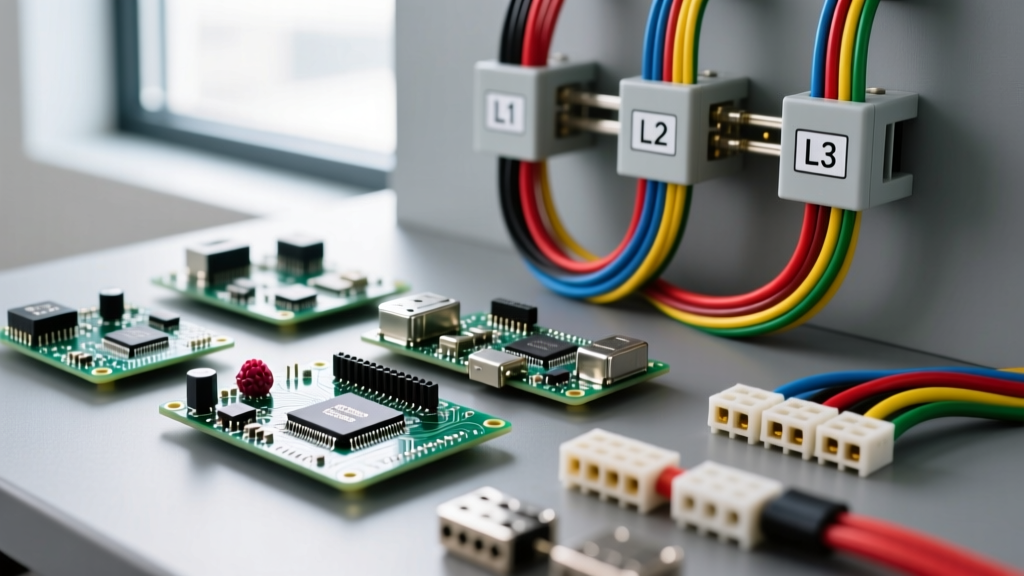
A Distributed Control System (DCS) is an industrial automation architecture that spreads control processing across multiple localized hardware nodes rather than relying on a single central processor, ensuring that a single point of failure cannot shut down an entire facility. If you have found yourself asking 'what is dcs mean' while reading industrial electrical schematics or panel layouts, you are looking at a decentralized topology that fundamentally changes how we wire, program, and troubleshoot large-scale electrical installations.
How a DCS Changes the Physical Installation
In a traditional centralized setup, every single sensor, limit switch, and actuator wires back to one massive Programmable Logic Controller (PLC) panel. This creates a single point of failure and requires enormous conduit runs. A DCS changes the physical installation by moving the I/O (Input/Output) marshalling cabinets out of the main control room and directly onto the plant floor, close to the machinery.
This architecture changes the fault domain. If a central PLC CPU crashes, the entire plant goes blind and stops. If a localized DCS controller node crashes, only that specific subsection of the plant (like a single cooling tower or one boiler feed pump) is affected, while the rest of the facility continues to run safely.
Worked Numeric Example: Centralized vs. Distributed I/O
Let us look at the hard numbers for a mid-sized municipal water treatment facility requiring 4,000 I/O points (a mix of 4-20mA analog sensors, 24VDC digital inputs, and 120VAC relay outputs). We will assume standard copper pricing and 24VDC control voltage.
| Metric | Centralized PLC Architecture | Distributed DCS Architecture |
|---|---|---|
| Hardware Setup | 1 Main CPU rack, 4,000 I/O cards | 8 Localized nodes (500 I/O each), 1 Master |
| Average Wire Run | 250 feet per point back to main room | 30 feet to local node, then 1 Cat6A cable |
| Total 18 AWG Wire | ~1,000,000 feet (massive conduit fill) | ~120,000 feet (85% copper reduction) |
| Network Scan Time | 45ms (bottlenecked by single CPU backplane) | 6ms per node (parallel processing) |
| CPU Failure Impact | 100% plant downtime | 12.5% plant downtime (1 of 8 nodes lost) |
By distributing the control, the DCS cuts copper wire requirements by over 80% and drops the local scan time from 45ms down to 6ms, allowing for much tighter PID loop tuning on critical valves. According to guidelines from the International Society of Automation (ISA), this distributed approach is the baseline requirement for continuous process manufacturing where downtime costs exceed $10,000 per hour.
Where You Meet DCS in Practice
If you are wiring a home subpanel or building a desktop Arduino project, you will not encounter a true DCS. You meet DCS architectures in continuous process industries: power generation (coal, nuclear, solar farms), oil refineries, chemical processing, and large-scale water/wastewater treatment.
However, as a maker or electronics hobbyist, you will intersect with DCS environments when building edge devices. Plant engineers frequently need to pull data from legacy machinery into their modern DCS historian. This is where you might be asked to build a custom Modbus RTU-to-MQTT gateway using an ESP32, or wire up a Raspberry Pi running Node-RED to act as a protocol translator between an old serial device and the plant's DCS Ethernet ring. When integrating these bench-built devices into a DCS, you must strictly adhere to the plant's VLAN segmentation and use opto-isolated RS-485 transceivers to prevent ground loops from frying your low-voltage logic.
The Big Confusion: DCS vs. PLC vs. SCADA
The most common mistake in industrial electrical theory is using DCS, PLC, and SCADA interchangeably. They are distinct layers of the automation stack.
- PLC (Programmable Logic Controller): A ruggedized, single-piece industrial computer designed for high-speed, discrete logic (e.g., turning a motor on/off based on a limit switch). It is the 'muscle'.
- DCS (Distributed Control System): An integrated hardware-and-software ecosystem designed for complex, continuous analog processes (e.g., maintaining a chemical reactor at exactly 450.5°C). It includes the controllers, the I/O, and the operator screens as one unified, vendor-locked package. It is the 'nervous system'.
- SCADA (Supervisory Control and Data Acquisition): The top-level software layer that gathers data from multiple PLCs or DCS nodes to display on a central screen. It is the 'eyes and ears', but it does not execute the fast, millisecond-level control logic itself.
While modern high-end PLCs (like the Allen-Bradley ControlLogix or Siemens S7-1500) have blurred the lines by offering distributed I/O and process control features, a true DCS is still defined by its unified engineering environment and inherent redundancy designed specifically for continuous process safety, as outlined in IEC Functional Safety standards.
Frequently Asked Questions
What does DCS mean compared to a standard PLC?
A standard PLC is typically a standalone controller programmed to handle discrete, high-speed machine logic, often sourced from various third-party vendors for I/O and HMI. A DCS is a holistic, vendor-supplied ecosystem where the controllers, I/O marshalling, operator workstations, and engineering software are all designed to work together out of the box, prioritizing analog process control, complex PID loops, and system-wide redundancy over raw discrete speed.
What is DCS in DC power and battery systems?
In the context of telecom, solar, and battery rooms, DCS is sometimes used as an acronym for Direct Current System (or Direct Current Supply). A 48V DCS telecom rectifier plant, for example, converts AC mains to DC to power telecommunications racks and charge backup lead-acid or LiFePO4 battery strings. If you are looking at a power electronics schematic rather than an automation schematic, DCS refers to the DC power distribution architecture, not distributed computing.
Can I build a mini DCS with an ESP32 or Raspberry Pi?
You can build a 'distributed control network,' but not a true industrial DCS. A true DCS requires deterministic, fail-safe real-time operating systems (RTOS) and hardware redundancy (like 1-out-of-2 or 2-out-of-3 voting logic) certified to SIL (Safety Integrity Level) standards. However, you can use a fleet of ESP32s communicating via ESP-NOW or MQTT to a central Raspberry Pi running Home Assistant or Node-RED to create a highly effective distributed monitoring and control system for home automation, greenhouse climate control, or off-grid solar management.
What does DCS mean for electrical safety and SIL ratings?
In a DCS environment, safety is often handled by a separate, dedicated Safety Instrumented System (SIS) that runs in parallel to the basic process control system. While the DCS handles the normal operational setpoints, the SIS monitors for dangerous conditions (like a pressure vessel exceeding its maximum rating) and independently trips the breakers or shuts the valves. You never rely solely on the standard DCS controller for life-safety or critical environmental shutdowns; the safety layer must be electrically and logically independent.