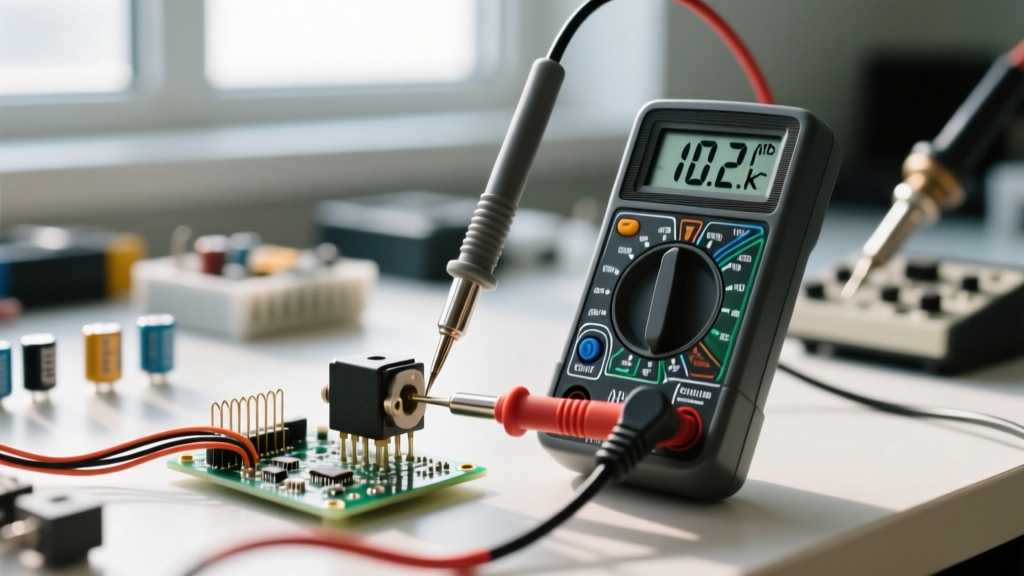
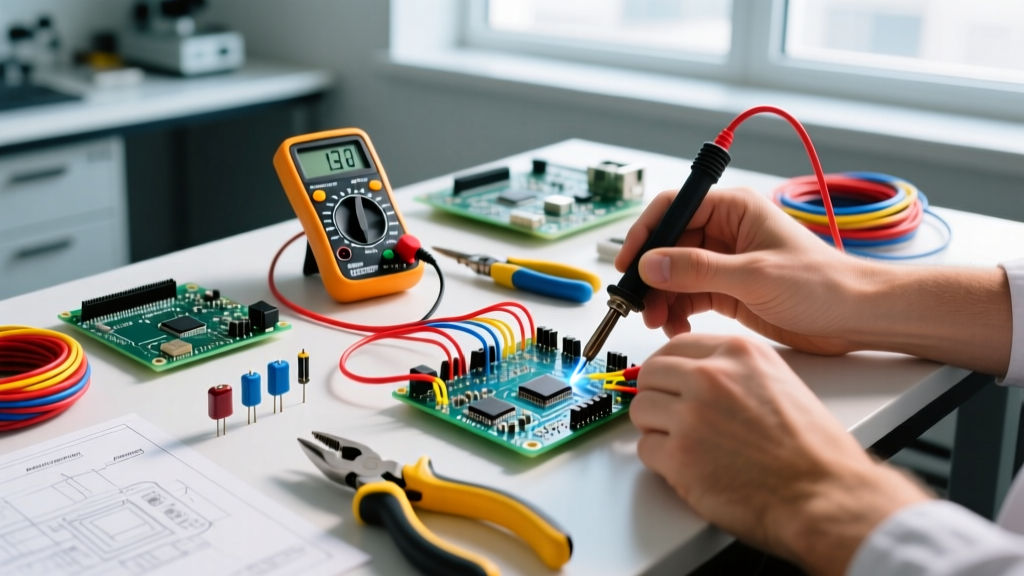
A volt is the measure of electrical potential difference, representing the exact amount of pressure needed to push one ampere of current through one ohm of resistance. If you are reading this to pass an exam, you might memorize the joules-per-coulomb textbook phrasing, but on the workbench, the volt definition in electricity is simply the "push" that forces electrons to do work. It is the independent variable you select when designing a system, and it dictates everything from your wire insulation thickness to the thermal output of your loads.
The One-Sentence Volt Definition (and What It Changes)
To be absolutely precise: One volt is the potential difference required to drive one ampere of current against one ohm of resistance, dissipating one watt of power.
But what does voltage actually change in a real circuit or installation? Voltage dictates the current flow for any given resistance (via Ohm's Law), determines the total power delivery (wattage), and sets the dielectric stress on your insulation. If you double the voltage across a fixed resistor, you don't just double the current—you quadruple the heat dissipation (Power = V²/R). Furthermore, in physical wiring, voltage determines your clearance and creepage distances; a 12V DC circuit can use bare busbars inches apart, while a 480V AC panel requires strict physical barriers to prevent arcing through the air.
The most common mistake hobbyists make is confusing voltage with current (amps) or power (watts). Voltage is the potential; current is the actual flow of electrons that occurs only when a path is provided; power is the total rate of work being done. A static shock from a doorknob can be 10,000 volts, but because the current is measured in microamps, the power is negligible and it won't harm you.
The Single Analogy: Pressure in the Pipe
If you need a mental model, think of a municipal water system. Voltage is the water pressure (PSI) sitting in the pipes behind a closed valve. Current (amps) is the flow rate (gallons per minute) once you open the tap. Resistance (ohms) is the diameter of the pipe and any kinks in the hose. High pressure (voltage) forced through a tiny pinhole (high resistance) yields a low flow (low current) but can still cut through metal. This analogy breaks down at high frequencies and AC reactance, but for DC and basic mains wiring, it holds up perfectly.
Worked Numeric Example: Sizing a 12V Load
Let's look at a practical bench scenario: building a DIY incubator using a 12V DC nichrome heating wire. You have a spool of wire that measures exactly 6.0 ohms on your multimeter. You plan to power it from a standard sealed lead-acid (SLA) battery.
- Nominal Supply: 12V
- Actual Resting Battery Voltage: 12.6V
- Resistance (R): 6.0 Ω
- Current (I = V/R): 12.6V / 6.0 Ω = 2.1 Amps
- Power (P = V × I): 12.6V × 2.1A = 26.46 Watts
Here is where understanding the volt definition matters: if you mistakenly power this same 6-ohm wire from a 5V USB power bank, the current drops to 0.83A, and your power output plummets to just 4.15W. The incubator will fail to reach temperature. Conversely, if you connect it to a 14.4V automotive alternator output, current jumps to 2.4A and power spikes to 34.5W, potentially melting the plastic housing of your incubator. The resistance didn't change; the voltage did, and it radically altered the physical outcome of the circuit.
Where You Meet Voltage in Practice
Voltage standards vary wildly depending on the application. Below is a reference table of nominal voltages you will encounter, alongside the actual measured ranges you should expect when troubleshooting with a multimeter.
| Application | Nominal Voltage | Real-World Measured Range | What It Means for Your Build |
|---|---|---|---|
| ESP32 / 3.3V Logic | 3.3V DC | 3.2V - 3.4V | Exceeding 3.6V on GPIO pins will destroy the silicon. Use level shifters for 5V sensors. |
| USB-C Power Delivery | 5V / 9V / 12V / 20V | 4.75V - 5.25V (at 5V) | Requires active negotiation via the CC pins; default is always 5V to protect legacy devices. |
| Automotive / Marine 12V | 12V DC | 11.8V (resting) to 14.4V (charging) | DC-DC buck converters must be rated for at least 16V input to survive load-dump spikes. |
| US Residential Mains | 120V / 240V AC | 114V - 126V / 228V - 252V | NEC-style guidance allows a ±5% variance. Always test for dead before touching terminals. |
For the official metrology standards that define these measurements, the National Institute of Standards and Technology (NIST) maintains the electrical metrology guidelines using the Josephson voltage standard, ensuring your Fluke multimeter reads the same in New York as it does in Tokyo.
Scenario Walkthrough: Frying an ESP32 with 12V Logic
Abstract definitions don't teach you as well as a melted component. Here is a classic failure mode when mixing voltage domains in embedded systems.
The Setup: You are building an automated gate controller. You wire a 12V industrial inductive proximity sensor to detect when the gate is closed. The sensor has an NPN open-collector output, meaning it pulls the signal line to ground when triggered, but relies on an internal pull-up resistor to 12V when idle. You connect this signal wire directly to GPIO 4 on your ESP32-WROOM-32 development board.
The Numbers: The sensor outputs 12.0V DC in the idle state. The ESP32 datasheet specifies an absolute maximum GPIO voltage of 3.6V.
The Outcome: You power up the 12V supply. The ESP32 instantly resets, the onboard 3.3V LDO regulator becomes too hot to touch, and the main chip is permanently bricked.
What Went Wrong: When 12V hit GPIO 4, it exceeded the 3.6V absolute max. This forward-biased the internal ESD protection diodes, which are designed to shunt excess voltage to the VDD (3.3V) rail. Instead of protecting the pin, the diode acted as a wire, back-feeding 12V directly into the 3.3V rail. The AMS1117-3.3 LDO regulator on the dev board isn't designed to sink reverse current, so it overheated and failed, taking the ESP32 silicon with it.
The Fix (Numbered Steps):
- Never connect a higher voltage logic signal directly to a microcontroller GPIO.
- Insert an optocoupler (like a PC817) between the 12V sensor and the ESP32.
- Wire the 12V sensor output through a 1kΩ current-limiting resistor to the optocoupler's anode (Pin 1).
- Connect the optocoupler's cathode (Pin 2) to the 12V system ground.
- Wire the optocoupler's emitter (Pin 4) to the ESP32 ground, and the collector (Pin 3) to GPIO 4 with a 10kΩ pull-up to the ESP32's 3.3V pin.
- Now, when the sensor triggers, it illuminates an internal LED, safely closing the phototransistor on the 3.3V side without any electrical connection between the two voltage domains.
FAQ: Clearing Up Common Volt Confusions
Q: Is a higher voltage always more dangerous to humans?
A: Not strictly, but practically yes. It is the current (amps) that disrupts the heart's electrical system, but voltage is the "push" that forces that current through your skin's resistance. Dry skin might have a resistance of 100,000 ohms. At 12V, only 0.12mA flows (harmless). At 120V, 1.2mA flows (tingling). If your skin is wet, resistance drops to 1,000 ohms, and 120V pushes a lethal 120mA. This is why the NFPA 70 (National Electrical Code) sets 50V AC as the threshold where strict shock-hazard wiring rules (like requiring conduit and GFCI protection) kick in.
Q: Why does my "12V" solar battery read 14.4V on my multimeter?
A: "12V" is just the nominal chemistry label for a 6-cell lead-acid battery. To actually push current into the battery to charge it, the solar charge controller must apply a higher potential difference (voltage). The 14.4V is the absorption charging voltage. Once the battery is full, it will settle back down to a resting voltage of about 12.7V.
Q: Can I use a 9V battery to power a 5V Arduino Nano?
A: Yes, but only if you wire it to the "VIN" or "RAW" pin, which routes the 9V through the board's onboard linear voltage regulator to step it down to 5V. If you wire 9V directly to the "5V" pin, you bypass the regulator and will instantly fry the ATmega328P microcontroller. Always respect the voltage domain of the specific pin you are using.