When determining if the US hertz is 50 or 60, the direct answer is that the North American power grid operates at a strict standard of 60 Hz. Hertz (Hz) measures how many complete cycles of alternating current (AC) occur per second, meaning US grid power completes 60 full sine waves—reversing direction 120 times—every single second. While much of Europe, Asia, and Africa runs at 50 Hz, the US 60 Hz standard fundamentally dictates the physical speed of AC motors, the sizing of transformers, and the flicker rate of magnetic lighting.
What 60 Hz Actually Changes in a Real Circuit
Frequency is not just a number on a utility meter; it actively changes the impedance (AC resistance) of inductive and capacitive components in your circuit. The inductive reactance of a coil is calculated as XL = 2πfL. Because frequency (f) is in the numerator, a 60 Hz grid forces inductors to present roughly 20% more reactance than they would on a 50 Hz grid. Think of an inductor like a heavy, water-filled flywheel; pushing it at a 50 Hz cadence meets less inertial resistance than rapidly jerking it back and forth at 60 Hz.
The most visible impact of this frequency difference is on the physical speed of AC induction motors. The synchronous speed of an AC motor is locked to the grid frequency and the number of magnetic poles in the stator, calculated using the formula: Ns = (120 × f) / P.
- At 60 Hz (US Standard): (120 × 60) / 4 poles = 1800 RPM (synchronous). With typical rotor slip, the motor shaft spins at roughly 1725 RPM under load.
- At 50 Hz (EU Standard): (120 × 50) / 4 poles = 1500 RPM (synchronous). Under load, this same motor design spins at roughly 1425 RPM.
This 20% speed difference completely alters the mechanical output of pumps, fans, and compressors.
Where You Meet This in Practice
You interact with the 60 Hz standard every time you plug in a device, but how the device handles that frequency depends entirely on its internal power supply topology.
- Switch-Mode Power Supplies (SMPS): Modern laptop bricks, phone chargers, and PC power supplies immediately rectify the incoming AC to high-voltage DC before chopping it at high frequencies (often 50 kHz to 100+ kHz). These are largely blind to whether the input is 50 Hz or 60 Hz, which is why they carry '100-240V ~ 50/60Hz' nameplates.
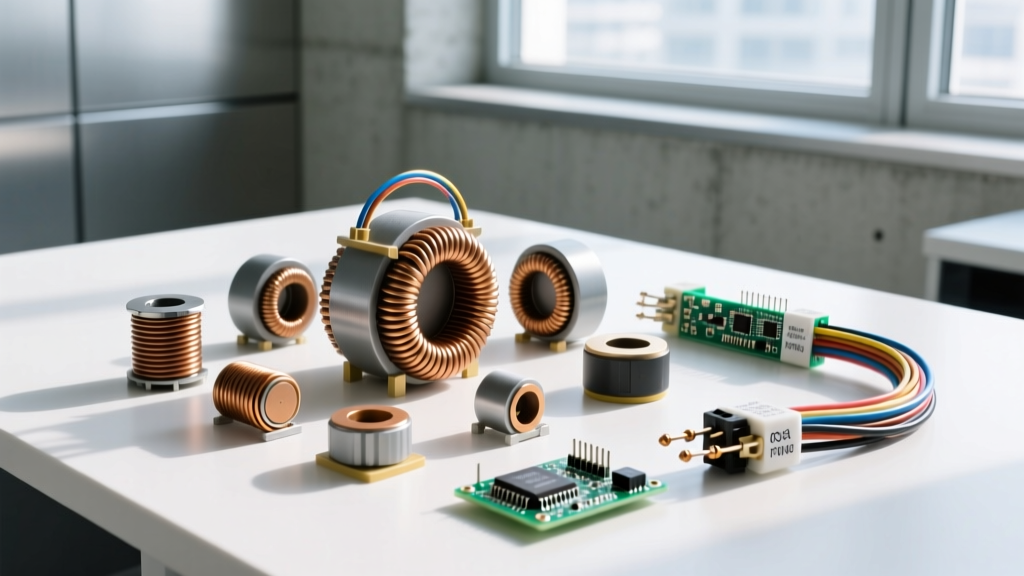
- Linear Transformers: Older HVAC control boards, microwave ovens, and industrial relays use heavy iron-core transformers. These are highly frequency-dependent. A transformer designed for 60 Hz will draw excessive magnetizing current and overheat if fed 50 Hz, because the lower frequency reduces the core's inductive reactance.
- Timing Circuits: Vintage AC-powered digital clocks and some industrial timers use the grid's zero-crossings as a timebase. If you plug a US 60 Hz clock into a European 50 Hz outlet, it will lose exactly 10 minutes every hour.
Real-World Scenario: The 50 Hz Pump on a 60 Hz Grid
To understand why you cannot simply 'adapt' frequency with basic hardware, let us walk through a common bench and jobsite failure.
The Setup: A maker imports a high-end German 230V/50Hz 3-phase coolant pump for a CNC mill. To run it in a US shop, they use a step-up transformer to convert the US 240V/60Hz split-phase supply to 230V. They successfully match the voltage but completely ignore the frequency mismatch.
The Numbers: The pump motor is rated 3 HP, 4-pole, 50 Hz. The nameplate Full-Load Amps (FLA) is 9.5A at a rated speed of 1425 RPM. The transformer steps the voltage up perfectly to 230V at 60 Hz.
The Outcome: When energized, the motor's synchronous speed jumps to 1800 RPM, and the shaft spins at roughly 1710 RPM. According to the NEMA MG 1 pump affinity laws, the power required to drive a centrifugal pump increases by the cube of the speed ratio. A 20% increase in speed (1.2x) means the power demand increases by a factor of 1.72 (1.2³). The motor attempts to draw over 16A to meet this mechanical load. The 15A breaker trips repeatedly, and the motor casing becomes dangerously hot before the thermal overload finally kicks in.
What Went Wrong: The operator treated the motor as a purely resistive load, assuming matching the voltage with a transformer was sufficient. They failed to account for the fact that AC induction motors are frequency-locked speed devices. To run this pump safely in the US, the operator would need a Variable Frequency Drive (VFD) capable of taking 60 Hz input and outputting a synthesized 50 Hz waveform to the motor, limiting the speed back to 1425 RPM.
Common Confusions: Voltage vs. Frequency
The most frequent mistake DIYers and junior technicians make is confusing voltage transformation with frequency conversion. A standard copper-wound step-up/step-down transformer only changes voltage. If you feed 120V at 60 Hz into the primary of a 1:2 transformer, you will get 240V out, but it will still be exactly 60 Hz. There are no passive magnetic components that can change grid frequency.
Another common myth is the 'Dual Rated' assumption. Just because a heavy appliance like a table saw or an air compressor has a motor that physically fits your voltage does not mean it is rated for US hertz 50 or 60 interchangeably. Always check the nameplate. If it says '60 Hz' only, running it on a 50 Hz generator will cause the motor to run 20% slower, lose its cooling fan efficiency, and likely burn out the windings due to inadequate back-EMF.
FAQ: US Hertz 50 or 60 Grid Questions
Q: Does the US grid frequency ever fluctuate from 60 Hz?
A: Yes, but only by fractions of a Hertz. According to the U.S. Energy Information Administration, grid operators continuously balance generation and load to maintain exactly 60.000 Hz over a 24-hour period. If the grid drops to 59.95 Hz for a few hours due to heavy load, operators will intentionally run the grid at 60.05 Hz later in the day to ensure AC synchronous clocks maintain perfect long-term time accuracy.
Q: Why did the US standardize on 60 Hz instead of 50 Hz?
A: Early AC systems used various frequencies (including 25 Hz and 133 Hz). 60 Hz was championed by Westinghouse and Tesla as the optimal compromise: it was high enough to eliminate the visible flicker in early arc and incandescent lighting, but low enough to keep the iron cores of transformers and motors from becoming excessively large and expensive.
Q: Can I run a US 60 Hz appliance in Europe on 50 Hz?
A: If it is a heating element (toaster, space heater) or an SMPS-powered device (laptop, TV), yes. If it contains an AC induction motor (refrigerator, power tool, HVAC), no. The motor will run 20% slower, the internal cooling fan will move less air, and the compressor or pump will stall or overheat.