A power transformer is a static electromagnetic device that transfers AC electrical energy between circuits by stepping voltage up or down while inversely scaling current to conserve power. In a real installation, it changes the available voltage and current delivery capacity to match either long-distance transmission efficiency or specific load requirements, while typically providing galvanic isolation. People commonly confuse true utility-scale 'power' transformers (optimized for near 100% load efficiency) with 'distribution' transformers (optimized for 50-70% load), or mistakenly assume all transformers provide safety isolation, which autotransformers do not.
The Core Function and the Gearbox Analogy
Think of a transformer like a mechanical gearbox in a truck. A gearbox doesn't create extra horsepower; it trades rotational speed for torque. Similarly, a transformer doesn't create extra watts. If you step the voltage down by a factor of 10, the available current steps up by a factor of 10 (minus a small percentage lost to heat and core eddy currents). This is why we transmit power at 345 kV (high voltage, low current to minimize I²R wire losses) and step it down to 240V for your dryer (lower voltage, high current to do the actual work).
The Main Types of Power Transformers
When sourcing a unit for a panel, solar interconnect, or heavy machinery, you are generally choosing between these physical and electrical configurations:
1. Isolation vs. Autotransformers
- Isolation Transformers: Feature physically separate primary and secondary windings. They provide galvanic isolation, meaning a fault to ground on the secondary side won't immediately trip the primary breaker, and touching a single secondary wire won't shock you to earth ground. Mandatory for medical equipment and most control circuits.
- Autotransformers: Use a single continuous winding with a tap. They are smaller, lighter, and cheaper because only a fraction of the power is actually transformed; the rest conducts directly. Zero galvanic isolation. Use these only for simple buck/boost voltage corrections where safety isolation isn't required.
2. EI Core (Laminated) vs. Toroidal
- EI Core: Made of stacked E and I shaped silicon steel laminations. They are robust, handle high inrush currents well, and are cheap to manufacture. They do, however, leak more magnetic flux and hum louder.
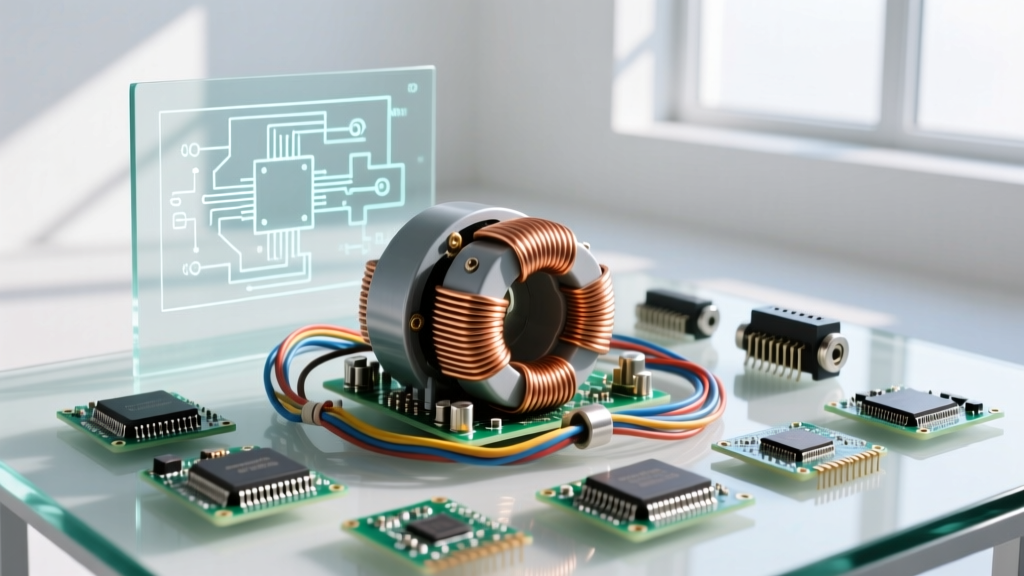
- Toroidal: Wound on a donut-shaped core. They are up to 50% lighter and emit significantly less electromagnetic interference (EMI). However, they are highly susceptible to massive inrush currents when switched on at the zero-crossing of the AC wave, which can nuisance-trip upstream breakers if not properly sized.
Worked Example: Sizing a 50 kVA Step-Down Unit
Let's size a transformer for a new CNC machine shop subpanel. We have a 480V 3-phase utility feed and need to step it down to 240V 3-phase delta for the machines.
- Required Load: 45 kW of continuous 3-phase motor load. Applying a 1.25 safety factor for continuous duty and future expansion, we need 56.25 kVA. We round up to the next standard size: 75 kVA.
- Primary Current (480V): Using the 3-phase formula I = kVA × 1000 / (V × √3).
I = 75,000 / (480 × 1.732) = 90.2 Amps.
Wire/Fuse Spec: We will feed the primary with 3 AWG THHN copper and 110A fuses. - Secondary Current (240V):
I = 75,000 / (240 × 1.732) = 180.4 Amps.
Wire/Fuse Spec: The secondary will use 250 kcmil copper to handle the 180A load plus derating, protected by a 200A breaker.
Where You Meet This in Practice
You will encounter these specific transformer types across different jobsites and workbenches:
- Solar Interconnections: Grid-tied solar inverters often require an isolation transformer to prevent DC injection into the grid and to shift the voltage from the inverter's 208V output to the utility's 480V feed.
- Industrial Control Panels: 'Control transformers' (a subset of isolation transformers, typically 100VA to 1000VA) step down 480V to 120V or 24VAC to run PLCs, contactor coils, and indicator lights safely.
- Residential Subpanels: When running a 240V feeder to a detached garage that requires 120V/240V split-phase, an autotransformer is sometimes illegally used by DIYers. The correct, code-compliant method is a 4-wire feeder with a separately derived system using a true isolation transformer if voltage shifting is needed.
Decision Tree: Specifying the Right Unit
Use this matrix to terminate your selection process with a concrete part type.
| If your application requires... | And your constraint is... | Then specify this type... | Concrete Pick / Standard |
|---|---|---|---|
| Galvanic isolation for safety & noise rejection | Standard panel mount, high inrush tolerance | EI-Core Isolation Transformer | Acme Electric T-2-50003 (1 kVA) |
| Low EMI, minimal physical footprint | Audio/precision DC supply, space-constrained | Toroidal Isolation Transformer | Hammond Manufacturing 118V Series |
| Simple voltage buck/boost (e.g., 208V to 240V) | Weight/cost savings, isolation NOT required | Autotransformer | Acme Electric BT2-500 (Buck/Boost) |
| High efficiency at partial loads (utility scale) | DOE compliance, commercial building feed | Distribution Class (Amorphous Core) | Schneider Electric EE30T2H (30 kVA) |
FAQ: Clearing Up Transformer Misconceptions
Q: Can I use a transformer to convert 60Hz to 50Hz?
A: No. A transformer only changes voltage and current amplitude. The frequency out is exactly the frequency in. To change frequency, you need a solid-state frequency converter or a motor-generator set.
Q: Why is transformer capacity rated in kVA instead of kW?
A: Because the manufacturer doesn't know what power factor (PF) your load will have. kW measures real work done, while kVA measures apparent power (the actual current and voltage the windings must handle). A 50 kVA transformer can deliver 50 kW only if your load has a perfect 1.0 PF. If your motors run at 0.8 PF, that same 50 kVA transformer can only deliver 40 kW of real work before the windings overheat from the reactive current.
Q: Do modern efficiency standards change how I buy these?
A: Yes. The U.S. Department of Energy mandates strict efficiency levels for low-voltage dry-type distribution transformers. When buying new, ensure the spec sheet explicitly states compliance with the latest DOE 10 CFR 431 standards to avoid failing commercial inspections.
The Default Recommendation: For 95% of commercial subpanels, heavy machinery feeds, and high-end DIY workshop builds requiring voltage conversion, specify a standard NEMA TP-1 rated, EI-core isolation transformer (like the Schneider Electric / Acme Electric general-purpose lines). It provides the mandatory galvanic isolation, handles the brutal inrush currents of starting motors better than toroidals, and meets all current federal efficiency mandates. Reserve toroidals strictly for benchtop electronics and autotransformers strictly for non-isolated buck/boost corrections.