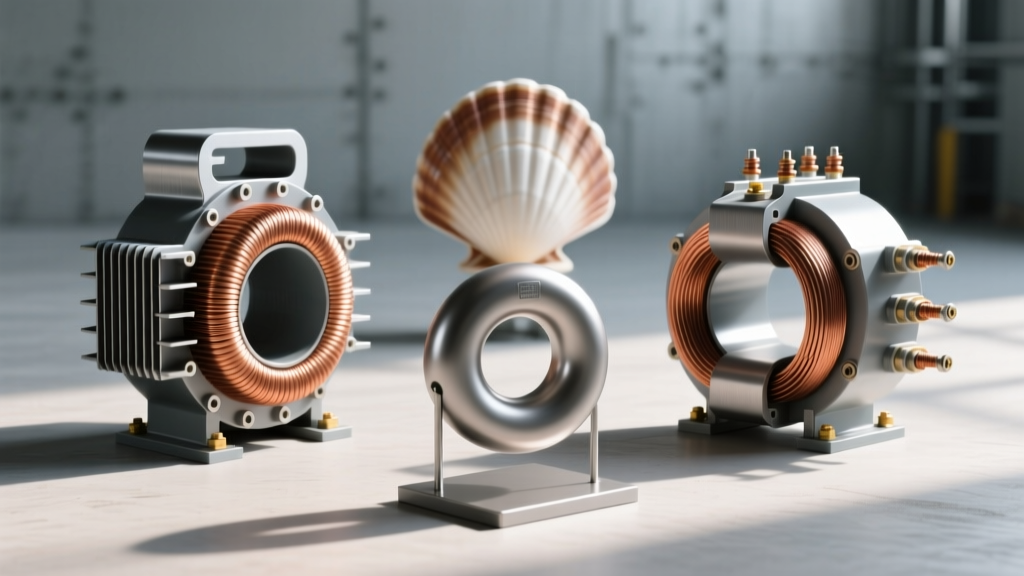

A transformer is a static electrical device that transfers alternating current (AC) energy between two or more circuits through electromagnetic induction, changing voltage and current levels while maintaining the same frequency. When you are asking what are the types of transformer, you are usually looking at how the magnetic core and copper windings are physically arranged to manage flux, heat, and stray magnetic fields. Unlike active semiconductor converters, a transformer doesn't create power or rectify AC to DC; it simply trades voltage for current to match the impedance of your load to your source.
The Core Function: What a Transformer Actually Changes
In a real circuit, a transformer changes three specific parameters: voltage, current, and reflected impedance. If you step down the voltage from 120V AC to 24V AC (a 5:1 turns ratio), the secondary current capability increases by a factor of 5, minus efficiency losses. More importantly, it changes the impedance. Just like a mechanical gear ratio allows a small motor to lift a heavy load by trading speed for torque, a transformer allows a high-impedance source to drive a low-impedance load. The impedance transformation follows the square of the turns ratio: Z_primary = Z_secondary × (N_primary / N_secondary)².
This impedance isolation is why transformers are indispensable in audio engineering to break ground loops, and in industrial control circuits to separate sensitive 24V logic from noisy 480V motor feeds.
The Main Types of Transformer Construction
The physical geometry of the core dictates the transformer's leakage inductance, mechanical strength, and electromagnetic interference (EMI) profile. According to foundational magnetic design principles outlined by Electronics Tutorials, laminated steel cores dominate power applications, while ferrite cores handle high-frequency switching. For standard 50/60Hz line-frequency applications, you will encounter three primary physical types.
| Construction Type | Core Geometry | Stray Magnetic Field | Typical Use Case | Cost & Weight |
|---|---|---|---|---|
| Core Type | Windings surround a central core leg (rectangular or stepped). | Moderate | High-voltage transmission, large industrial substations. | Lower cost, easier to insulate and repair. |
| Shell Type | The core surrounds the windings (like a donut around the coils). | Low | Low-voltage, high-current applications, HVAC control transformers. | Heavier, better mechanical support for short-circuit forces. |
| Toroidal | Continuous ring (donut) core with windings distributed evenly around it. | Very Low | High-end audio amplifiers, medical equipment, sensitive instrumentation. | Highest cost, lightest weight, hardest to manufacture. |
Worked Numeric Example: Sizing a Control Transformer
Let’s size a shell-type control transformer for a commercial rooftop HVAC unit. The control board requires 24V AC, and the total continuous load of the contactor coils and relays is 1.2 Amps.
- Calculate Required VA: Power (VA) = Voltage × Current. 24V × 1.2A = 28.8VA. We select the next standard size up: a 40VA transformer.
- Determine Primary Current: Assuming a 120V AC primary supply. I_primary = 40VA / 120V = 0.33 Amps.
- Determine Secondary Current: I_secondary = 40VA / 24V = 1.67 Amps (maximum continuous capacity).
- Wire Sizing (NEC-style guidance): The primary draws only 0.33A, but for mechanical strength in control panels, we use 18 AWG THHN (rated 16A at 90°C). The secondary carries 1.67A continuous; we use 14 AWG THHN to handle the high inrush current of the contactor coils without voltage sag.
- Overcurrent Protection: Primary fuse sized at 125% of primary current (0.33A × 1.25 = 0.41A), so we install a 0.5A slow-blow fuse. Secondary gets a 2A fast-acting fuse.
Where You Meet This in Practice
You will rarely design a 50/60Hz power transformer from scratch unless you are working in specialized magnetics engineering. Instead, you meet transformers in the field as integration and troubleshooting components:
- HVAC Control Circuits: Shell-type step-down transformers (120V/208V/480V to 24V) powering thermostats and gas valves.
- Audio Isolation: 1:1 toroidal or specialized laminated transformers used in DI (Direct Injection) boxes to lift ground loops between a guitar amp and a PA mixer.
- Linear Power Supplies: Heavy core-type or toroidal transformers dropping mains voltage down to 12V-24V AC before a bridge rectifier and smoothing capacitor bank convert it to DC.
- Current Transformers (CTs): Toroidal measurement transformers clamped around a single mains conductor to step down high AC current (e.g., 200A) to a measurable 5A or 1A signal for an energy meter.
Real-World Scenario Walkthrough: The Melted Terminal Lug
Theory is clean, but jobsite physics are messy. Here is a failure analysis from a commercial refrigeration repair that highlights why transformer sizing and termination matter.
The Setup: A technician replaced a burnt-out 24V 40VA control transformer in a walk-in freezer defrost control board. The new transformer was a standard shell-type unit with spade quick-connect terminals.
The Numbers: The continuous secondary load was 1.5A (well within the 1.67A max of the 40VA unit). The technician used 18 AWG stranded wire for the secondary, which has an ampacity of roughly 14A in free air—more than enough for 1.5A. He crimped the spade lugs with a generic, non-ratcheting crimper and slid them onto the transformer tabs.
The Outcome: Three weeks later, the freezer alarm triggered. Upon inspection, the secondary spade lug had melted into the transformer's plastic bobbin, destroying the unit and blowing the primary fuse.
What Went Wrong: The technician sized the wire for continuous current but ignored inrush current and termination torque. When the defrost contactor engaged, the coil drew an inrush current of nearly 9 Amps for the first 50 milliseconds. The poorly crimped, non-ratcheted spade lug had a high contact resistance (measured post-failure on identical setups at roughly 0.8 ohms). At 9A inrush, that high-resistance joint dissipated over 60 watts of heat instantly (P = I²R). Repeated daily thermal cycling oxidized the copper, increased the resistance further, and caused a thermal runaway that melted the terminal. The fix: Always use ratcheting crimpers for quick-connects, apply a dab of antioxidant compound, and consider hard-wiring (screwing down ring terminals) for high-inrush inductive loads.
Common Confusions and FAQ
What do people commonly confuse a transformer with?
Beginners often confuse a transformer with an AC-DC power supply or a Switching Mode Power Supply (SMPS). A standard iron-core transformer only outputs AC. It cannot rectify voltage to DC, nor can it regulate voltage against load changes. If you need 12V DC from a 120V AC wall outlet, you need a power supply (which may contain a high-frequency ferrite transformer inside it), not just a standalone line-frequency transformer.
Can a transformer work on DC?
No. Faraday’s law of induction requires a changing magnetic field to induce a voltage in the secondary coil. If you apply steady DC to a transformer primary, the magnetic field saturates the core instantly, the winding acts as a simple low-resistance wire, and it will draw massive current until it catches fire or blows a fuse. (Note: Flyback converters in SMPS designs use DC, but they chop it into high-frequency AC pulses first using a MOSFET switch).
What is the difference between an autotransformer and an isolation transformer?
An isolation transformer (like the core and shell types discussed above) has physically separate primary and secondary windings, providing galvanic isolation for safety and noise rejection. An autotransformer (like a Variac) uses a single continuous winding with a sliding tap. Autotransformers are smaller, cheaper, and more efficient for voltage buck/boost tasks, but they offer zero galvanic isolation—touching the "stepped down" output can still give you a lethal shock referenced to earth ground. For deeper reading on magnetic isolation principles, the All About Circuits textbook chapter on transformers provides excellent schematic breakdowns.


