
The Hidden Cost of Guesswork: Why Your Bench Needs a Dedicated Tester
For decades, the digital multimeter (DMM) was the undisputed king of the electronics workbench. While a modern DMM is essential for measuring voltage, current, and resistance, its built-in transistor testing capabilities are notoriously rudimentary. Most multimeters feature a basic hFE socket that only tests NPN and PNP bipolar junction transistors (BJTs) at a single, low test current. They are entirely blind to MOSFETs, IGBTs, JFETs, TRIACs, and complex diode arrays. As power electronics and high-frequency switching circuits become more prevalent in DIY and repair scenarios, relying on a DMM for semiconductor identification is no longer viable.
A dedicated transistor tester does more than just identify pinouts. It measures critical parameters like gate threshold voltage, junction capacitance, DC current gain (hFE), and equivalent series resistance (ESR) for capacitors. Whether you are salvaging components from dead ATX power supplies, designing custom motor drivers, or troubleshooting audio amplifiers, a proper semiconductor analyzer is the fastest way to verify part integrity before you commit it to a printed circuit board.
The Counterfeit Component Epidemic
One of the most compelling reasons to invest in a high-quality component tester in 2026 is the rampant issue of counterfeit semiconductors. If you source power transistors from unauthorized online marketplaces, you are highly likely to receive remarked parts. A classic example is the TIP122 Darlington pair or the 2N3055 power BJT. Counterfeiters often sand down the markings of cheap, low-power transistors and paint them black to mimic expensive, high-power alternatives.
A multimeter diode test will show a standard forward voltage drop, giving you a false sense of security. However, a dedicated transistor tester measuring hFE will immediately expose the fraud. A genuine TIP122 will show an hFE well over 1000, while a faked part might show an hFE of 40. Catching these fakes before soldering them into a 500W inverter circuit prevents catastrophic failures, blown traces, and potential fire hazards.
Categorizing the Market: From Budget Kits to Professional Analyzers
The market for component testers is broadly divided into three tiers, each catering to different budgets and technical requirements. Understanding the architecture behind these tools is critical for making an informed purchase.
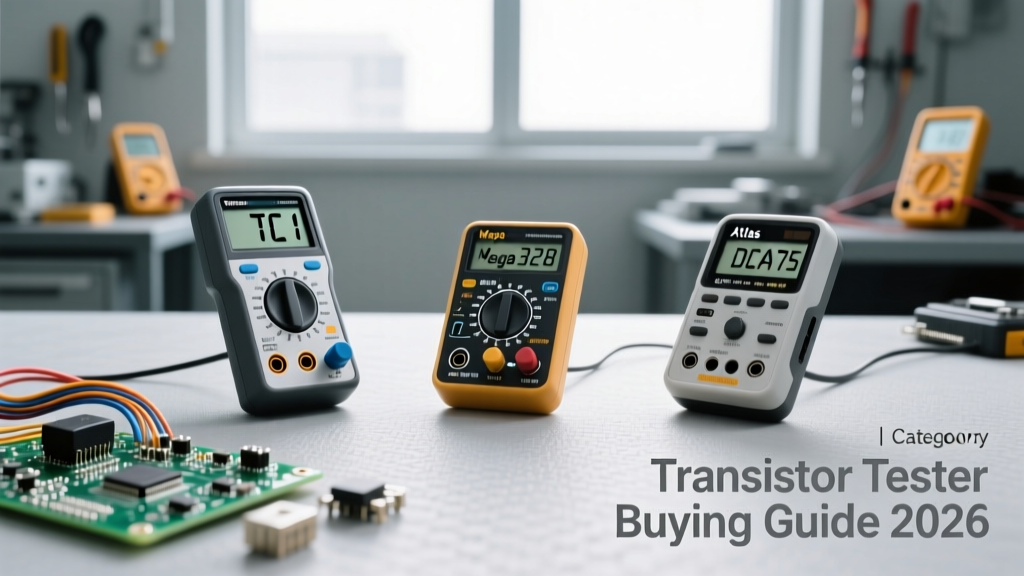
1. The AVR-Based Hobbyist Testers (Mega328 and TC1)
The open-source community revolutionized bench testing with the ATmega328P-based component testers. Originally designed as DIY kits, these devices use a clever resistor network and the microcontroller's internal analog-to-digital converter (ADC) to charge and discharge component junctions, calculating values based on the time constants. The original Mega328 kits are incredibly cheap (often under $15) but suffer from poor build quality, monochrome displays, and a reliance on bulky 9V batteries.
The TC1 is the modernized, premium evolution of this architecture. Priced around $25 to $35, the TC1 features a vibrant 1.8-inch color LCD, a built-in USB-C rechargeable lithium battery, and a 30-pin ZIF (Zero Insertion Force) socket. It also adds advanced features like IR remote decoding, PWM signal generation, and rotary encoder testing. For hobbyists and students, the TC1 offers 90% of the utility of professional tools at a fraction of the cost.
2. Next-Gen Touchscreen Multifunction Testers (FNIRSI DSO-TC3)
For field technicians and advanced hobbyists who need to minimize bench clutter, combination devices like the FNIRSI DSO-TC3 represent the cutting edge of 2026 portable test gear. Priced between $50 and $70, these units integrate a component tester with a basic digital storage oscilloscope (DSO) and a programmable signal generator. While the component testing module is fundamentally similar to the TC1, the addition of a 200kHz oscilloscope allows you to verify the output of the PWM generator or probe low-frequency audio signals in the same device. The trade-off is a slightly more complex user interface and higher power consumption.
3. Professional Semiconductor Analyzers (Atlas DCA75)
When precision, repeatability, and deep data analysis are required, professional curve tracers like the Peak Atlas DCA75 are the industry standard. Costing approximately $130, the DCA75 does not just identify components; it allows you to configure custom test currents and voltages to simulate real-world operating conditions. It connects to a PC via USB, providing visual gain curves and detailed leakage current measurements that budget testers simply cannot resolve. For audio engineers matching differential pairs or power electronics designers verifying IGBT gate characteristics, the DCA75 is an indispensable investment.
Head-to-Head Comparison Matrix
| Model / Architecture | Price Range | Display & Interface | Max Zener Test Voltage | MOSFET Gate Drive | Best Use Case |
|---|---|---|---|---|---|
| Generic Mega328 Kit | $12 - $18 | 128x64 Monochrome LCD | ~3V (Internal) | Fixed 5V | Students, basic DIY sorting |
| TC1 (Upgraded AVR) | $25 - $35 | 1.8-inch Color TFT | Up to 30V (Requires Ext. Power) | Fixed 5V | Hobbyists, repair bench, salvage |
| FNIRSI DSO-TC3 | $50 - $70 | 2.8-inch Touchscreen | ~3V (Internal) | Fixed 5V | Field repair, portable diagnostics |
| Peak Atlas DCA75 | $120 - $140 | PC Software / Dot-Matrix LCD | Not Primary Focus (Curve Tracing) | Adjustable (Custom Curves) | Professional R&D, audio matching |
Critical Buying Criteria: Beyond Basic Pinout Detection
When evaluating a transistor tester, look past the basic 'insert and read' functionality. The following features separate a capable bench tool from a cheap novelty:
- Zener Diode Testing Capability: Standard ZIF socket testers only provide enough voltage to test standard rectifier and signal diodes (up to ~3V). If you repair switching power supplies, you must test 12V, 15V, or 24V Zener diodes. Look for testers that include a dedicated high-voltage Zener terminal (often requiring an external 12V-24V DC adapter).
- ESR Measurement Resolution: Electrolytic capacitor failure is the number one cause of dead electronics. A good tester measures Equivalent Series Resistance (ESR) in-circuit or out-of-circuit with a resolution down to 0.01 ohms, allowing you to identify dried-out capacitors that still show the correct bulk capacitance.
- Leakage Current Detection: Power MOSFETs and BJTs can develop internal micro-shorts that only manifest under thermal stress. High-end testers measure junction leakage current (Iceo / Idss), flagging degraded components that would otherwise pass a basic continuity check.
- TRIAC and Thyristor Latching Verification: Identifying the Gate, MT1, and MT2 pins of a TRIAC is easy. Verifying that the device actually latches and holds current when the gate signal is removed is much harder. Ensure your tester's firmware supports full TRIAC latching verification.
Information Gain: Where Budget Testers Fail (And How to Compensate)
It is vital to understand the physical limitations of AVR-based testers like the TC1 and Mega328. These devices operate on a single 3.7V lithium cell or a 9V battery, stepping up the voltage internally to a maximum of about 5V for component excitation. This creates a massive blind spot when testing logic-level vs. standard MOSFETs.
According to DigiKey's MOSFET application notes, a standard power MOSFET (like the IRF3205) requires a gate-to-source voltage (Vgs) of 10V to 15V to fully enhance and achieve its rated RDS(on). A budget tester only applies ~5V to the gate. Consequently, the tester might report a high on-resistance or misidentify a perfectly good IGBT as a defective MOSFET because it cannot fully saturate the channel.
Pro-Troubleshooting Insight: If a budget tester flags a high-voltage N-channel MOSFET as 'damaged' or shows an unusually high gate capacitance, do not throw it away immediately. The tester is likely failing to fully charge the gate dielectric due to its low test voltage. Cross-reference the part number with its datasheet to check the Vgs(th) threshold. If the component is meant for 12V gate drive, trust the datasheet over the $20 tester.
Furthermore, as discussed in EEVblog's extensive test gear forums, budget testers struggle with components that have extremely high junction capacitance, such as large IGBT modules used in induction heaters or EV inverters. The internal RC time constant exceeds the microcontroller's measurement window, resulting in a timeout error. For high-power industrial electronics, you must step up to a dedicated curve tracer or use a custom bench test jig with a variable power supply and an oscilloscope.
Final Verdict: Matching the Tester to Your Workflow
Your purchasing decision should be dictated by the types of projects that dominate your workbench. If you are a hobbyist building Arduino projects, repairing consumer audio gear, or sorting through bins of salvaged through-hole components, the TC1 is the undisputed value champion. Its color screen, rechargeable battery, and broad component support will handle 95% of your daily tasks.
If you frequently leave the bench to troubleshoot automotive electronics, HVAC control boards, or stage lighting equipment, the FNIRSI DSO-TC3 provides the added utility of an oscilloscope in a single, pocket-sized chassis. Finally, for professional engineers, audio enthusiasts matching output transistors, and repair technicians dealing with high-reliability aerospace or medical equipment, the Peak Atlas DCA75 is non-negotiable. Its ability to generate custom test curves and log data to a PC provides the empirical proof required for serious semiconductor validation.