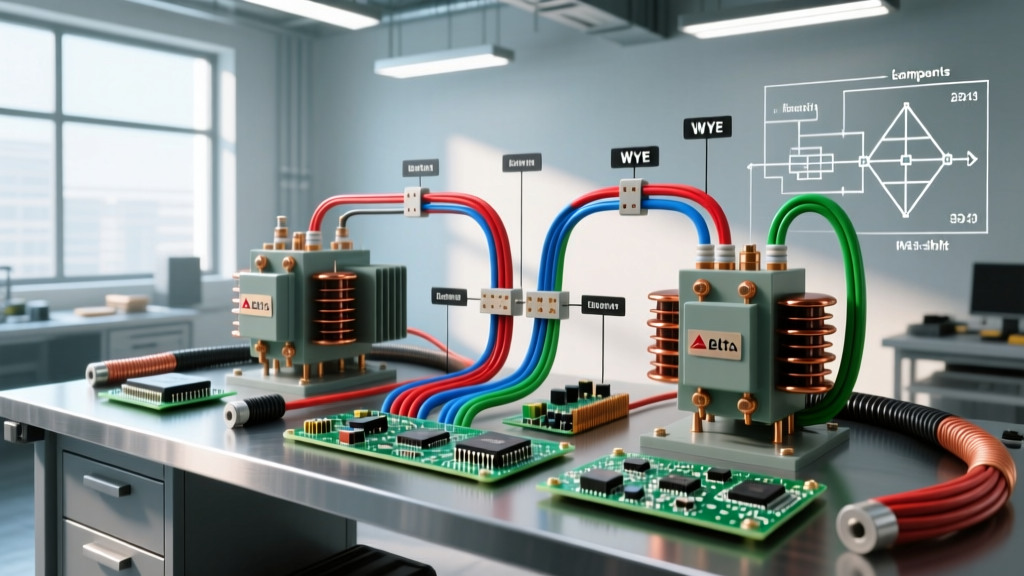

Transformer connections refer to the specific wiring configurations—such as Delta, Wye (Y), or Zigzag—used to link the primary and secondary windings of a transformer to establish desired voltage ratios, phase shifts, and grounding paths in an AC power system. While the physical iron core and copper coils handle the magnetic induction, the connection topology is what dictates how the transformer interacts with the broader three-phase grid. Specifically, the connection type changes the line-to-line versus line-to-neutral voltage relationships, introduces or eliminates phase angle shifts (like the classic 30° shift in a Delta-Wye setup), and controls how zero-sequence (ground fault) currents flow. People most commonly confuse the physical winding arrangement with the terminal line outputs, or mistakenly assume that any Wye secondary inherently provides a usable neutral—it only does if the star point is solidly grounded and bonded to the system earth.
The Core Configurations: Quick-Reference Table
Before diving into the math, you need a reliable map of how primary and secondary windings interact. The table below outlines the four most common three-phase transformer connections you will encounter in commercial and industrial power distribution. Note how the zero-sequence path dictates ground fault behavior—a critical factor for protective relay coordination.
| Configuration | Phase Shift | Secondary Line vs. Phase Voltage | Zero-Sequence Path | Primary Use Case |
|---|---|---|---|---|
| Delta - Delta | 0° (or 180°) | Line = Phase | Blocked (trapped in winding) | Industrial motor loads, high-reliability feeders (open-delta fallback) |
| Delta - Wye (Y) | 30° lagging | Line = √3 × Phase | Blocked on primary; passes on secondary | Commercial building step-down (480V to 208Y/120V), solar isolation |
| Wye - Delta | 30° leading | Line = Phase | Passes on primary; blocked on secondary | Utility step-down at substations, generator step-up transformers |
| Zigzag (Interconnected Star) | 0° | Line = √3 × Phase | Low-impedance path provided | Deriving a neutral on ungrounded Delta systems, harmonic filtering |
Worked Numeric Example: Sizing a 150 kVA Delta-Wye Step-Down
Let’s move from theory to the workbench. You are specifying a dry-type transformer for a commercial HVAC control panel and lighting circuit. The nameplate reads: 150 kVA, 480V Delta Primary, 208Y/120V Secondary. You need to size the primary and secondary overcurrent protection and conductors, which requires knowing both the line currents (what flows in the supply cables) and the phase currents (what flows inside the actual transformer windings).
1. Primary Side (480V Delta)
First, calculate the full-load primary line current using the standard three-phase power formula: I = S / (V × √3).
- Primary Line Current: 150,000 VA / (480V × 1.732) = 180.4 Amps.
- Primary Phase Current: Because the windings are in a Delta configuration, the current splits at each node. The current flowing through the actual coil is the line current divided by √3. Therefore, 180.4 A / 1.732 = 104.1 Amps.
Sizing takeaway: Your primary feeder cables and breaker must be sized for the 180.4A line current (typically a 200A breaker with 3/0 AWG copper THHN), but the transformer's internal windings only experience 104.1A of thermal stress.
2. Secondary Side (208Y/120V Wye)
Now, calculate the secondary side. The line-to-line voltage is 208V, and the line-to-neutral (phase) voltage is 120V.
- Secondary Line Current: 150,000 VA / (208V × 1.732) = 416.5 Amps.
- Secondary Phase Current: In a Wye configuration, the line conductor is in series with the winding. Therefore, Line Current = Phase Current = 416.5 Amps.
Where You Meet This In Practice
Understanding transformer connections isn't just for passing the PE exam; it solves specific, expensive problems on real jobsites.
Commercial Building Power (Delta-Wye)
The vast majority of commercial buildings in North America use a Delta-Wye step-down transformer. The utility delivers 480V Delta (three wires, no neutral) to the building. The Delta-Wye transformer steps this down to 208Y/120V. The Wye secondary creates a star point that is bonded to ground, providing a stable 120V line-to-neutral for standard receptacles and a 208V line-to-line for heavy HVAC equipment. Furthermore, the Delta primary blocks zero-sequence currents from the secondary side from propagating back upstream to the utility grid, preventing nuisance tripping of utility ground-fault relays.
Solar PV Inverter Isolation
Modern commercial string inverters (like those from SMA or SolarEdge) often require an ungrounded or Delta secondary connection. If a facility ties a solar array into a standard solidly grounded Wye-Wye transformer, the inverter will immediately throw a ground fault error upon startup because it detects the neutral-to-ground bond. Installing a Delta-Wye isolation transformer (with the Wye secondary left ungrounded, or using a Delta secondary) solves this by providing galvanic isolation and blocking the zero-sequence path, allowing the inverter's internal ground-fault detection to operate correctly.
VFD Harmonic Mitigation (12-Pulse Systems)
Variable Frequency Drives (VFDs) are notorious for generating 5th and 7th harmonics, which overheat upstream transformers. To mitigate this without expensive active filters, engineers use a 12-pulse transformer setup. This involves a single primary winding feeding two separate secondary windings on the same core: one Wye and one Delta. Because the Delta-Wye connection inherently introduces a 30° phase shift, the two secondary outputs are offset by 30°. When the DC buses of the two VFDs are combined, the 5th and 7th harmonics (which are 150° and 210° out of phase, respectively) perfectly cancel each other out on the primary side. This is a highly cost-effective solution for large pump and fan motors.
Common Confusions and Troubleshooting
When transformer connections are misunderstood, the symptoms on the bench or in the panel can be baffling. Here are the most frequent pitfalls.
The 'Floating Neutral' Voltage Drift
Symptom: You measure line-to-ground voltages on a Wye secondary and read 65V on Phase A, 180V on Phase B, and 110V on Phase C, even though line-to-line voltages are a perfectly balanced 208V.
Cause: The Wye star point is not bonded to ground. Without a ground reference, capacitive coupling between the windings and the transformer core creates a phantom, highly unstable neutral point.
Fix: Install a grounding jumper from the X0 terminal (the star point) to the equipment grounding conductor and the grounding electrode system, per NEC Article 250. Once bonded, the line-to-ground voltages will instantly stabilize at 120V.
Paralleling Mismatched Vector Groups
Symptom: You attempt to parallel two 500 kVA transformers to increase capacity. One is Delta-Wye (Dyn11), and the other is Wye-Wye (Yyn0). Upon closing the tie breaker, a massive fault occurs, tripping both primary breakers instantly.
Cause: The Delta-Wye transformer introduces a 30° phase shift, while the Wye-Wye introduces 0°. When you paralleled them, you effectively created a dead short across a 30° phase angle difference, resulting in massive circulating currents.
Fix: Never parallel transformers unless their vector groups (phase shifts) and impedance percentages match exactly. Refer to the NETA Maintenance Testing Specifications for proper paralleling verification protocols.
Open-Delta Capacity Derating
Symptom: A three-transformer Delta bank loses one unit due to a blown fuse. The facility maintenance team assumes they still have 66% of their original capacity available.
Cause: An open-delta (V-V) connection can indeed supply three-phase power with only two transformers, but the math is not linear. The capacity drops to 57.7% of the original three-phase bank rating, not 66.6%, due to the phase angle geometry of the remaining two windings.
Fix: If running in open-delta as an emergency measure, immediately shed at least 43% of the connected load to prevent overheating the remaining two transformers.
Frequently Asked Questions
Can I use a Wye-Delta transformer to step down 480V to 240V for a workshop?
Yes, but be aware that a standard Delta secondary does not provide a 120V neutral. If you need 120V for control circuits or lighting, you must specify a 'High-Leg Delta' (also known as a Red-Leg or Stinger Delta) configuration, which taps the center of one winding to ground, providing 120V on two phases and 208V to ground on the high leg. Alternatively, use a Delta-Wye transformer to get a standard 208Y/120V output.
Why do utility substations almost always use Wye-Delta connections?
Utility transmission lines are almost exclusively Wye-connected to provide a ground path for fault detection and to allow the use of single-phase-to-ground insulation grading. The substation transformer uses a Wye primary to match the grid, and a Delta secondary to feed the distribution lines. The Delta secondary blocks zero-sequence currents from the distribution grid from flowing back into the transmission grid, isolating ground faults to the local distribution zone.
What happens if I reverse the phase rotation on a Delta-Wye transformer?
Reversing the primary phase rotation (e.g., swapping A and B phases) will reverse the secondary phase rotation. However, it will also change the phase shift relationship. A standard 30° lagging shift (Dyn1) might behave unexpectedly relative to your protective relaying if the utility expects a specific vector group. Always verify phase rotation with a digital phase rotation meter before energizing a new installation.
For deeper study on transformer impedance and loss calculations, consult the US Department of Energy's Distribution Transformer Guidelines, which detail the efficiency standards and thermal limits for modern dry-type and liquid-filled units.