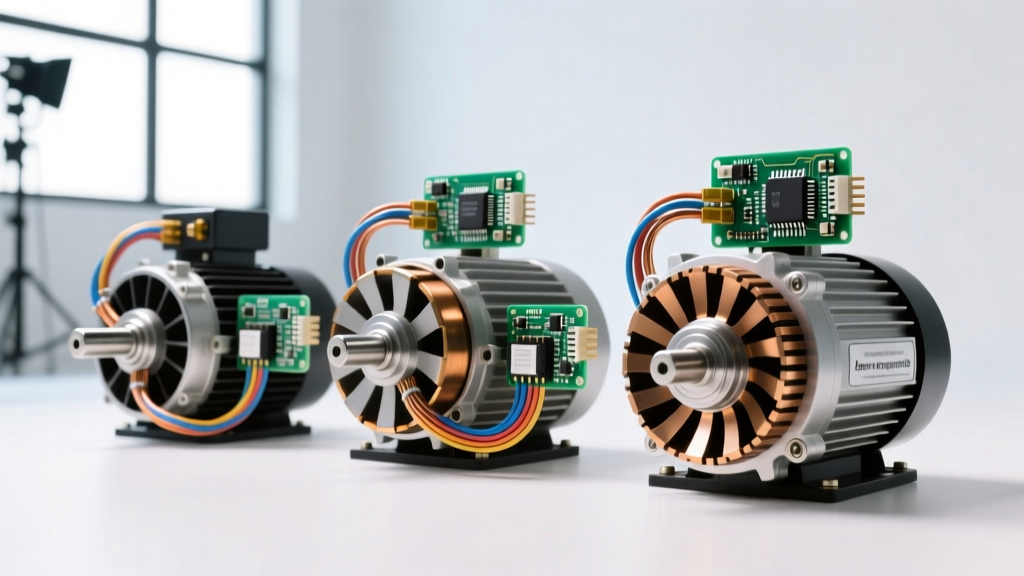

When specifying equipment for industrial or heavy-duty bench applications, three-phase motor types are identified by their type of rotor construction and their synchronization method relative to the AC supply frequency. While hobbyists often group all three-phase AC motors together, the internal rotor architecture dictates everything from the starting torque curve to the required drive electronics. Picking the wrong rotor type for a high-inertia load will result in tripped breakers, melted windings, or stalled production lines.
This guide breaks down the physical differences between the primary three-phase motor classifications, provides a concrete sizing methodology, and gives you a hard decision matrix to select the exact motor and drive for your application.
The Core Distinction: Rotor Construction and Synchronization
The stator of almost all three-phase AC motors looks identical: three sets of copper windings spaced 120 electrical degrees apart, creating a rotating magnetic field (RMF) when energized. The classification happens inside the rotor.
1. Squirrel Cage Induction Motor (SCIM)
The rotor consists of a laminated steel core with longitudinal aluminum or copper bars short-circuited at both ends by heavy end rings (resembling a hamster cage). The RMF induces a current in these bars, creating a secondary magnetic field that chases the stator field. Because the rotor must "slip" behind the RMF to induce current, it never reaches true synchronous speed. SCIMs account for over 90% of industrial motor applications due to their ruggedness and lack of brushes.
2. Wound Rotor Induction Motor (WRIM)
Instead of cast bars, the rotor has actual copper wire windings connected to slip rings on the shaft. By connecting external variable resistors to these slip rings, you can manipulate the rotor's impedance. This allows for massive starting torque with minimal inrush current, making WRIMs ideal for heavy, high-inertia loads like mine hoists or large rock crushers. However, the slip rings and brushes require regular maintenance.
3. Synchronous Motor (PMSM / Wound Field)
The rotor contains either permanent magnets (PMSM) or a DC-excited electromagnet. Once the motor reaches near-synchronous speed (usually via an amortisseur winding or VFD ramp), the rotor magnetically "locks" to the stator's RMF. There is zero slip. These are used when exact speed holding is required regardless of load fluctuations, or when power factor correction is needed.
Motor Type Comparison Matrix: Torque, Control, and Cost
| Motor Type | Torque Curve Profile | Control / Drive Needs | Relative Cost (per 10HP) | Best Load Profile |
|---|---|---|---|---|
| SCIM (NEMA Design B) | Moderate starting torque (150%), low starting current. | Direct-On-Line (DOL), Soft Starter, or standard V/f VFD. | $600 - $900 | Centrifugal pumps, fans, standard conveyors. |
| SCIM (NEMA Design C) | High starting torque (200-250%), low starting current. | DOL with high-breakaway thermal overload, or VFD. | $800 - $1,200 | Reciprocating compressors, loaded conveyors, crushers. |
| WRIM | Extremely high starting torque, highly controllable via external resistance. | Specialized liquid rheostat or resistor bank controller. | $2,500 - $4,000+ | High-inertia mills, hoists, large ball mills. |
| PMSM (Synchronous) | Peak torque at zero RPM (with drive), constant speed under load. | Mandatory: Sensorless Vector or Closed-Loop Flux Vector VFD. | $1,200 - $2,000 | Precision extruders, CNC spindles, high-efficiency HVAC. |
Sizing Rule of Thumb and Worked Load Example
Let's look at a real-world sizing scenario to see how this works in practice, avoiding abstract HP/kW conversions that ignore mechanical reality.
Worked Example: 15 HP Inclined Conveyor
The Load: An inclined aggregate conveyor requires 12 HP to run continuously at full capacity. However, because it is loaded before starting, the breakaway (starting) torque requirement is 180% of the full-load torque. The ambient temperature is a standard 40°C.
The Mistake: Sizing a standard 15 HP NEMA Design B SCIM. A Design B motor typically produces 150% starting torque. It will stall, draw locked-rotor current (approx. 600% of FLA), and trip the breaker or melt the windings.
The Correct Sizing Path:
- Calculate Breakaway Requirement: 12 HP running × 1.80 (breakaway factor) = 21.6 HP equivalent starting demand.
- Option A (Across-the-line starting): Select a 25 HP NEMA Design C motor. Design C provides ~225% starting torque. This overcomes the 180% requirement without oversizing the running thermal mass too drastically. Cost: High initial footprint and idle losses.
- Option B (The 2026 Standard - VFD): Select a 15 HP NEMA Premium (IE3) SCIM paired with a Vector-Control VFD (e.g., Allen-Bradley PowerFlex 527). The VFD can deliver 150% to 200% torque at 0 RPM without drawing massive inrush current from the grid. This allows the motor to be sized exactly for the 12 HP running load (using a 15 HP frame for thermal headroom).
Verdict: Option B is the modern default. It reduces mechanical shock on the gearbox and lowers grid inrush penalties. For more on motor efficiency standards, refer to the US DOE Premium Efficiency Motor Guide.
Wiring, Terminals, and Failure Signatures
Identifying the motor type also dictates how you wire it. Most industrial SCIMs are 9-lead (NEMA) or 6-lead (IEC) dual-voltage motors.
Terminal Identification
| Standard | Terminal Markings | Configuration Notes |
|---|---|---|
| NEMA (9-Lead) | T1 through T9 | Wye (Star) for high voltage (e.g., 460V); Delta for low voltage (e.g., 230V). T1, T2, T3 are the line connections. |
| IEC (6-Lead) | U1, V1, W1 / U2, V2, W2 | U1/V1/W1 to line. Wye achieved by shorting U2/V2/W2. Delta achieved by linking U1-W2, V1-U2, W1-V2. |
Diagnosing Failure Signatures
When a three-phase motor fails, the acoustic and thermal signatures tell you exactly what went wrong:
- Humming without rotation (Single-Phasing): The motor energizes but refuses to turn, emitting a loud, low-frequency hum. This is almost always caused by a blown fuse on one of the three phases, a broken contactor pole, or a severed cable. The single-phasing creates negative-sequence currents that rapidly overheat the rotor. Fix: Check all three phases with a multimeter for line-to-line voltage.
- Overheat (Stator Winding Failure): The motor runs but the casing is too hot to touch (>90°C), eventually tripping the internal thermal overload. Causes include blocked cooling fins, operating a 60Hz motor on a 50Hz supply without a VFD, or continuous operation above the service factor (e.g., 1.15). Fix: Verify ambient temp, clean fan cowl, check V/f ratio.
- Stall under load: The motor runs fine at no-load but bogs down or stalls when mechanical resistance is applied. This indicates severe voltage drop in the feeder wiring, an undersized motor, or an incorrect VFD torque boost parameter. Fix: Measure voltage at the motor terminals under load; if it drops more than 5% from nominal, upsize the feeder wire.
The Decision Path: Picking the Exact Motor and Drive
Stop guessing. Use this decision matrix to lock in your hardware selection based on your specific mechanical load profile.
| Load Profile Condition | Required Motor Architecture | Required Drive / Controller |
|---|---|---|
| Variable speed, high dynamic response, precise positioning (e.g., extruders, hoists). | Permanent Magnet Synchronous Motor (PMSM). | Closed-Loop Flux Vector VFD with encoder feedback. |
| Massive inertia, must start fully loaded across-the-line without grid brownout (e.g., ball mills). | Wound Rotor Induction Motor (WRIM). | Liquid Rheostat or stepped resistor bank. |
| High breakaway torque, but variable speed is desired (e.g., loaded rock conveyors). | Squirrel Cage (NEMA Design C or D). | Sensorless Vector VFD. |
| Standard centrifugal pumps, fans, blowers, unloaded conveyors (90% of applications). | Squirrel Cage (NEMA Design B, IE3/IE4 Premium). | Standard Volts-per-Hertz (V/f) VFD or Soft Starter. |
The Concrete Default Recommendation
If your application falls into the standard industrial or heavy-maker category (pumps, compressors, standard conveyors, machine tools) and you do not have extreme high-inertia starting requirements, do not overcomplicate the build.
The Pick: Buy a NEMA Premium Efficiency (IE3/IE4) Squirrel Cage Induction Motor, NEMA Design B. Specifically, the WEG W22 Premium line or the Baldor-Reliance EM4100T series. These motors feature copper rotors or optimized die-cast aluminum that minimize I²R losses, running significantly cooler than older EPAct-compliant models.
Pair it with a standard V/f VFD (like the Yaskawa GA800 or ABB ACS580) to eliminate mechanical starting shock and provide basic speed control. This combination provides the highest reliability-to-cost ratio, eliminates the need for complex encoder wiring, and ensures replacement parts are available from any local electrical distributor. For detailed NEMA enclosure and mounting standards, always cross-reference the NEMA MG 1 standard documentation.


