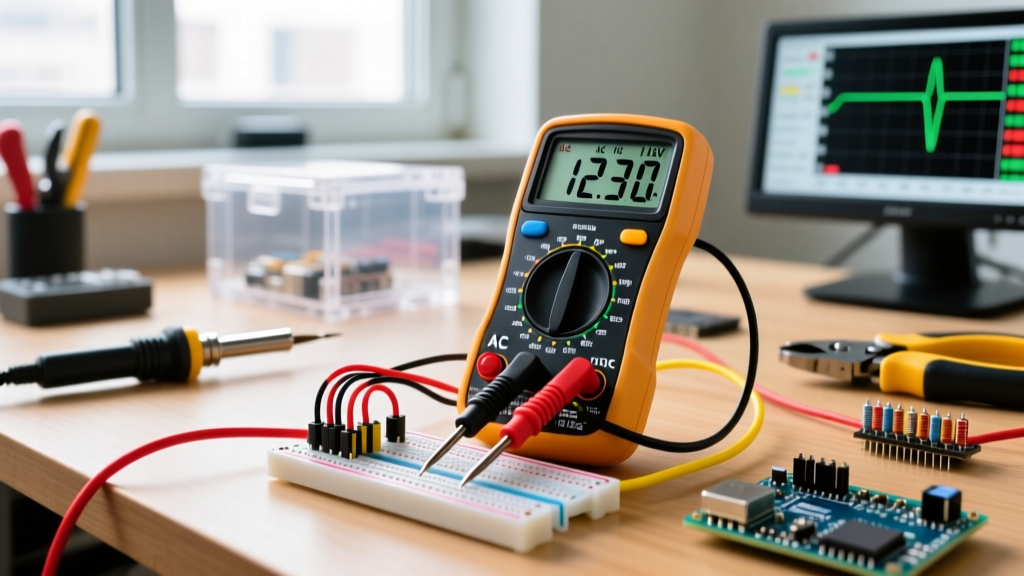
To test for ground with a multimeter, set your meter to AC Volts (V~), insert the black probe into the ground slot (the U-shaped hole) and the red probe into the hot slot (the shorter straight hole). A reading between 114V and 126V confirms a present ground path. However, voltage alone does not prove a safe, code-compliant ground. You must also test neutral-to-ground to catch dangerous "bootleg" jumpers that fool basic plug-in testers.
Below is the exact bench-and-jobsite procedure for verifying equipment grounding conductors (EGC), the physics of why it matters, and the decision matrix for fixing faults.
The Hazard: Why a Missing or Fake Ground Risks Fire and Shock
The ground wire does not carry current during normal operation. Its sole purpose is to provide a low-impedance path back to the panel during a fault (e.g., a frayed hot wire touches the metal chassis of your drill press). Without a true ground, the metal chassis stays energized at 120V. The next person to touch it while grounded completes the circuit, resulting in lethal shock. Furthermore, without a low-impedance ground path, the circuit breaker will not trip fast enough to prevent an electrical fire.
Many older homes (pre-1960s) have two-prong ungrounded receptacles. A common, highly dangerous DIY fix is the "bootleg ground"—a jumper wire connecting the neutral screw to the ground screw on the back of the receptacle. This tricks a standard $5 plug-in receptacle tester into showing a green "Correct" light. But under a heavy load, or if the neutral wire breaks upstream, the metal chassis of any plugged-in appliance will instantly become energized at 120V. Testing with a multimeter is the only way to expose this hidden hazard before it causes a fatality.
Ground vs. Neutral vs. Bond: Clearing the Confusion
To interpret your multimeter readings, you must understand the distinct roles of the three conductors in a standard 120V branch circuit:
- Neutral (Grounded Conductor): The white wire. This is the normal return path for current flowing back to the transformer during regular operation. It carries the exact same current as the hot wire.
- Ground (Equipment Grounding Conductor / EGC): The bare or green wire. This is a safety shield. It carries zero current during normal operation and only carries current during a fault to trip the breaker.
- Bond: The physical connection between the neutral busbar and the ground busbar (and the metal panel enclosure). In a US residential system, this bond occurs at exactly one location: the main service disconnect panel. It is never bonded at subpanels or receptacles.
Because neutral and ground are bonded together at the main panel, they are at the same electrical potential at that exact point. However, because neutral carries load current, it experiences voltage drop across the length of the wire. Ground carries no current, so it does not experience voltage drop. This difference in physics is the key to testing for a true ground.
How to Test for Ground with a Multimeter (Step-by-Step)
For this procedure, use a true-RMS CAT III or CAT IV rated multimeter, such as the Fluke 117 (~$170) or the Klein Tools MM400 (~$50). Never use an unrated, cheap import meter for live mains testing; a transient voltage spike can cause the meter to explode in your hand.
Before testing the target receptacle, verify your meter works on a known live source (like a confirmed working outlet), then test the target, then test the known live source again. This proves your meter didn't blow its internal fuse or lose battery power mid-test, giving you a false "dead" reading.
- Test Hot-to-Neutral (Baseline): Insert the red probe into the hot slot (short) and black into the neutral slot (long). You should read between 114V and 126V (per ANSI C84.1 standards for a nominal 120V system). Record this number.
- Test Hot-to-Ground (Presence): Move the black probe to the ground slot (U-shape). The reading should be identical to your Hot-to-Neutral reading (within 1-2 volts). If it reads 0V, the ground is completely open or missing.
- Test Neutral-to-Ground (The Lie Detector): Insert the red probe into neutral and black into ground. This should read very close to 0V. A reading under 2V is normal. A reading above 2V indicates excessive voltage drop on the neutral wire (overloaded circuit or loose termination). If it reads 120V, your hot and neutral are reversed.
- The Bootleg Continuity Check (Power Off): To definitively rule out a bootleg jumper, turn off the circuit breaker. Verify the receptacle is dead. Set your multimeter to Continuity (or Ohms). Place one probe on the neutral screw and one on the ground screw. If the meter beeps (reads < 1 ohm), you have a bootleg ground. The jumper must be removed immediately.
Decision Tree: Interpreting Your Readings
Use this matrix to diagnose your receptacle and take the exact corrective action required. This decision path terminates in specific, actionable fixes.
| Hot-to-Gnd | Neutral-to-Gnd | Continuity (Power Off) | Diagnosis | Required Action & Concrete Part |
|---|---|---|---|---|
| 114V - 126V | 0V - 2V | Open (No beep) | True, safe ground. | No action required. Circuit is safe for standard use. |
| 0V | 0V | N/A | Open hot or completely dead circuit. | Check breaker. If breaker is on, hire an electrician to trace the open hot. |
| 114V - 126V | 114V - 126V | N/A | Reversed polarity (Hot and Neutral swapped). | Turn off breaker, swap the black and white wires on the receptacle terminals. |
| 114V - 126V | 0V - 2V | Closed (< 1 ohm) | Danger: Bootleg ground (Neutral jumpered to Ground). | Remove jumper wire. Install Leviton 7899-WMP GFCI receptacle and apply included "No Equipment Ground" label. |
| 114V - 126V | 3V - 10V | Open (No beep) | Shared neutral overload or loose neutral termination upstream. | Tighten neutral busbar lugs in panel. Do not plug in sensitive electronics until fixed. |
| 60V - 90V | 30V - 60V | Open (No beep) | Phantom voltage or high-impedance open ground. | Verify with a low-impedance tester (Fluke 117 has LoZ mode). If voltage drops to 0 in LoZ, ground is open. Install GFCI. |
The Ultimate Fallback: If your multimeter confirms the ground is truly missing (open) and you cannot pull a new equipment grounding conductor through the walls, NEC-style guidance allows you to replace the ungrounded receptacle with a GFCI receptacle (like the Leviton 7899-WMP SmartlockPro). The GFCI will protect against shock by detecting current imbalances, even without a ground wire. You must apply the "GFCI Protected" and "No Equipment Ground" stickers included in the box. Note: This does not provide a ground for surge protectors; sensitive electronics should be moved to a properly grounded circuit.
When to Call a Licensed Electrician (And Code Guidance)
While testing and swapping a receptacle is well within the capabilities of a competent DIYer, certain scenarios require a licensed professional. The National Fire Protection Association (NFPA) strongly recommends professional evaluation for aging electrical infrastructure.
Hire a licensed electrician when:
- You find bootleg grounds throughout the house: This indicates a history of unpermitted, dangerous DIY work. A professional needs to audit the entire panel and branch circuits.
- Neutral-to-Ground voltage exceeds 5V: This points to a severely overloaded shared neutral, a failing main service neutral, or a loose busbar lug. Loose lugs cause arcing and panel fires. Only a pro should remove the panel dead-front to torque these connections to manufacturer specs (usually 20-40 in-lbs).
- You need to upgrade a 2-prong circuit to a true 3-prong ground: Pulling a new copper EGC (Equipment Grounding Conductor) back to the panel, or running a new NM-B (Romex) cable entirely, requires fishing wires behind drywall and working inside the live main panel.
Disclaimer: The National Electrical Code (NEC) Article 250 covers grounding and bonding, and Article 406.4(D) covers receptacle replacements. The information provided here is NEC-style guidance for educational purposes; your local Authority Having Jurisdiction (AHJ) or municipal inspector has final legal authority over code compliance and permitting requirements in your area.
For deeper reading on safe meter usage and category ratings, refer to the Fluke multimeter safety and usage guides, and always consult OSHA's electrical safety standards when working in commercial or industrial environments. Testing for ground is not just about verifying a wire is connected; it is about verifying the physics of the fault loop will save your life when a tool fails.