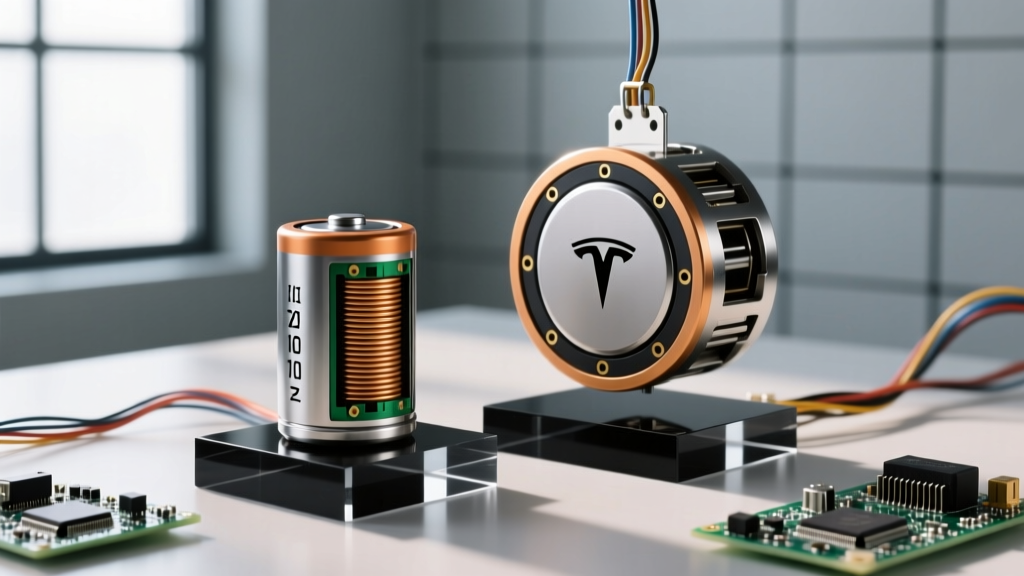

Tesla batteries look like thousands of small, cylindrical lithium-ion cells—specifically 18650, 2170, or 4680 formats—bundled into heavily monitored modules and structural packs, rather than a single large block. This cylindrical, multi-cell architecture fundamentally changes how a real high-voltage circuit handles thermal management, requiring complex liquid cooling channels woven between cells and a Battery Management System (BMS) capable of balancing thousands of individual parallel and series nodes simultaneously. Makers and DIY solar enthusiasts commonly confuse Tesla's architecture with the large, rectangular prismatic LiFePO4 cells or flexible pouch cells used in off-grid solar banks and portable power stations, but the internal physics and packaging are entirely different.
The Physical Anatomy of a Tesla Battery Pack
To understand what these packs look like when the skid plate is removed, you have to look at the hierarchy of the assembly. Tesla does not build a battery; they build a pack out of discrete, mass-manufactured commodity cells. The hierarchy flows from Cell to Module/Brick to Pack.
At the lowest level, the individual cylindrical cell contains a 'jellyroll' of anode, separator, and cathode materials wound tightly inside a metal can. These cells are grouped into 'bricks' (parallel groups) and 'modules' (series groups). In older Model S and X vehicles, these modules were distinct, removable aluminum boxes. In modern Model 3, Model Y, and Cybertruck platforms, the modules are largely abandoned in favor of a continuous, heavily potted matrix where cells are bonded directly to the pack enclosure and cooling ribbons.
The entire assembly is encased in a structural aluminum or steel enclosure that serves as both a physical shield and a stressed member of the vehicle's chassis. The cooling system consists of extruded aluminum thermal ribbons or cold plates that snake between the cells, circulating a water-glycol mixture to keep the cells within the optimal 25°C to 35°C operating window during DC fast charging.
Cell Form Factors: 18650 vs. 2170 vs. 4680
The most distinct visual difference between Tesla generations is the physical size of the cylindrical cells. The naming convention is straightforward: the first two digits represent the diameter in millimeters, and the last two (or three) represent the length. Below is a breakdown of the three primary formats Tesla has deployed.
| Format | Dimensions | Nominal Capacity | Primary Vehicle Use | Key Architectural Feature |
|---|---|---|---|---|
| 18650 | 18mm x 65mm | ~3.5Ah | Model S / Model X (Legacy) | High cell count, mature supply chain |
| 2170 | 21mm x 70mm | ~5.0Ah | Model 3 / Model Y | Optimized energy density, silicon-doped anode |
| 4680 | 46mm x 80mm | ~24.0Ah | Cybertruck / Model Y (Austin) | Tabless electrode, structural pack integration |
Worked Numeric Example: The Volume and Cell Count Shift
Let us calculate the physical impact of moving from a 100 kWh pack built with 18650 cells versus one built with 4680 cells. An 18650 cell has a volume of roughly 16.5 cm³. To achieve 100 kWh using cells that hold roughly 12.5 Wh each, you need approximately 8,000 cells. The combined cell volume is 132,000 cm³, not including the massive amount of wiring, busbars, and module casing required to connect 8,000 individual nodes.
Now, look at the 4680 cell. Its volume is roughly 132.9 cm³ (about 8 times larger than an 18650), but it holds roughly 90 Wh to 100 Wh of energy due to the tableless design reducing internal resistance. To build that same 100 kWh pack, you only need about 1,100 cells. This reduces the total number of welds, the amount of nickel busbar material, and the casing weight by roughly 15% to 20%, fundamentally altering the manufacturing cost and the physical weight distribution of the vehicle. For a deeper look into the chemistry shifts driving these size changes, the U.S. Department of Energy's Vehicle Technologies Office maintains excellent primers on EV battery cell scaling.
Where You Meet This in Practice
If you are an EV technician, a teardown engineer, or a DIYer looking at salvage yards, the physical reality of Tesla batteries dictates your workflow. The most immediate practical encounter is the potting compound. Unlike off-grid solar batteries where cells sit in open-air racks, Tesla packs are injected with a two-part polyurethane or epoxy thermally conductive potting foam. This foam locks the cells in place, dampens vibration, and transfers heat to the cooling ribbons, but it makes non-destructive teardowns nearly impossible without specialized solvents or CNC milling.
Another practical encounter is the BMS architecture. Because Tesla uses thousands of parallel cells, a single cell shorting internally does not immediately drop the pack voltage; the surrounding parallel cells dump massive current into the failed cell. To manage this, Tesla uses wire-bond fusing at the cell level. If you are diagnosing a pack with an open circuit, you are often looking for a melted bond wire on a specific parallel group, which requires opening the pack and probing individual busbars. The National Renewable Energy Laboratory (NREL) provides extensive data on how these specific pack topologies handle degradation and fault propagation over time.
Frequently Asked Questions
What do Tesla batteries look like inside the casing?
Inside the outer structural casing, you will not see loose wires. You will see a highly organized grid of cylindrical cells standing vertically (or lying horizontally in the 4680 structural pack), bonded together by a hardened, foam-like potting compound. Woven through this foam are flat aluminum cooling ribbons and thick copper or aluminum busbars that connect the positive and negative terminals of the cell groups in a precise series-parallel matrix. The BMS logic boards are usually mounted at the ends or center of the pack, sealed behind metal access plates.
What do the new Tesla 4680 batteries look like compared to older cells?
Visually, a 4680 cell looks like a massive D-cell battery, measuring 46mm in diameter and 80mm in height—more than double the width of the older 18650 cell. The most distinct visual difference on the manufacturing line is the absence of traditional tab welds on the top and bottom. Instead, the 4680 uses a 'tabless' (or shingled) design where the edges of the anode and cathode foils are laser-patterned and folded over to make direct contact with the top and bottom caps, creating a solid, continuous metal lid rather than a small welded nub.
Can you use salvaged Tesla batteries for a home solar setup?
While physically possible, it is highly impractical and generally advised against for modern packs. Early Model S modules (which operated at lower, safer 24V or 48V nominal configurations) were popular in the DIY solar community. However, modern Tesla packs (Model 3/Y) operate at 350V+ and rely on a highly proprietary, encrypted BMS that will shut down the contactors if it loses communication with the vehicle's main CAN bus network. Bypassing this requires complex CAN bus spoofing, and the potting compound makes tapping into individual cell groups for an aftermarket BMS incredibly difficult.
What do Tesla batteries look like when they degrade?
Physical degradation is rarely visible from the outside unless the pack has suffered mechanical trauma or severe thermal runaway (which looks like melted aluminum, scorched potting foam, and vented electrolyte residue). Electrically, degradation manifests as 'cell imbalance.' Because the pack consists of 96 series groups, if one parallel group degrades faster than the others due to a micro-short or cooling channel blockage, the BMS will limit the entire pack's charge and discharge capacity to match the weakest group, resulting in a sudden, non-linear drop in displayed vehicle range.


