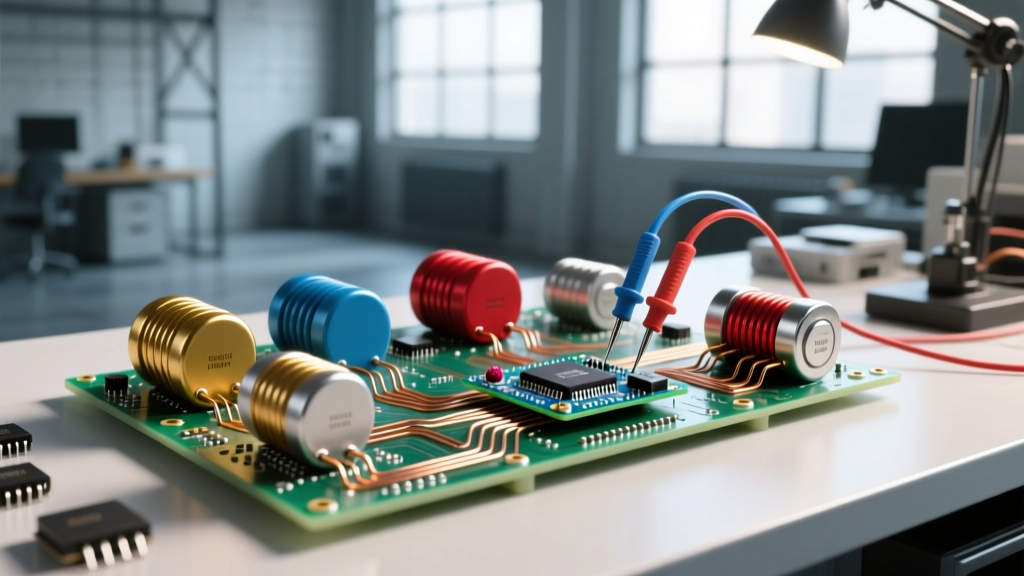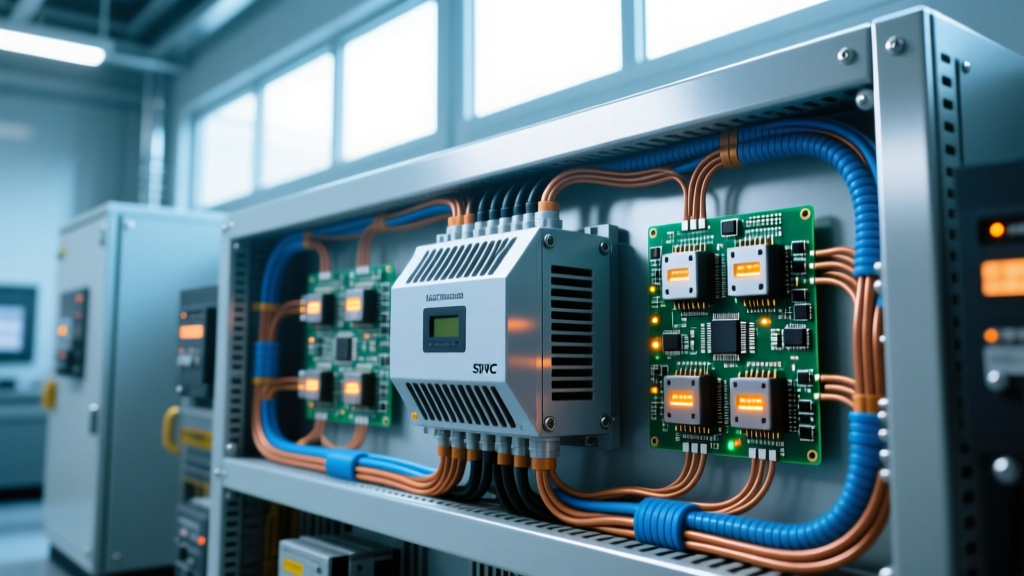

A static voltage compensator is a solid-state power electronics device that injects a corrective AC voltage in series with the power line to instantly cancel out grid voltage sags, swells, and imbalances without using mechanical tap changers or battery storage. By dynamically altering the voltage profile seen by the downstream load bus, it ensures that sensitive equipment receives a flawless sine wave even when the upstream utility grid experiences severe transient disturbances. It is critical to understand what this device changes in a real installation: it does not generate bulk power or provide ride-through for total blackouts; rather, it acts as a high-speed, programmable voltage offset that bridges the exact gap between degraded grid voltage and the nominal voltage your machinery requires.
The Core Mechanism: Series Voltage Injection
At the heart of a modern static voltage compensator (often marketed as an Active Voltage Conditioner or Dynamic Voltage Restorer) is a three-part topology: a shunt-connected rectifier, a DC-link capacitor, and a series-connected IGBT (Insulated-Gate Bipolar Transistor) inverter paired with an injection transformer.
When the utility voltage is perfectly nominal, the device essentially stays out of the way. The series inverter is bypassed, and line power flows directly to the load with near-zero losses (typically under 1%). However, when a fault on the grid causes a voltage sag, the shunt rectifier detects the anomaly in microseconds. The series inverter then uses Pulse Width Modulation (PWM) to synthesize a precise AC voltage. This synthesized voltage is fed through a series injection transformer and added directly to the incoming grid voltage in real-time.
Think of it like a booster pump on a municipal water line: if the city pressure drops, the booster instantly adds exactly enough pressure to maintain the flow at the factory tap, without needing a massive water tower (battery) to draw from. Because the device only needs to supply the difference between the sagging grid and the nominal requirement, the energy stored in its DC-link capacitor only needs to be large enough to handle high-frequency ripple, not bulk energy storage. This allows for response times under 2.5 milliseconds, effectively correcting the voltage before the first zero-crossing of the AC cycle completes.
Worked Numeric Example: Sizing the Injection Transformer
To understand the physical and economic advantage of this topology, let us run a sizing calculation for a typical industrial manufacturing load and compare it to a traditional double-conversion UPS.
System Parameters:
- Nominal Grid Voltage: 480V Line-to-Line (L-L), 3-phase
- Nominal Line-to-Neutral (L-N) Voltage: 480V / √3 = 277.1V
- Continuous Load Current: 150A per phase
- Total Load Apparent Power (kVA): √3 × 480V × 150A = 124.7 kVA
The Disturbance:
A large motor starting three miles away on the utility feeder causes a 20% voltage sag lasting 150 milliseconds. The incoming L-L voltage drops to 384V, and the L-N voltage drops to 221.7V.
The Compensation Math:
- Required Injection Voltage: The compensator must make up the difference per phase. 277.1V (nominal) - 221.7V (sag) = 55.4V of injected voltage required.
- Injection kVA per Phase: 55.4V × 150A = 8.31 kVA.
- Total 3-Phase Injection Rating: 8.31 kVA × 3 phases = 24.93 kVA.
The Takeaway: To protect a 124.7 kVA load from a 20% sag using a static voltage compensator, you only need to size the series injection transformer and IGBT inverter for roughly 25 kVA. If you attempted to protect this same load with an online double-conversion UPS, you would need to purchase, cool, and maintain a 125 kVA UPS system with a massive bank of VRLA or lithium batteries. The static compensator requires roughly 80% less floor space, eliminates battery maintenance entirely, and operates at 98-99% efficiency compared to the UPS's 94-96% efficiency. For a deep dive into how these sags originate on the grid, Fluke's power quality documentation provides excellent field data on transient fault profiles.
Where You Meet This in Practice
You will rarely find a static voltage compensator in a commercial office building or a residential panel. This technology is strictly deployed in high-stakes industrial and commercial environments where the cost of a single micro-sag vastly exceeds the capital cost of the equipment.
Semiconductor Fabrication: In a wafer fab, a 100ms voltage sag of just 15% can cause vacuum pumps to drop offline and ruin a batch of silicon wafers worth hundreds of thousands of dollars. Manufacturers like Hitachi Energy deploy Dynamic Voltage Restorers (the utility-scale equivalent of this topology) at the medium-voltage intake to immunize the entire facility against upstream grid faults.
Automated Textile and Printing Mills: High-speed web presses and textile looms rely on perfectly synchronized servo motors. A voltage swell or sag causes a momentary torque ripple, which can snap the physical material web, resulting in hours of downtime to re-thread the machine.
Data Centers and Server Farms: While IT loads use internal power supplies that can ride through brief sags, the massive HVAC chillers and cooling tower fans cannot. If a chiller trips offline due to a voltage sag, the server room temperature spikes rapidly. Static compensators are often installed on the dedicated mechanical feeders to keep the cooling infrastructure running through grid transients.
Frequently Asked Questions
What is the difference between a static voltage compensator and a UPS?
A Uninterruptible Power Supply (UPS) is designed to provide backup power during a complete loss of utility power (a blackout). It does this by continuously converting AC to DC to charge a battery bank, and then inverting that DC back to AC (double-conversion). This process generates significant heat, wastes 3-6% of the energy, and requires strict battery maintenance. A static voltage compensator does not have a battery bank and cannot sustain a load during a 100% blackout. Instead, it only draws a small amount of power from the grid to synthesize the missing voltage during a partial sag or swell. It is strictly a power quality conditioner, not a backup generator.
Can a static voltage compensator handle a complete power outage?
No. Because the device lacks bulk energy storage (like batteries or a flywheel), it relies on the presence of at least some residual grid voltage to operate its shunt rectifier and power its internal control logic. If the grid voltage drops to absolute zero (a 100% outage), the compensator's DC-link capacitor will discharge in milliseconds, and the internal bypass contactor will open to isolate the load. If your application requires ride-through for total blackouts, you must pair the compensator with a standby diesel generator or a traditional battery-backed UPS.
How fast does a static voltage compensator react to a voltage sag?
Modern IGBT-based static compensators detect a voltage deviation and begin injecting the corrective waveform in less than one-quarter of an AC cycle. On a 60Hz grid, one full cycle is 16.67 milliseconds; therefore, the response time is typically under 2.5 to 4 milliseconds. This sub-cycle reaction time is critical because many sensitive industrial PLCs and variable frequency drives (VFDs) will drop offline if a sag persists for longer than 10 to 20 milliseconds. The compensator effectively masks the sag before the downstream equipment's internal power supplies even register a drop in their DC bus voltage.